Begin with the whole castle scene
Before choosing a pencil, look at the page from a little distance. Find the largest shapes first: sky, walls, roofs, ground and any trees or water. Then notice the smaller area that should lead the eye, such as a gatehouse, tower or group of figures. The English Heritage history of castle design is useful here: keeps, curtain walls and projecting towers were built for different jobs, so treating them as separate forms is more convincing than colouring the castle as one enormous grey object.
Choose one direction for the light
Imagine the light arriving from the upper left or upper right of the page and keep that choice throughout the scene. Leave the light-facing edges of walls, roofs and towers paler. Add deeper colour beneath ledges, inside arches and on the opposite side of a structure. The drawing already supplies the architecture; your light choice helps the separate shapes read clearly without needing heavy outlines.
Make a small working palette
Start with fewer colours than you think you need. For stone, choose a pale base, a middle tone and one darker pencil for the deepest shadow. Add one or two colours for timber or roofs, then a restrained group for sky and landscape. A limited palette lets colours echo around the page; Faber-Castell’s pencil tutorial shows how layering and colour harmony can produce depth from a focused set. The pencil tin need not arrive like a medieval army.
Build stone in light layers
- Use light pressure for the first layer, keeping the palest areas close to the paper colour.
- Add the middle tone unevenly so every block does not look identical.
- Place the darkest tone beneath ledges, in narrow openings and where walls meet.
- Let a little warmth or coolness appear in selected stones rather than covering the whole wall with one flat grey.
Work across a small section, then pause and look at it beside an unfinished area. It is easier to deepen a light layer than to remove a very dark one. Variation can suggest age and texture, but keep the shadow direction consistent so the wall still feels like one solid form.
Separate materials with texture
Stone can use short, irregular layers; timber may suit strokes that follow the grain; foliage can be built from small clustered marks. Use smoother, more even colour for open sky or calm water so the textured castle stands apart. Changing the direction and density of your pencil marks can distinguish materials even when some of their colours are similar.
Let light and texture do more of the work than a crowded box of colours.
Save the strongest contrast for a focal point
Choose one area that deserves the clearest dark-against-light contrast. It might be the main entrance, a sunlit tower or a figure in the foreground. Keep nearby details a little quieter so the eye has somewhere to settle. If every window, stone and banner receives the darkest pencil, the page can lose its sense of depth.
Finish in two calm passes
In the first pass, cover the main shapes and establish light and shadow. In the second, strengthen only the areas that need more depth, repeat small accent colours and tidy the edges around your focal point. Stop before every patch of paper is filled. A little breathing room can preserve the light in the scene and keep fine architectural lines visible.
Use the book as a studio companion
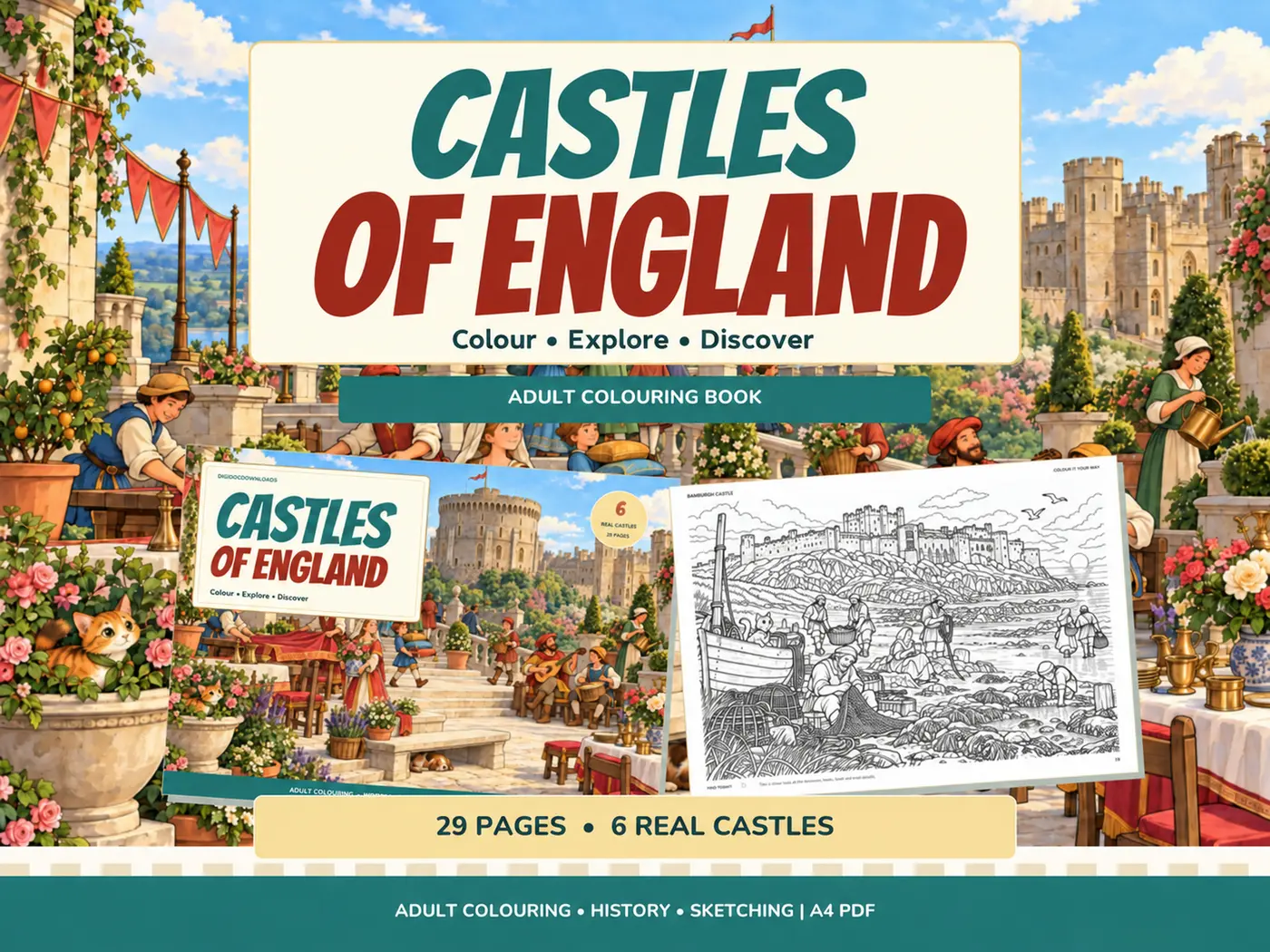
Castles of England includes six full-colour scenes and matching colouring pages, six illustrated castle profiles, colouring techniques, suggested palettes, modern location maps and a labelled architecture plan. Treat the colour scenes as references rather than rules: borrow a stone combination, notice where the shadows fall, then make your own choices. For a closer look at what the walls and towers were doing, Historic England’s introduction to stone castles adds the architectural context. The scenes combine recognisable buildings with imagined activity, so observation and invention can share the page quite happily.
More to read, make and discover
A few useful, interesting and checked routes into the subject.
- Castle historyEnglish Heritage: how castles changed through time
A visual route from earth-and-timber forts to stone keeps, gatehouses, curtain walls and later showier residences.
- Architecture guideHistoric England: an introduction to stone castles
Useful context for recognising the walls, towers and domestic spaces that give a castle scene its shapes.
- Pencil techniqueFaber-Castell: depth and colour from a limited palette
Layering, blending and colour harmony demonstrated with a deliberately focused set of pencils.