In this guide
- Begin with one character, one place and one problem
- Let the finished model become the stage
- Use a three-part story engine
- Give each character one job, not a long biography
- Move the story across the map
- Try six prompts when the plot pauses
- Let the dragon be genuinely strange
- Record the ending while everyone remembers it
Begin with one character, one place and one problem
The quickest way to start is to choose a standing character, point to one place on the map and give that character a small problem. A ranger cannot cross the drawbridge. A royal has found the treasure in the wrong tower. A dragon has arrived with a message that nobody can read. One clear difficulty gives the first scene somewhere to go; a complete history of the kingdom can wait.
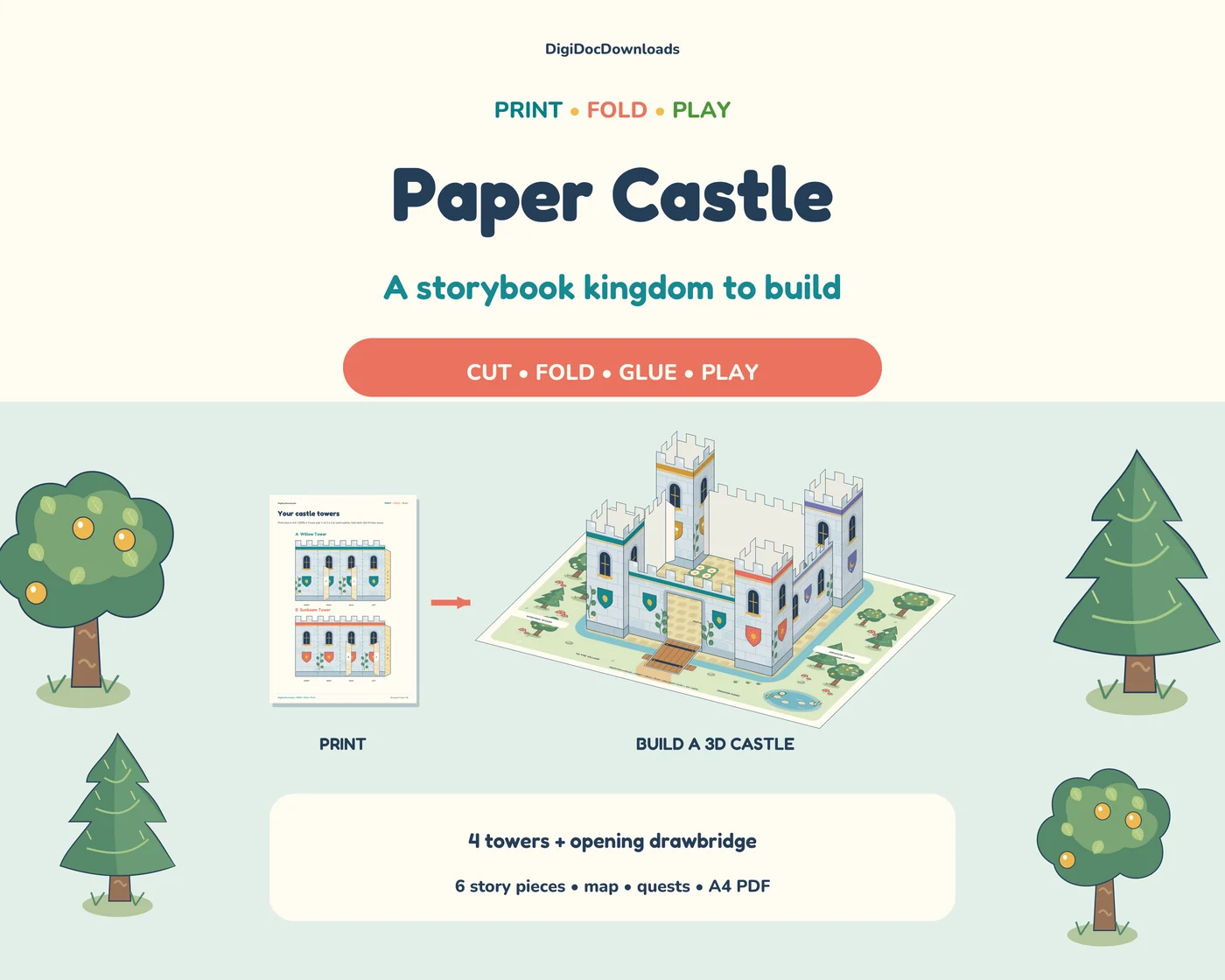
The Storybook Castle paper model kit includes a four-tower castle, a drawbridge that opens by hand, six standing story pieces, a decorated map, six quests and a story journal. Use one element first. Bringing every piece into the opening scene is rather like inviting the entire kingdom to speak at once.
Let the finished model become the stage
Build the castle before deciding the whole plot. Its footprint, towers and gate create useful limits: a character can be inside or outside, above or below, welcomed or kept waiting. Those physical choices are easier to answer than the broad and slightly alarming question, “What happens in your story?”
The kit is a 15-page A4 PDF suggested for ages 8+ with adult help. The six making pages are printed at Actual Size on light card, and the model takes roughly 45–60 minutes plus drying time. If this is the first model in the household, the careful first-build guide covers printing, sorting, scoring, dry fitting and glue. Let the joins dry before the castle acquires a dramatic siege; damp paper has enough troubles of its own.
Use a three-part story engine
A simple story game only needs three repeated moves: choose, change and respond. First, the player chooses what a character wants to do. Next, another player changes one detail. Finally, the first player says how the character responds. For example: the knight wants to open the gate; the gate key is missing; the knight asks the wizard for help.
Repeat that sequence for three to five turns, then pause. The National Literacy Trust’s Dream up a World storytelling project connects narrative settings, characters and plot with thinking aloud, planning and rehearsal. Spoken play can therefore be useful story planning rather than a detour from writing.
Give each character one job, not a long biography
Choose a temporary role that helps the scene: guide, messenger, guard, inventor, visitor or keeper of a clue. The role may change in the next story. A wizard might know the map but be hopeless with knots; a ranger might recognise a footprint but not the creature that made it. A useful limitation creates decisions, while an all-powerful character tends to solve the adventure before anyone has found a pencil.
For cooperative play, let one person move the figures, another describe the place and another introduce the next change. Anyone can pass a turn or offer two choices instead of inventing a fresh idea. That keeps the activity welcoming for confident storytellers and quieter players alike.
Move the story across the map
Choose a starting point and a destination on the decorated kingdom map. Trace a route with a finger, then stop at one place between them. Ask what makes that location important: a sound, a clue, somebody waiting or a path that has changed. The route gives the story a middle, which is often the part most inclined to wander off for a biscuit.
If the group is using one of the kit’s six quests, keep its goal visible and treat the map as the route towards it. If the group invents a separate adventure, write a one-sentence goal at the top of the journal page. “Return the treasure before sunset” is easier to steer than “have an epic adventure”, even if the latter has excellent poster potential.
Try six prompts when the plot pauses
Offer one prompt and wait for an answer. Do not read all six like a royal proclamation:
- The drawbridge will not open. What is stopping it?
- The treasure has been moved. Who noticed first?
- A new path has appeared on the map. Where might it lead?
- The wizard needs help with something magic cannot fix. What is it?
- The dragon wants something other than a battle. What does it ask for?
- A sound comes from beyond the wall. Who goes to investigate?
Questions beginning with what, who or how usually leave more room than a yes-or-no choice. If an answer creates a better direction than the original prompt, follow it. The castle is a stage, not a railway timetable.
Let the dragon be genuinely strange
The standing dragon need not behave like the standard winged, fire-breathing version. The British Library’s illustrated account of dragons in medieval manuscripts shows creatures that could be lizard-like, lion-like, horned, many-legged or many-headed. Even the old pictures refused to settle on one correct dragon.
Borrow that freedom for one descriptive detail. Perhaps this dragon has duck-like feet, carries messages under one wing or collects blue buttons. A precise oddity is more useful to a story than a paragraph of general fierceness, and it gives the illustrator something memorable to draw afterwards.
Record the ending while everyone remembers it
Finish when the original problem changes, even if the kingdom still has unanswered questions. Ask for three closing facts: what the character tried, what changed and what remains to be explored next time. Write or draw those in the story journal. Younger or reluctant writers can dictate a sentence while somebody else records it.
Keep the figures, map and journal together once the game ends. The next session can begin with the unresolved clue rather than another blank page. A paper castle then becomes more than a completed craft: it is a small, reusable world with four towers, one slightly overworked drawbridge and plenty of room for a better second chapter.
Explore Paper Castle Model Kit – Storybook Castle
More to read, make and discover
A few useful, interesting and checked routes into the subject.
- Storytelling practiceNational Literacy Trust: Dream up a World storytelling project
Guidance for ages 7–11 that connects settings, characters and plot through thinking aloud, planning, rehearsing, drafting and editing.
- Medieval manuscript detailBritish Library: The Anatomy of a Dragon
Examples showing how widely dragons varied in medieval manuscripts, from lizard-like creatures to winged, lion-like and many-headed forms.