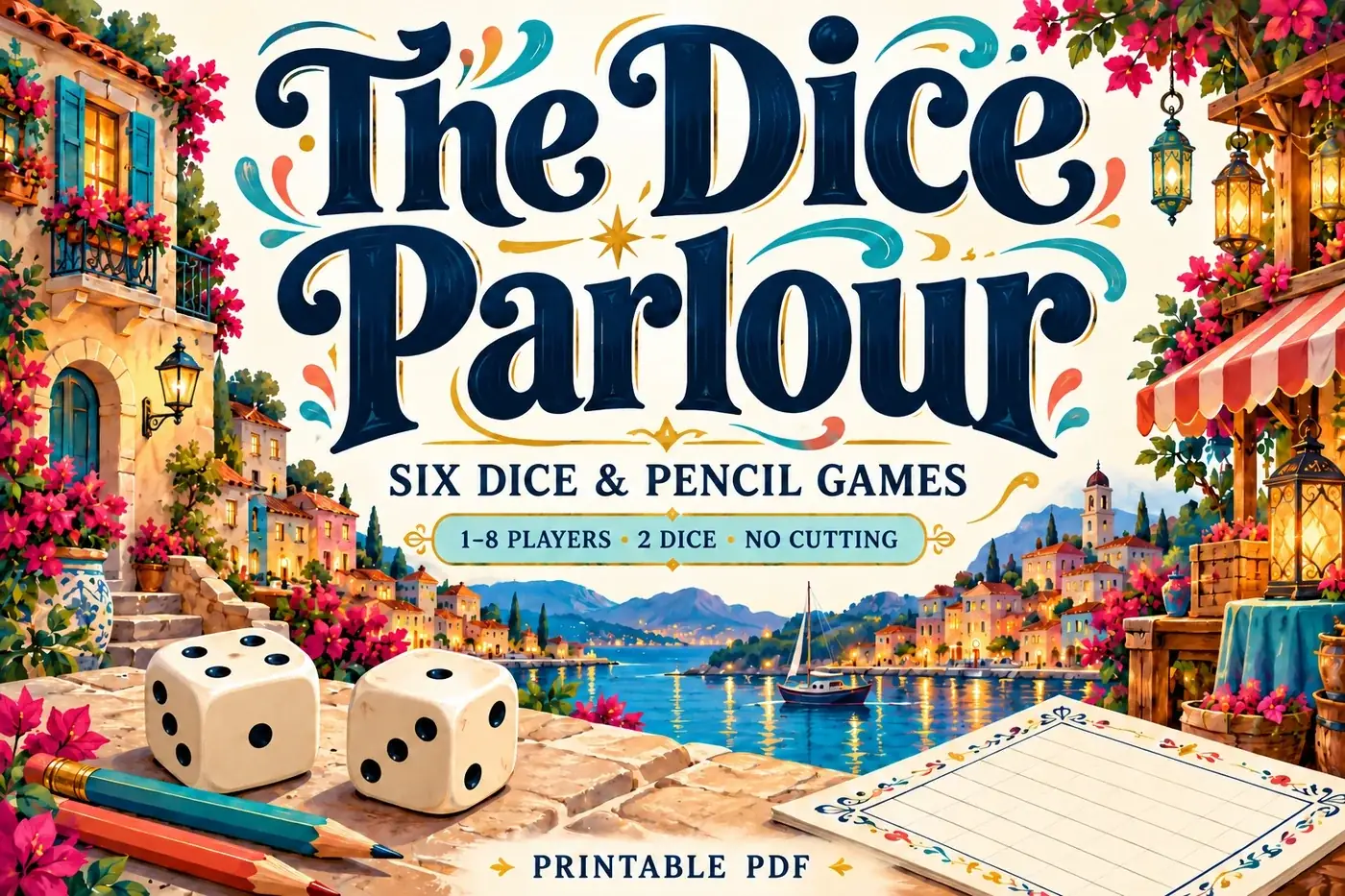
A dice-and-pencil game night has a pleasingly short equipment list. Put two ordinary six-sided dice in the middle of the table, give everyone a pencil and a sheet, and the evening can begin without charging controllers, learning a sprawling board or discovering that the one vital counter has retired beneath the sofa. The simplicity is genuine, but a little hosting structure makes the difference between a smooth shared game and eight people asking whether that roll counted.
This guide gives you a complete plan for a relaxed roll-and-write evening. The Dice Parlour contains six original games set in an illustrated miniature town: Windowbox, Market Day, Lantern Lane, Harbour Cargo, Grand Gallery and Midnight Snacks. Its 18-page A4 PDF includes a rule page and printable play sheet for each game, worked scoring examples, a shared-start host guide, print menu, optional dice log, league and tie rules, a parlour-night record and a bonus probability page. You supply the dice, pencils and printed sheets.
Choose the size of the evening before printing
For a first gathering, choose one game and leave the other five for later. Each Dice Parlour game lasts 12, 16 or 18 shared rolls, so a single round makes a neat short activity while two or three games create a fuller evening. The included league system is there when the group wants to connect several results; it is not a summons to complete all six before anybody is allowed to go home.
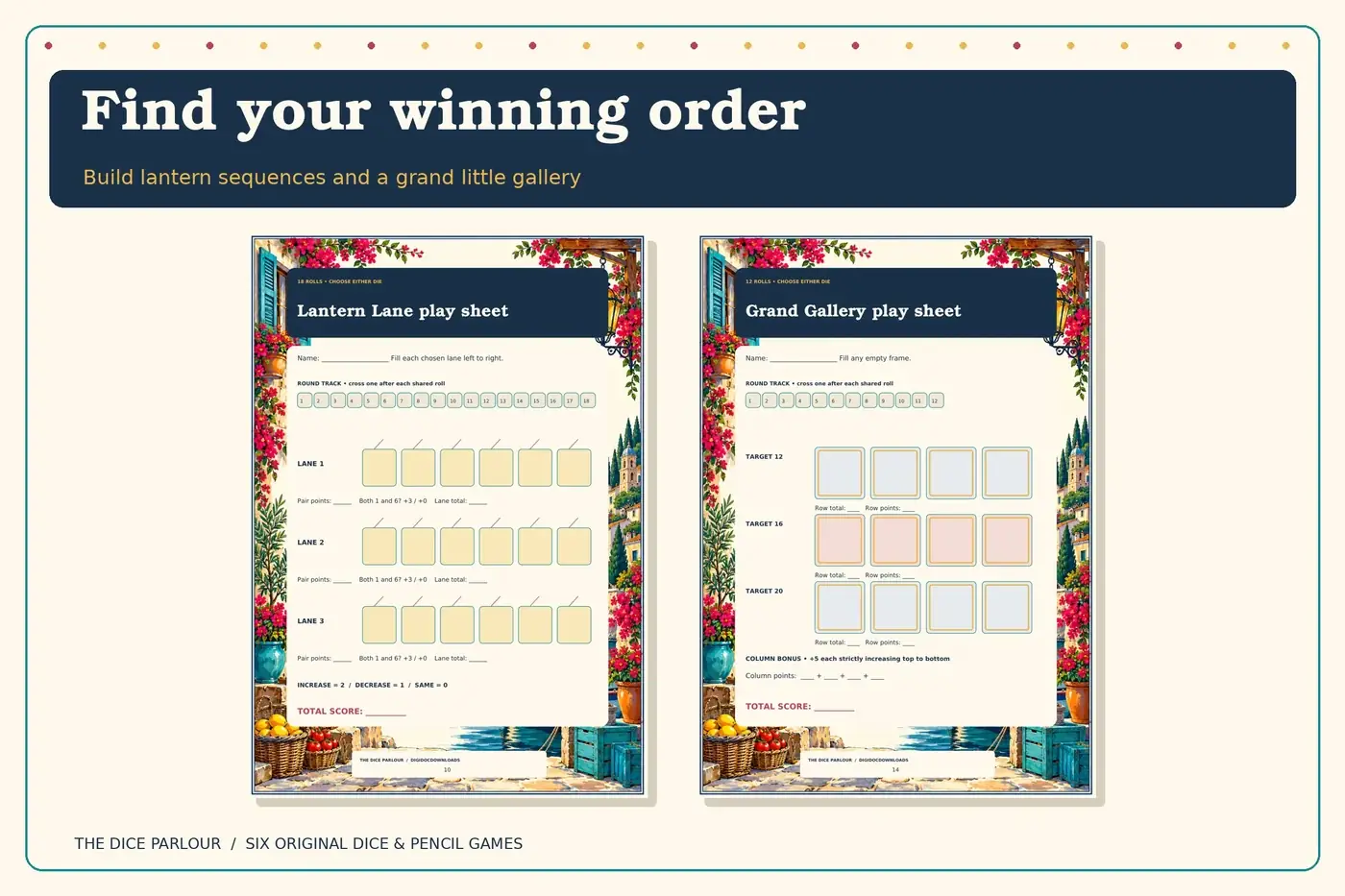
Match the choice to the mood. Windowbox and Grand Gallery reward players who enjoy arranging values across rows and columns. Market Day offers clear targets, Lantern Lane builds rising sequences, Harbour Cargo asks where each whole cargo should be stowed, and Midnight Snacks fills numbered jars while trying to avoid spills. Do not explain every option at once. Give the group one interesting decision, not a prospectus.
Make a precise print list
Print the chosen rule page once for the table and one play sheet per person. Add a spare play sheet or two for an accidental mark, a late arrival or the host who assumed they would merely supervise and then developed competitive feelings. The pages are fixed-layout A4 sheets designed to be completed by hand; no cutting or editing software is required. Keep the worked example close to the host rather than distributing every page in the file.
Print at the page size and scaling stated in the file, then check that the outer boxes and writing spaces are complete. Use a legible standard or draft setting rather than the printer's most ink-hungry photographic mode. If the group will replay the same game, retain one clean rule page and print fresh play sheets for the next occasion. The product is reusable by reprinting, not by attempting to erase a determined pencil league from ordinary paper.
Set a table that supports quiet decisions
Give each player enough elbow room to see and write on their own sheet without having to guard it like a state document. Put the dice where everyone can see the result, use a tray or shallow box if they tend to travel, and provide an eraser and a few spare pencils. A firm board or clipboard helps if the table has a deep grain, a cloth or an impressive collection of crumbs.
Seat the host where the dice and all players are visible. Good light matters more than decorative gloom, especially when the sheets contain several scoring areas. Keep drinks away from the shared rule page and make snacks easy to handle between turns. The games do not require a timer, so the table can remain unhurried.
Teach the decision before the scoring detail
Start with the purpose of the chosen sheet in one sentence: arrange sums, reach targets, build sequences, stow cargos, balance a gallery or fill jars. Then show where a result is written and walk through the worked scoring example. Players need to know what choice they make after a roll before they need every possible end-of-game calculation.
Use one demonstration roll that does not enter the real game. Ask everyone to point to the place they could record it, discuss two plausible choices, then clear the example and begin. This catches misunderstandings while they are still inexpensive. Invite questions before the first official roll, but keep the complete rule page available for details that become meaningful later.
Make the shared-roll rhythm unmistakable
One host rolls both dice for everybody. Announce the individual values and their total, place the dice where the table can see them, and wait until every player has made their choice. Nobody is racing; play pauses for the whole table. When all pencils are down or everybody gives a clear signal, record the roll on the optional dice log if you are using it and move to the next one.
This shared start is what gives the games their interesting comparison. Everyone receives the same chance result, but the sheets diverge because people place or use it differently. Resist rerolling an awkward result. The inconvenient numbers are not interruptions to the game; they are often where the game lives. If a die is cocked, falls off the table or cannot be read, agree before starting that both dice will be rerolled.
Keep the pace friendly without hurrying
After each roll, let the quickest players wait without narrating a solution over everyone else's sheet. The host can say, ‘Tell me when you are ready,’ rather than beginning a countdown. If one player repeatedly needs longer, check quietly that the rule is clear and point to the worked example. Do not turn their thinking time into the evening's entertainment.
For a mixed-experience table, play the first few rolls openly enough for questions, then let decisions become private. Guests may discuss the general rule but should not tell another player where to write a value unless help is requested. A player who makes a legal but unusual choice may simply have seen something interesting. Or they may be constructing a magnificent future problem, which is also part of the pleasure.
Use the dice log when accuracy matters
The optional dice log provides a shared record of each roll. Use it for a league, for a larger group or whenever someone is likely to ask whether roll nine was a five and two or a five and three. The host can call the values, confirm the total and write them down before continuing. If a disagreement appears later, consult the log rather than reconstructing probability from several confident memories.
At the final roll, stop together and follow the scoring steps in order. Read one line at a time, allow everyone to calculate it, then continue. Exchange sheets only if the whole group enjoys checking and everyone is comfortable with it; self-checking against the worked example is perfectly respectable. The aim is a trustworthy result, not a surprise audit.
Explain why two-dice totals are not equally likely
Two ordinary dice can make totals from 2 to 12, but those totals do not appear equally often. There is only one way to make 2 — one plus one — while several different pairs make 7. The University of Cambridge's NRICH activity Chance Combinations explores the different probabilities of two-dice totals, and its Two Dice problem lays out the possible sums visually. The bonus probability page in The Dice Parlour gives the same idea a useful place beside the games.
Treat probability as context, not a promise. A total can be more likely over many rolls and still fail to appear in one short game. Players make decisions with incomplete information; nobody is owed a seven because the table has been waiting politely. If the group enjoys the mathematics, compare the completed dice log with the theoretical pattern after scoring rather than pausing every turn for a lecture.
Turn several games into a fair little league
For a longer evening, choose two or three different games and use the included league points and shared-tie rules. Change the type of decision between rounds so that the same strength does not dominate every sheet. Keep the player order and shared-roll process consistent, then take a short break between games to collect pages, sharpen pencils and return snacks to civilian life.
Record the results on the parlour-night page and celebrate more than the overall winner. A clever recovery, an audacious placement or a spectacularly unfortunate run of rolls may deserve a mention. If a tie remains after the stated method, share the position rather than inventing a sudden-death rule after seeing who is involved. Rules are fairest when they arrive before the score.
Offer a solo table as a real version of the game
The six games can be played solo as well as with two to eight people. For a quiet solo session, choose one sheet, roll at a steady pace and keep the dice log so you can compare decisions or totals on another attempt. Do not chase a perfect score immediately. First learn which choices felt useful, which created pressure later and where the final calculation rewarded a pattern you had overlooked.
Dice games have travelled through many cultures and centuries; the British Museum's dice collection search brings together game objects from widely separated periods and places. Your pair of modern plastic cubes need not carry that entire history into the living room, but they do belong to a wonderfully durable family of small objects that turn uncertainty into play.
Dice-and-pencil game night checklist
- Choose one game for a first session or two to three for a longer evening.
- Print one rule page and one play sheet per person, plus a spare.
- Put two ordinary six-sided dice, pencils, erasers and a dice tray on the table.
- Explain the main decision before the full scoring detail.
- Use a demonstration roll that does not count.
- Let one host roll for everyone and keep the dice visible.
- Wait until every player is ready; there is no timed speed challenge.
- Agree how to handle a cocked or unreadable roll before starting.
- Use the dice log for a league, a larger group or easy checking.
- Score one line at a time and apply the stated tie rule.
- Use the league points only when the group wants several connected games.
- Keep the parlour-night record if the group would enjoy a return visit.
A good dice-and-pencil evening feels both shared and individual. The whole table sees the same two cubes land, then each person decides what those numbers will mean on their own page. Print only what you need, teach the first choice clearly and let every roll settle before the next one begins. The equipment may be modest, but the decisions need not be.
More to read, make and discover
A few useful, interesting and checked routes into the subject.
- Probability activityNRICH: Chance Combinations
A University of Cambridge mathematics activity showing how the totals from two ordinary dice have different probabilities.
- Probability explorationNRICH: Two Dice
A visual exploration of the possible totals made by adding the spots on two six-sided dice.
- Museum collectionBritish Museum: dice collection search
A collection search bringing together dice and related game objects from many periods and places.