In this guide
Start with a map and one good question
Gather a map or atlas, pencils and three sheets of paper. Allow roughly twenty minutes for each session as a flexible starting point, not a target to beat. Find the country first, then ask a question that a child can investigate: what do people hear, give or notice about the season? An adult can read the linked material aloud and choose a suitable image or short passage.
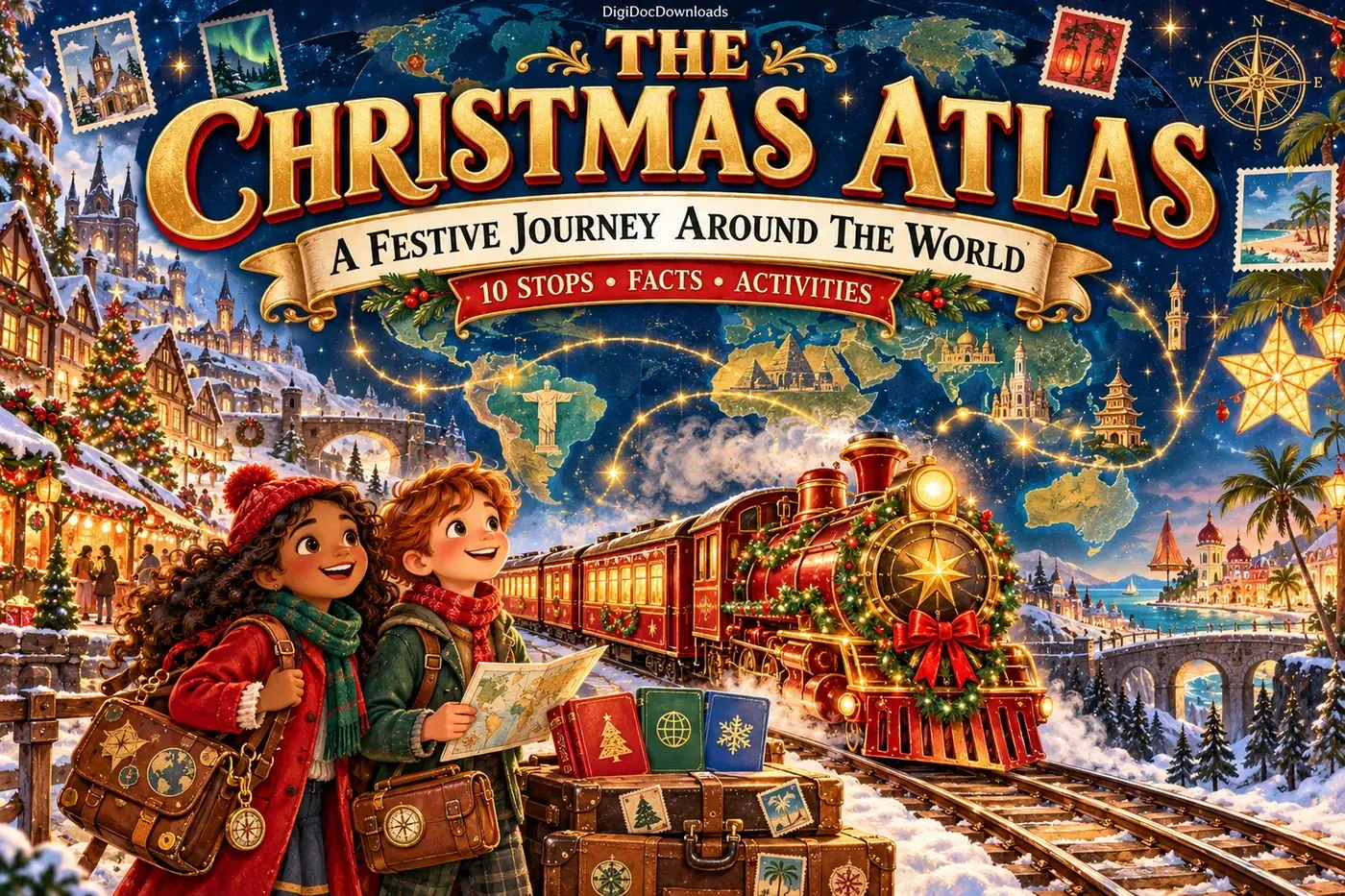
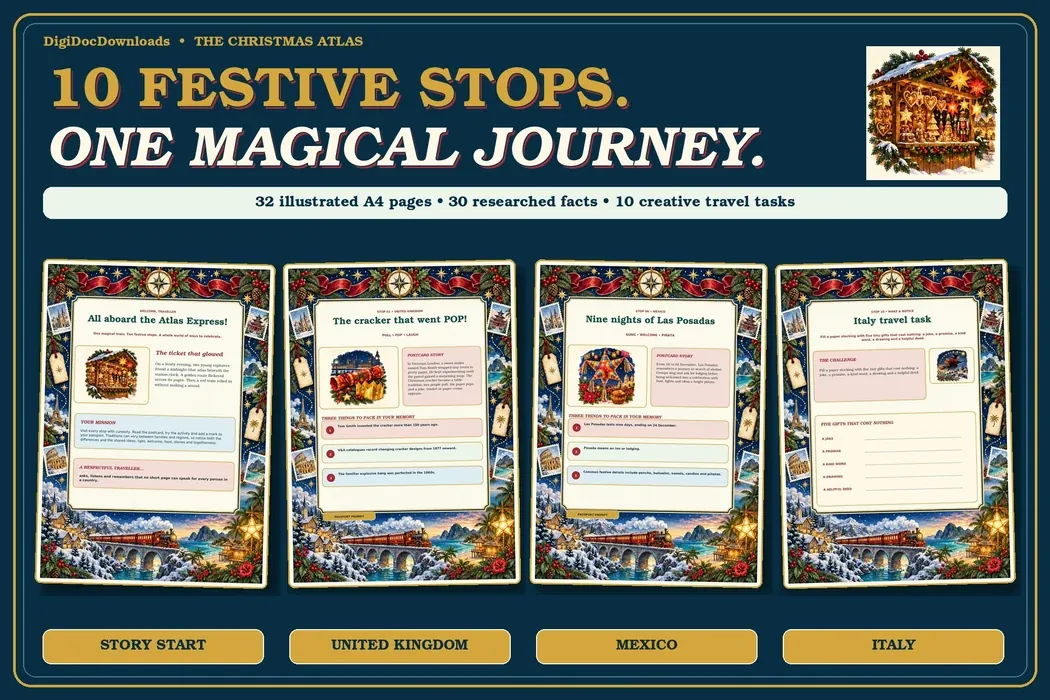
The Christmas Around the World Activity Book provides a ready-made route for ages 6–10 with a grown-up. Its 32 A4 pages include ten destination activities, thirty cultural fact callouts, a passport, stamps and a linked research desk. Start with those supplied stories and activities; the suggestions below add ways to discuss and compare them. Plain paper and a map also work perfectly well.
Sweden: listen for the story behind Lucia
Lucia is celebrated on 13 December. Today it is associated with singing processions and a white-clad figure wearing a crown of lights, but it has not always looked the same. Nordiska museet’s account of Lucia describes influences from different places and periods, including an Italian saint and a song whose melody comes from Italy. A tradition can belong deeply to a place while having travelled to get there.
After reading about it, divide a sheet into “What we can observe” and “What we still wonder”. Sketch the procession on one side; add questions about the music, clothing or date on the other. If listening to a recording, identify it as one performance rather than the single correct version. There is no need to recreate the candle crown: drawing the lights keeps this a simple table activity.
Ask what stays recognisable when a tradition changes. A child might notice the singing or the lights while wondering whether every procession uses the same characters. Keep that as a genuine question, not a guessing test. The museum’s history gives older children a useful example of culture developing rather than remaining frozen in an old illustration.
Iceland: make a book recommendation, not a shopping list
The Icelandic term Jólabókaflóð means the Christmas Book Flood. Visit Iceland explains that it refers to the seasonal cycle of new books being published, given and read around Christmas; its account also describes exchanging books on Christmas Eve and settling down to read. It is more than a name for a cosy evening, and it does not mean every Icelandic household follows one identical routine.
Invite each child to choose a book already at home or borrowed from the library. Fold a small recommendation card and complete three prompts: “This book is about…”, “I would recommend it to someone who…” and “One detail worth noticing is…”. Avoid giving away the ending. Younger children can draw a scene and dictate their recommendation to an adult.
Swap recommendations and spend a little time reading or being read to. Label this an activity inspired by Icelandic book-giving, not an exact reproduction of an Icelandic family Christmas. A recommendation can be a thoughtful gift without anyone needing to buy another book. For children who enjoy keeping reading notes, our reading-journal guide offers prompts that go beyond a star score.
Australia: draw a Christmas postcard without snow
Christmas falls in summer in Australia. The Australian Government’s Study Australia guide describes beach visits, seafood and salads, but also hot roast dinners. That combination matters: warmer weather does not replace every familiar custom with a barbecue, and a single beach photograph cannot stand for a whole country.
Find Australia on the map, then design a postcard showing one possible summer celebration. Put a short caption under each detail: a shaded table, a bowl of summer fruit or decorations beside an open window. On the back, write two sentences explaining what might differ from the child’s own December and one thing that could stay the same. Mark imagined details as ideas, not facts about all Australians.
Compare traditions without ranking them
Lay the three sheets together. Make three small headings on another page: “Something shared”, “Something different” and “A question for next time”. Books, music, food, light and time together may appear in different combinations. Ask children to support each observation with something they read, heard or drew, rather than choosing which country has the “best” Christmas.
Keep language precise: “some families”, “this account describes” and “in this celebration” are often more accurate than “they always”. Not everyone celebrates Christmas, and people within one country have different beliefs, backgrounds and family customs. Children can contribute a different celebration or an ordinary family gathering without being asked to represent an entire culture.
Finish with a tradition of your own
Write down one small custom from home, school or another familiar gathering: who takes part, what happens and why someone wants to repeat it. The activity book includes a write-your-own-tradition keepsake page and a traveller quiz with answers, so there is already a place to reflect and check learning after the destination activities.
End with one sentence the child can explain in their own words, plus one honest unanswered question. A page of careful observations is a better souvenir than a list of impressive facts nobody quite understands.
Explore Christmas Around the World Activity Book – The Christmas Atlas
More to read, make and discover
A few useful, interesting and checked routes into the subject.
- Cultural historyNordiska museet: Lucia
Swedish museum explains the changing, layered Lucia tradition and Italian origins of the song melody.
- Icelandic cultureVisit Iceland: the Christmas Book Flood
Business Iceland describes the pre-Christmas publishing cycle, book-giving and Christmas Eve reading.
- Australian cultureStudy Australia: A Classic Aussie Christmas
Australian Government guide distinguishes summer weather and varied hot and cold festive meals. Published7December2023.