Begin with the outline
Himeji Castle rewards a second look because its outline is not one simple tower. Roofs project beyond walls; smaller structures gather around the main keep; dark lines interrupt the white surfaces. The eye keeps finding another layer. Before reading a date or a building count, follow the silhouette with a finger and notice where it changes direction.
That is an accessible way into architecture. Instead of trying to remember everything at once, choose one visible feature and ask what it contributes. A roof can frame the next storey, create shadow or change the apparent width of the building.
Let a Japanese source introduce it
The Japan National Tourism Organization’s Himeji introduction explains the White Heron name through the castle’s white-plastered appearance. Its comparison invites us to look at the building’s shape; it is a nickname, not a claim that every architectural detail was designed to imitate a bird.
The organisation’s wider castle guide supplies photographs and context for the surrounding site. Start there rather than relying on a single tightly cropped image of the main keep. The smaller structures help make sense of the composition.
White does not mean empty
UNESCO’s account of Himeji-jo draws attention to wooden construction, white plaster and the relationships between building masses and roof layers. Those are useful things to look for in a photograph: the light walls are part of a complex arrangement, not blank space waiting to be coloured in.
Try a quick study using only the white of the paper and one grey pencil. Reserve the paper for lit walls; use grey for roof edges and shadow. Leaving an area untouched becomes a deliberate mark-making decision, rather than a failure to finish.
Compare a photograph with a model
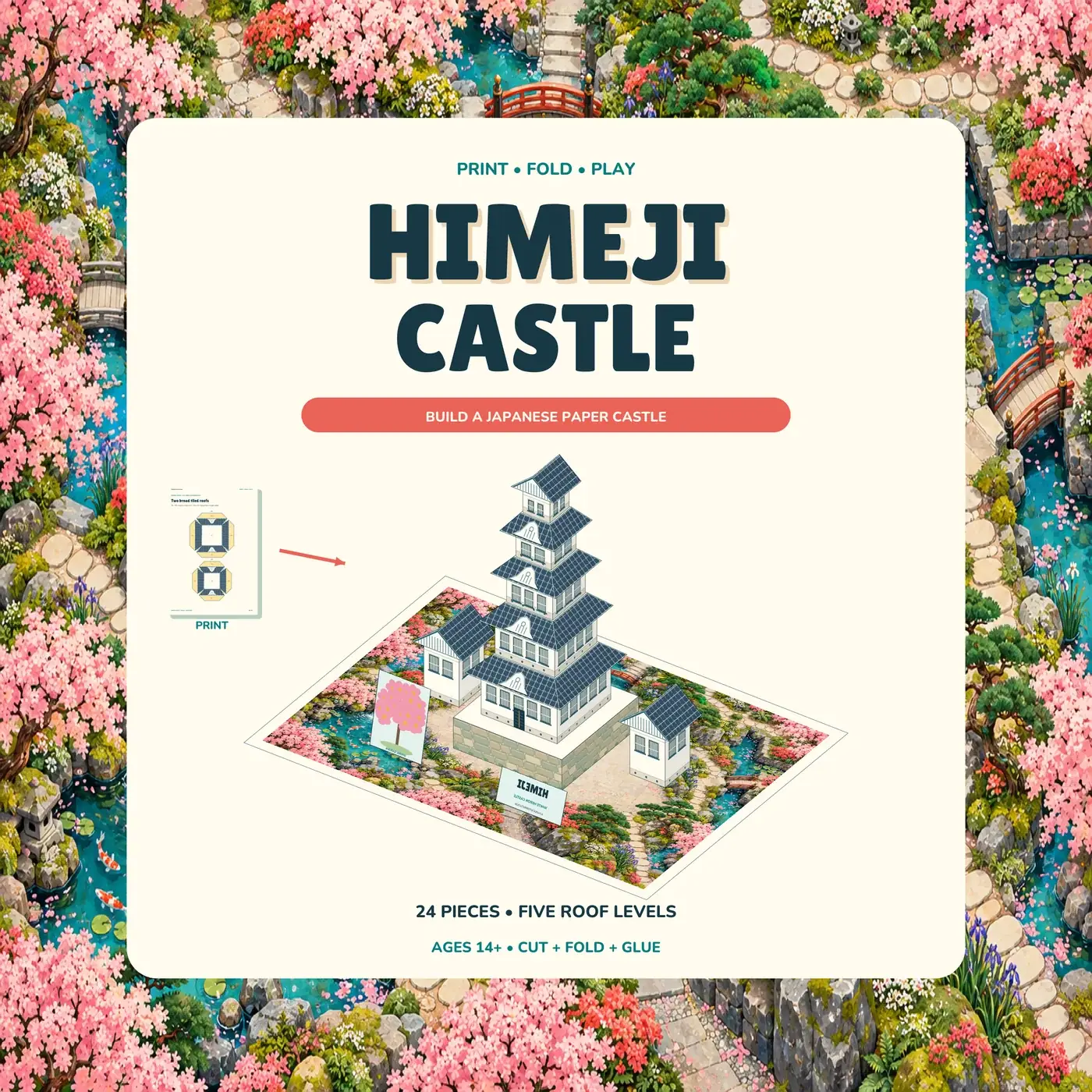
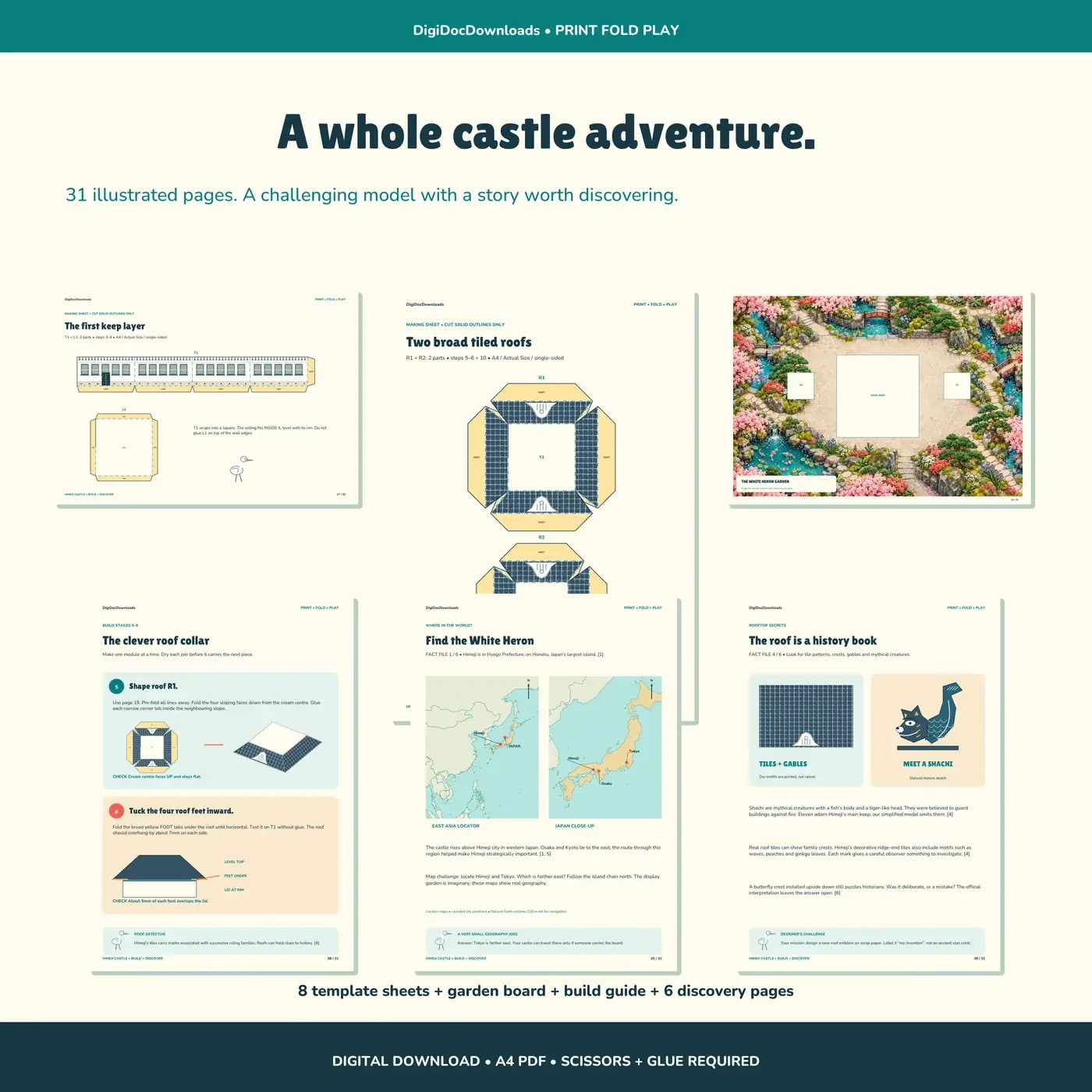
Our Himeji Castle paper construction kit includes a five-roof castle, smaller keeps, a garden board and twenty illustrated assembly stages. Its 31-page PDF also provides maps, a timeline, castle facts and a quiz. Those included learning pages give the finished model context without requiring a separate research project before starting.
The kit is a stylised interpretation, not a scale replica. It identifies simplified or invented elements. Keep that distinction visible when comparing it with photographs: “This model helps us see layered roofs” is more accurate than “This is exactly how the castle is built.”
The making slows the looking
Assembling a roof encourages noticing its edge, fold and relationship to the wall beneath. That does not make the maker a specialist in Japanese construction, but it changes a passing glance into a sequence of small observations. The building becomes a set of connected shapes rather than one impressive image.
It is an advanced project for ages 14+, with an estimated three to five hours plus drying. Read the supplied guide before printing or cutting. Our guide to keeping paper-model roofs aligned focuses on dry fitting and small assembly checks; it supplements the kit’s instructions rather than replacing them.
Keep one detail worth remembering
Write a short label for the display: the building’s name, a source link and one feature you noticed. A photograph reference beside the model makes the simplifications easier to discuss. For a family activity, invite different people to choose different details instead of testing everyone on the same facts.
The most useful souvenir may be the habit of looking at a familiar building’s roofline on the next walk. Once you have spent time with Himeji’s layers, an ordinary house has rather more going on above its windows.
More to read, make and discover
A few useful, interesting and checked routes into the subject.
- Further readingJapan National Tourism Organization: Himeji-jo
A Japanese source explaining the White Heron name and distinctive appearance.
- Further readingJapan National Tourism Organization: Himeji Castle
Photographs and an introduction to the castle and its surroundings.
- Further readingUNESCO: Himeji-jo
The wooden construction, white plaster and layered roof composition.