In this guide
- Count bakers, not everyone in the room
- Choose one share size and do the arithmetic once
- Ask about dietary needs before recipes are chosen
- Build variety without turning the party into homework
- Set up three small stations
- Give everyone the same first chance
- Save the recipes as well as the cookies
- Use a short, forgiving timetable
- Pack for the journey home
Cookie swaps have been doing the useful seasonal trick of multiplying variety without multiplying every baker's workload for decades. The Library of Congress points to a 1960 newspaper feature declaring that cookie swaps were sweeping the country. The modern version needs no grand hall or competitive tower of icing: it needs one agreed exchange rule, readable ingredient notes and enough table space to keep the shortbread out of the gingerbread's personal territory.
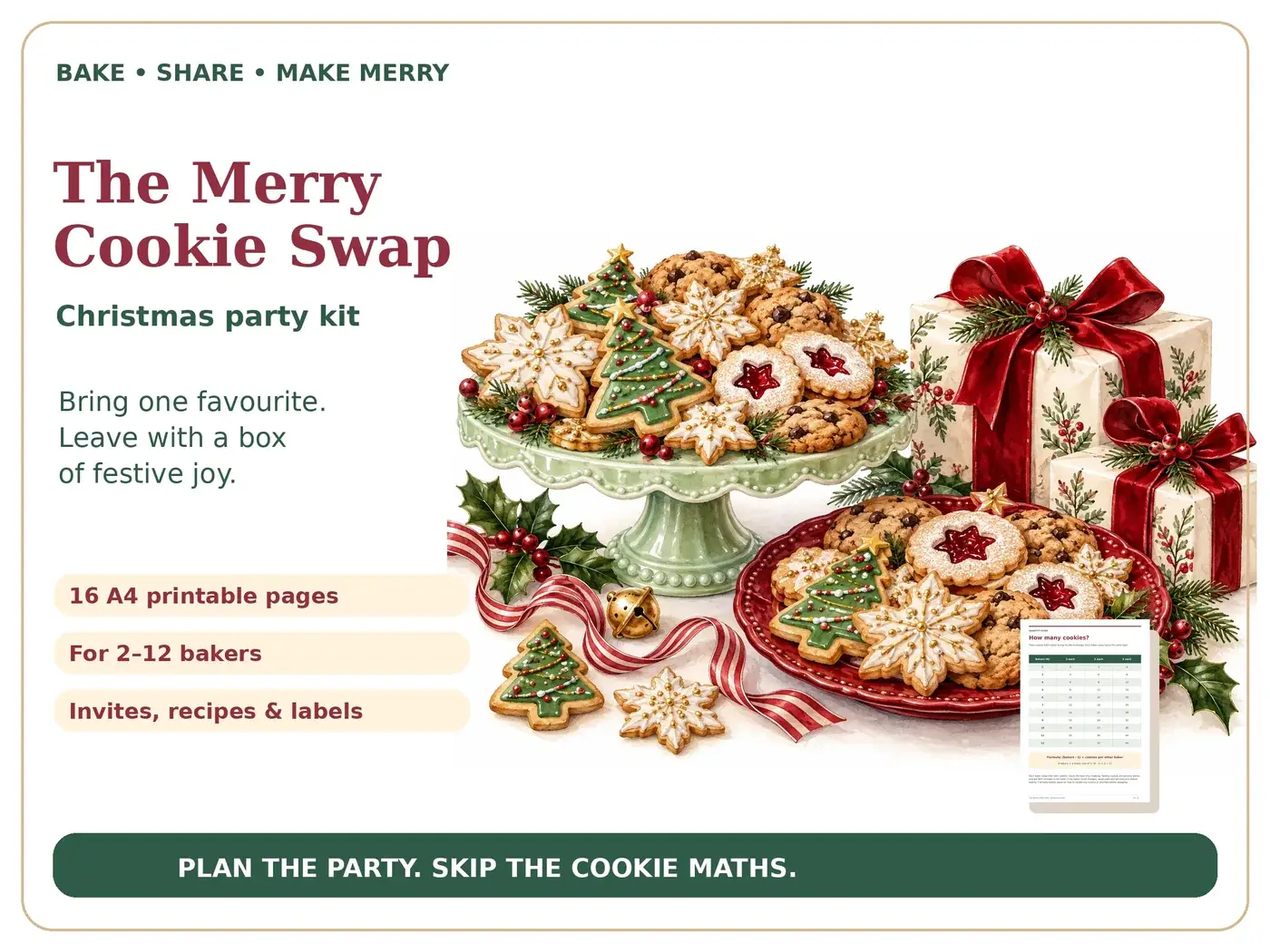
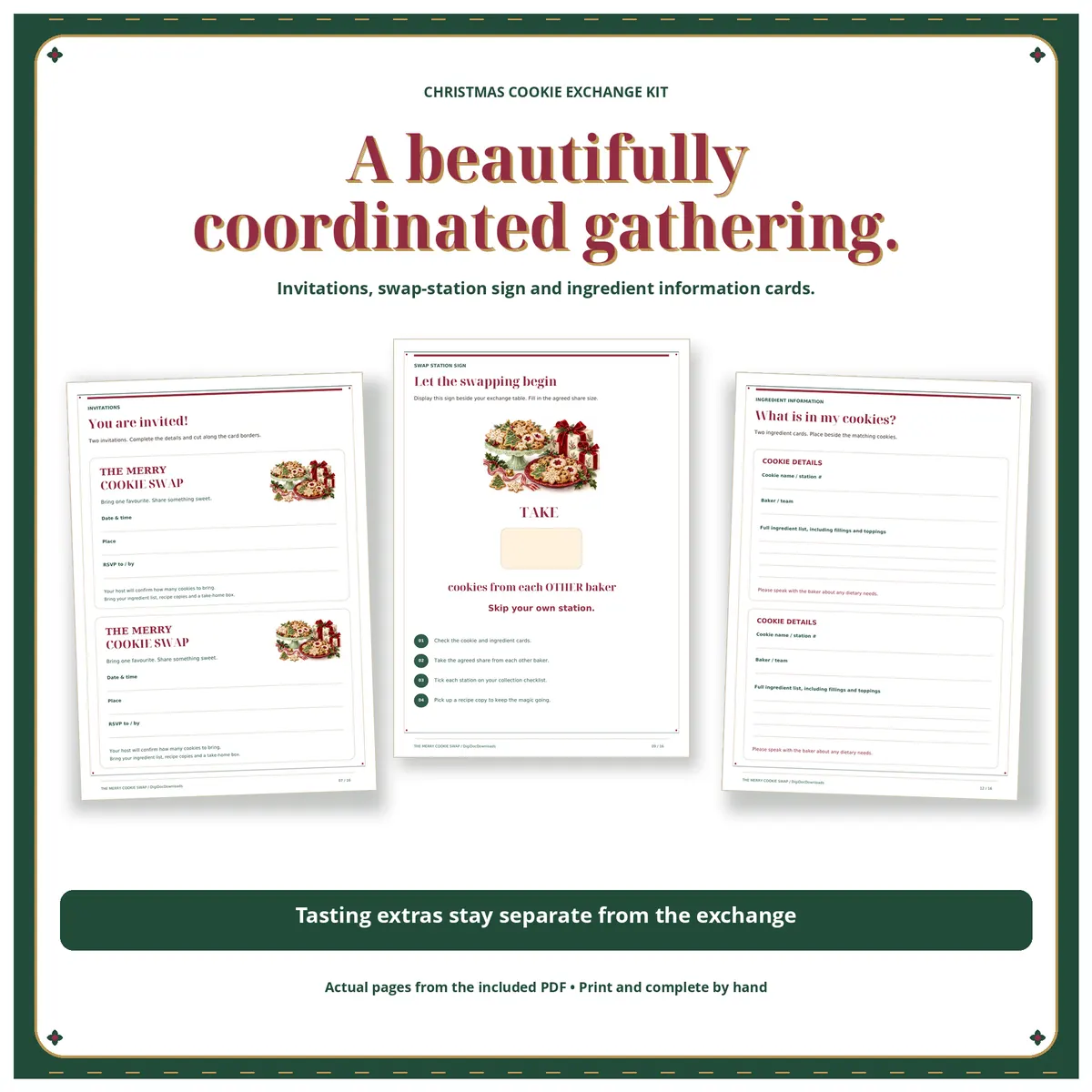
The Merry Cookie Swap printable party kit is a 16-page A4 PDF for 2–12 participating bakers. It includes a host guide, sign-up and preparation sheets, a quantity table, invitations, signs, blank recipe keepsakes, ingredient cards, display labels, gift tags, a collection checklist and six conversation cards. This Guide explains how to turn those pieces into a fair exchange; every baker still chooses and makes their own recipe.
Count bakers, not everyone in the room
Start with the number of batches, not the total number of guests. A couple sharing one bake counts as one participating baker, while a non-baking friend who comes for tea does not change the exchange arithmetic. Include the host if the host is baking. Record the final number after the RSVP deadline, then send the same quantity and arrival instructions to everyone at once.
Choose one share size and do the arithmetic once
Ask each baker to bring the same number of cookies for every other baker: two, three or four works well. The exchange total is (number of bakers minus one) multiplied by the share size. With eight bakers choosing three each, every person brings 21 exchange cookies and takes home 21. Keep tasting extras separate so nobody discovers that half the official allocation disappeared during quality control.
Choose the share size by the cookies' likely dimensions, fragility and cost. Two generous iced biscuits may be kinder than four elaborate sandwich cookies. Use the quantity table in the kit as the shared authority, and ask bakers to bring their batch in a covered reusable container or sturdy box.
Ask about dietary needs before recipes are chosen
Add dietary needs to the sign-up conversation rather than raising them beside a full table. The Food Standards Agency's guidance for people with allergies, intolerances and coeliac disease explains that cross-contamination matters as well as intentional ingredients. Home-baked ingredient cards are useful information, but they are not a guarantee that a bake is safe for someone with a serious allergy. Let that person decide what they can eat or take home without pressure, and never relabel an ordinary home kitchen as allergen-free.
Ask every baker to list the full ingredients, including fillings, toppings and decorations, and to keep original packets or recipe notes available. Put the completed card beside the matching plate. Separate serving utensils reduce muddle, but a table arrangement cannot undo cross-contact that happened during baking or transport.
Build variety without turning the party into homework
Use the sign-up sheet to reveal broad choices—spiced, chocolate, citrus, nutty, iced or plain—so six identical batches do not arrive by accident. King Arthur Baking's cookie-swap plan recommends making recipe choices visible while encouraging people to bake what excites them. That is a better balance than assigning twelve recipes like a particularly buttery project manager.
Set up three small stations
Create a display area for the cookies and ingredient cards, a separate packing area with boxes or reusable containers, and a drinks corner away from the exchange. Give each variety a display label and its own utensil. Put the swap-station sign where everyone can see the agreed share size, then place collection checklists and pencils at the start of the table.
Give everyone the same first chance
Begin with a quick welcome: explain whether tasting happens before or after the exchange, restate the share size and ask guests to collect from each station once before returning for extras. A clockwise circuit is simple for a small group; for a larger table, start people at spaced positions and move in the same direction. The checklist prevents both accidental doubles and the tragic omission of the excellent-looking biscuit at the far end.
Save the recipes as well as the cookies
Invite bakers to fill in a recipe card or the full-page keepsake, including yield, oven temperature, timing and storage notes. Holiday baking often carries more than instructions: the Smithsonian's family account of three generations making Christmas cut-out cookies shows how recipes, tins and repeated kitchen jobs can hold memory. Ask for the detail another baker would genuinely need, plus one optional line about where the recipe came from.
Use a short, forgiving timetable
- Two or three weeks before: invite 2–12 bakers and ask about dietary needs.
- Ten days before: close sign-ups, confirm the share size and calculate each batch total.
- Three days before: remind bakers about ingredient cards, covered transport and recipe notes.
- On the day: allow 20 minutes for arrivals and labels, 20 minutes to look and taste if appropriate, 20 minutes to exchange, then unhurried tea and conversation.
- Before anyone leaves: check every box has the agreed number, add gift tags and return serving plates.
Pack for the journey home
Separate crisp cookies from soft or heavily iced ones with paper cases or parchment, and avoid sealing warm bakes. Keep ingredient cards or recipe notes with the relevant varieties. Any leftovers can be divided only after the equal round is complete. The result should feel generous rather than mathematical, but the quiet mathematics is what lets generosity survive contact with a plate of very good ginger biscuits.
Explore Cookie Swap Party Kit – The Merry Cookie Swap
More to read, make and discover
A few useful, interesting and checked routes into the subject.
- HistoryLibrary of Congress: Holiday Cookie Swap in historic newspapers
Connects a 1960 newspaper feature on cookie swaps with digitised seasonal recipes from the historic press.
- Food heritageSmithsonian Center for Folklife and Cultural Heritage: A generational tradition of Christmas cookies
A family foodways account of recipes, baking skills and memories passing through three generations.
- Allergy guidanceFood Standards Agency: Food allergies, intolerances and coeliac disease
Consumer guidance on food allergies, intolerances, cross-contamination and making safe choices.
- HostingKing Arthur Baking: How to host a cookie swap
Practical advice on guest numbers, sign-ups, exchange styles, labels, packaging and swap-day setup.