
In this guide
Decide what is welcome before anyone fills a bag
A fair clothes swap starts before the first hanger reaches the rail. Tell guests exactly what the event accepts: clean clothes in good wearable condition, perhaps with accessories included and underwear or swimwear excluded. Set a sensible item limit, such as five or ten pieces per person, so one heroic wardrobe clear-out does not become the evening’s entire geography.
Ask guests to check fastenings, pockets and obvious marks at home. A missing button need not disqualify an otherwise good garment, but label it clearly and let the next owner choose. This is a swap, not an ambush by a temperamental zip.
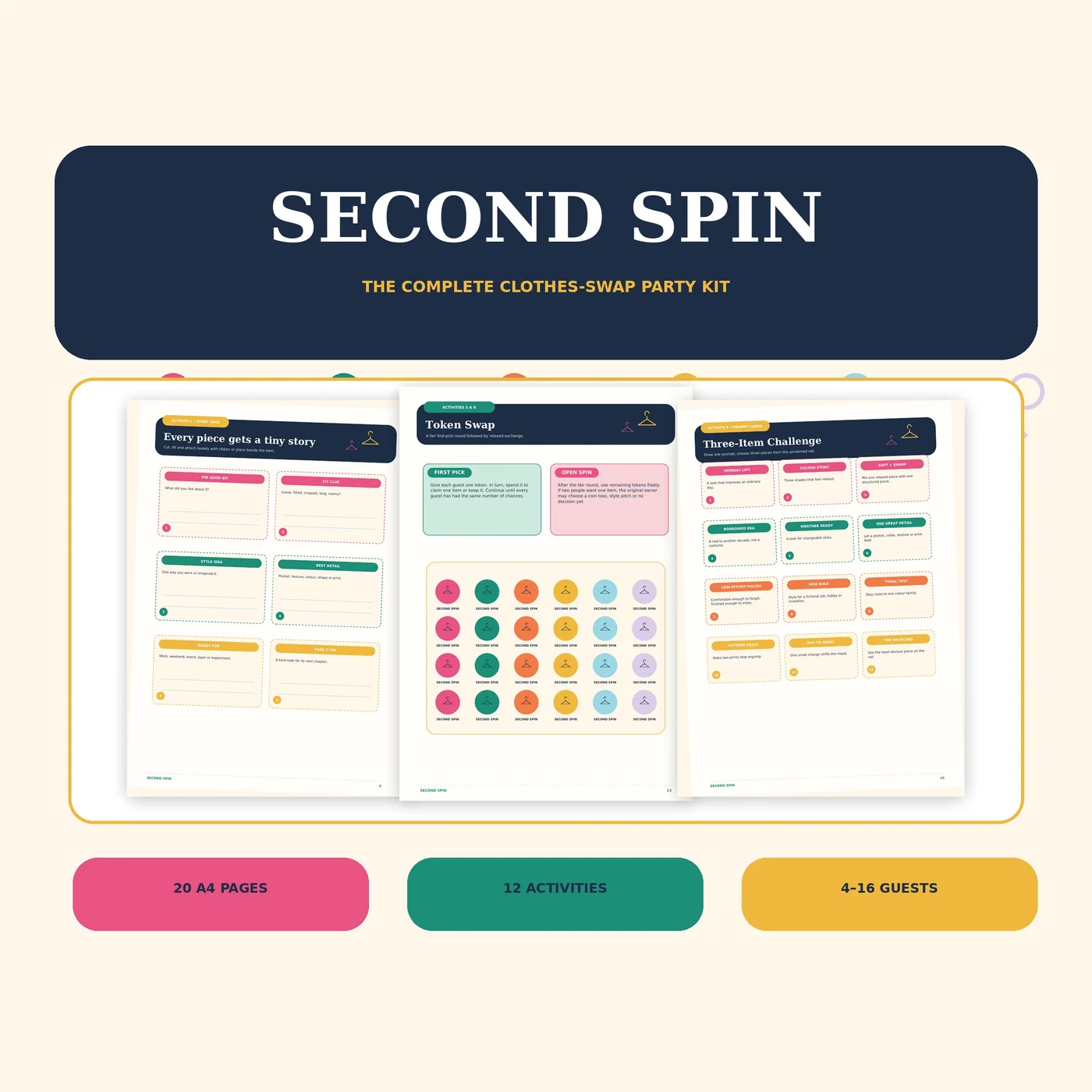
The Second Spin Clothes Swap Party Kit includes shared rules, a host checklist, a rack map and six rail signs. Those pages turn a polite idea into something everyone can see and follow. Plain handwritten signs work too; the important part is agreeing the rules before browsing begins.
Sort by garment type, not by body
Use broad, practical sections such as tops, knitwear, trousers and skirts, dresses, outerwear and accessories. Sorting by garment type makes the room easier to scan without turning sizes into social categories. Keep size labels visible, and add a tape measure near the rails for garments whose tags are missing or optimistic.
Leave enough space for a seated guest or mobility aid to move between tables. Provide chairs, a private changing area if possible and a clear route to the exit. Guests should be able to browse, take a break or pass on an activity without explaining themselves.
If the group is small, a sofa and two labelled rails may be plenty. For a larger gathering, use the kit’s rack map to decide where each section, mirror, changing area and bag station will go. A two-minute plan prevents the accessories table from slowly colonising the refreshments.
Choose a fair claiming system
The simplest small-group method is one-for-one: each accepted item earns one token, and each claimed item costs one. For mixed-value clothing, keep the same rule unless the whole group wants something more elaborate. Trying to decide whether a coat is worth three blouses introduces a miniature stock exchange where a party ought to be.
Second Spin supplies 24 cut-out tokens and eight Wildcard Trade cards. For more than 16 guests, reprint the party tools or make extra tokens before the event. Explain when tokens can be used, what happens when two people want the same item and whether unspent tokens carry any meaning. Usually they should not; the aim is a fair choice, not a champion shopper.
A calm tie-breaker can be random rather than competitive. Put both names in a bowl, toss a coin or return the garment to the rail for a later round. Do not reward speed. Guests who need more time to read labels, try clothing or make decisions should have the same chance as everyone else.
Browse first, then open the swap
Give everyone ten or fifteen minutes to look before claims begin. This separates discovery from decision and reduces the urge to clutch the first promising jumper like a lifeboat. The host can use that time to point out the sections, explain the token rule and invite questions privately.
For a relaxed 90-minute evening, try this shape:
- 15 minutes for arrival, check-in and sorting;
- 15 minutes for an unhurried first browse;
- 25 minutes for the first claiming round and try-ons;
- 15 minutes for returns, a second browse and Wildcard Trades;
- 10 minutes for one optional style activity;
- 10 minutes to decide leftovers and pack the room.
The kit includes three timed host routes, so this plan is a starting point rather than a commandment. A group of four may finish quickly; sixteen guests will need longer at the rails and mirror.
Keep style activities kind and optional
A clothes swap can include playful prompts without making anyone’s body the subject. Ask guests to build an outfit around a colour, find an unexpected layer or style one item in two different ways. Praise a specific choice — a clever colour pairing, an inventive cuff or a useful pocket — rather than rating the person wearing it.
Second Spin includes Style Snapshot, Wishlist Match, Gallery Browse, Outfit Remix, twelve Three-Item Challenge cards, eight Compliment Mirror notes and Repair Rescue. Choose one activity that suits the group. Running all of them would be less a party than a textile decathlon.
Keep photographs optional and ask before sharing any image. A guest may enjoy the outfit and still prefer it not to appear online. The same principle applies to trying on clothes: browsing is participation; nobody has to model a garment for the room.
Give each garment a little context
A short story tag can make an item easier to notice: “excellent pockets”, “best over a roll-neck”, “worn once to a very rainy wedding”. Second Spin includes six story tags, but ordinary luggage labels or folded cards also work.
The point is not to manufacture sentiment. Useful facts help: fabric feel, approximate fit, a small repair or why the original owner is passing the item on. Avoid claims about brand, fibre or age unless the label or owner genuinely supports them.
There is a practical reason to help good clothes find another wearer. WRAP’s UK research on clothing longevity and circular models found that people owned an average of 118 clothing items, with just over a quarter unused in the previous year. WRAP also found that pre-loved and vintage clothes tended to be kept longer than items bought new. A swap will not solve textile waste on its own, but it can move one overlooked garment back into active use.
Plan the leftovers before the party
Tell guests in the invitation what happens to unclaimed items. Offer three clear choices: take them home, place them in a named donation bag or move suitable pieces to a repair pile. Do not promise that a charity shop can accept everything; check its current donation guidance first.
Oxfam’s current guide to donating clothes to charity asks donors to wash clothing first and give clean items in good condition. It also explains that donations which cannot be sold may be reused or recycled. That makes the final sort easier: wearable pieces can go to a checked donation route, repairable ones can be separated clearly, and worn-out textiles need an appropriate recycling service rather than an optimistic charity bag.
The kit’s leftover decision page helps record that plan, while the Night in One Look keepsake gives the group a light finish. Pack claimed clothes, return personal bags and count the rails before anyone leaves. The successful ending is not an empty room at any cost; it is a room where every garment has an agreed next destination and nobody has had to wrestle for a cardigan.
Explore Clothes Swap Party Kit – Second Spin
More to read, make and discover
A few useful, interesting and checked routes into the subject.
- Clothing longevity and reuseWRAP: Citizen Insights — Clothing Longevity and Circular Business Models Receptivity in the UK
UK evidence on wardrobe size, unused clothing and the longer reported life of pre-loved and vintage garments.
- Practical clothing reuseOxfam GB: Donate clothes to charity
Current guidance on preparing clean, good-quality clothing for donation and what happens to items that cannot be sold.