In this guide
Set the finish time before choosing the film
Work backwards from when people need to leave or go to bed. Allow time to arrive, choose seats and talk afterwards, rather than treating a two-hour gathering as space for a two-hour film. Check the running time of the actual version you will use; extras and opening menus need not be part of the programme.
For a mixed-age group, ask about language, subtitles, sound levels and anything people would prefer to avoid. Check the film's rating and content information before putting it on the shortlist. A familiar Christmas title is not automatically suitable for every child or every household. Let someone decline a suggestion privately without requiring an explanation.
Offer three choices, then close the vote
Choose three films that fit the time and the group, and confirm that each is available through a viewing option you can actually use. Do this before sending invitations if the film matters to a guest's decision. Streaming catalogues and access arrangements change; a title remembered from last December is not a confirmed plan.
Give everyone one vote and announce the tie-break beforehand: a short run-off between tied titles, followed by the host choosing if the tie remains. That is a suggested house rule, not a requirement of any particular kit. Do not keep reopening nominations after the result. Anyone keen to recommend another film can add it to a future watchlist.
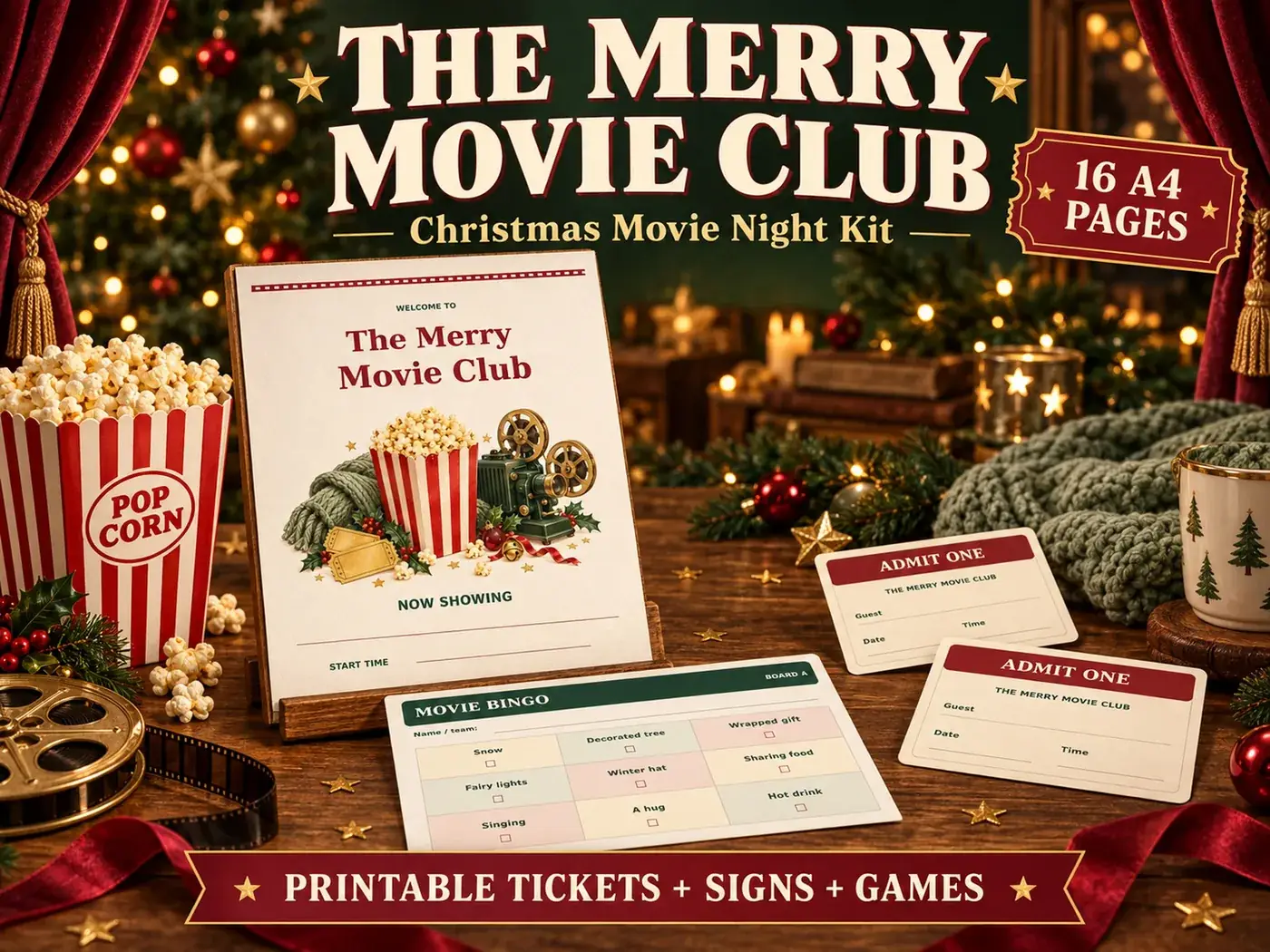
For a coordinated paper version, The Merry Movie Club Christmas movie-night kit includes a three-film voting sheet and six voting slips within its 16 A4 pages. Its planner, write-in invitations and admission tickets give the evening a clear shape. Choose and supply the film yourself; the kit supplies printable hosting activities, not a movie or viewing subscription.
Give bingo a quiet role
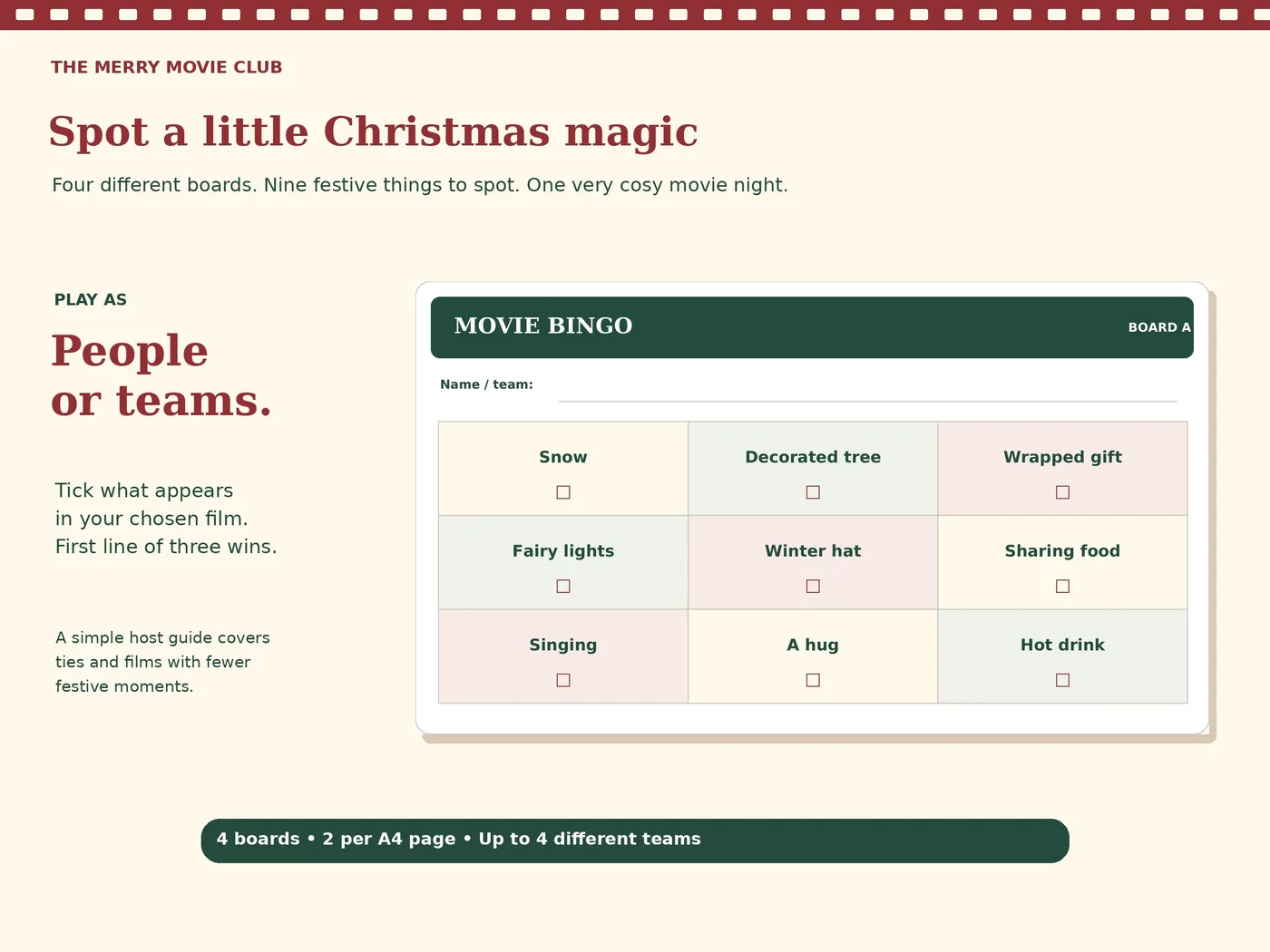
Movie bingo works best when it adds a small noticing game without requiring the film to stop. Decide whether players will mark their boards silently and check results after the credits. Someone who wants to watch without playing should be able to do exactly that. Not every seat needs an additional job.
The kit provides four different festive bingo layouts for up to four players or teams, with its own tie rules and guidance for films showing fewer festive details. Read those before starting. With more than four guests, sharing a board in small teams keeps the four layouts meaningful; extra printouts do not create new unique boards. Let a reader help a younger teammate, and avoid treating the game as a test of who noticed every background decoration.
Make the room easier to use, not harder to photograph
Put drinks where they can be reached without crossing the screen, leave a clear route out and check that everyone can see comfortably. Ask whether subtitles would help. Agree a pause signal and mention any planned break before starting, so a guest does not have to interrupt apologetically.
A snack table can be modest. The kit's snack-bar sign and write-in labels can identify what you have brought, but decorations need not take over the viewing space. Use ordinary paper and handwritten labels if that is enough. Keep packets or ingredient information available for guests who need to check them; a charming snack name is not a useful ingredient list.
Try this simple evening timetable
Here is an original example for a film whose checked running time is 90 minutes. Guests arrive at 6pm, vote and collect snacks by 6.15pm, then settle in. The film runs from 6.20pm to 7.50pm if there is no break. Reserve another ten minutes if your group plans a pause, and leave a little time afterwards rather than promising a finish to the minute.
Hand out optional bingo before pressing play, not during the first scene. If the group has only an hour, choose something shorter instead of speeding through the welcome or expecting everyone to stay late. A short film can be the whole occasion, rather than an apology for not showing a feature.
Add a small piece of Christmas cinema history
Festive filmmaking is almost as old as cinema itself. The BFI's archive record for Santa Claus (1898) describes George Albert Smith's one-minute silent film. A superimposed image shows Santa on the rooftop while the children sleep elsewhere: viewers see two places within the same picture. Smith had worked with magic-lantern shows, and the circular image makes that earlier visual tradition visible.
That gives a group a useful question without turning the evening into a quiz: how does a filmmaker show something the characters cannot see? Ask it about your chosen film after viewing, or simply keep the historical example as a conversation starter. The linked archive record provides context; it is not a promise of unrestricted home streaming.
Keep the conversation short and specific
Afterwards, ask one question people can answer from what they saw: which small detail made the setting feel festive, or which scene would they describe to someone who missed the evening? Invite different answers without trying to settle a final verdict. Anyone can pass.
The kit includes four review cards, twelve after-the-film conversation cards and an eight-film Christmas watchlist. Choose a few prompts rather than using them all. End by recording one possible title for another evening, then put the voting slips away. The next film can wait until the next film night.
Explore Christmas Movie Night Kit – The Merry Movie Club
More to read, make and discover
A few useful, interesting and checked routes into the subject.
- Film historyBFI Replay: Santa Claus (1898)
Archive record for George Albert Smith's one-minute silent film; its superimposed rooftop scene shows another location while the children sleep. Viewing access may depend on the service.