In this guide
Start with a small collection, not a complete account
Choose one notebook, a folder of loose pages or a printable journal. Write the year and the names people want used near the front, then decide how much time to give it. A few short entries across December can be easier than reconstructing everything in January. Leave space for drawings, dictated answers or contributions sent from another household.
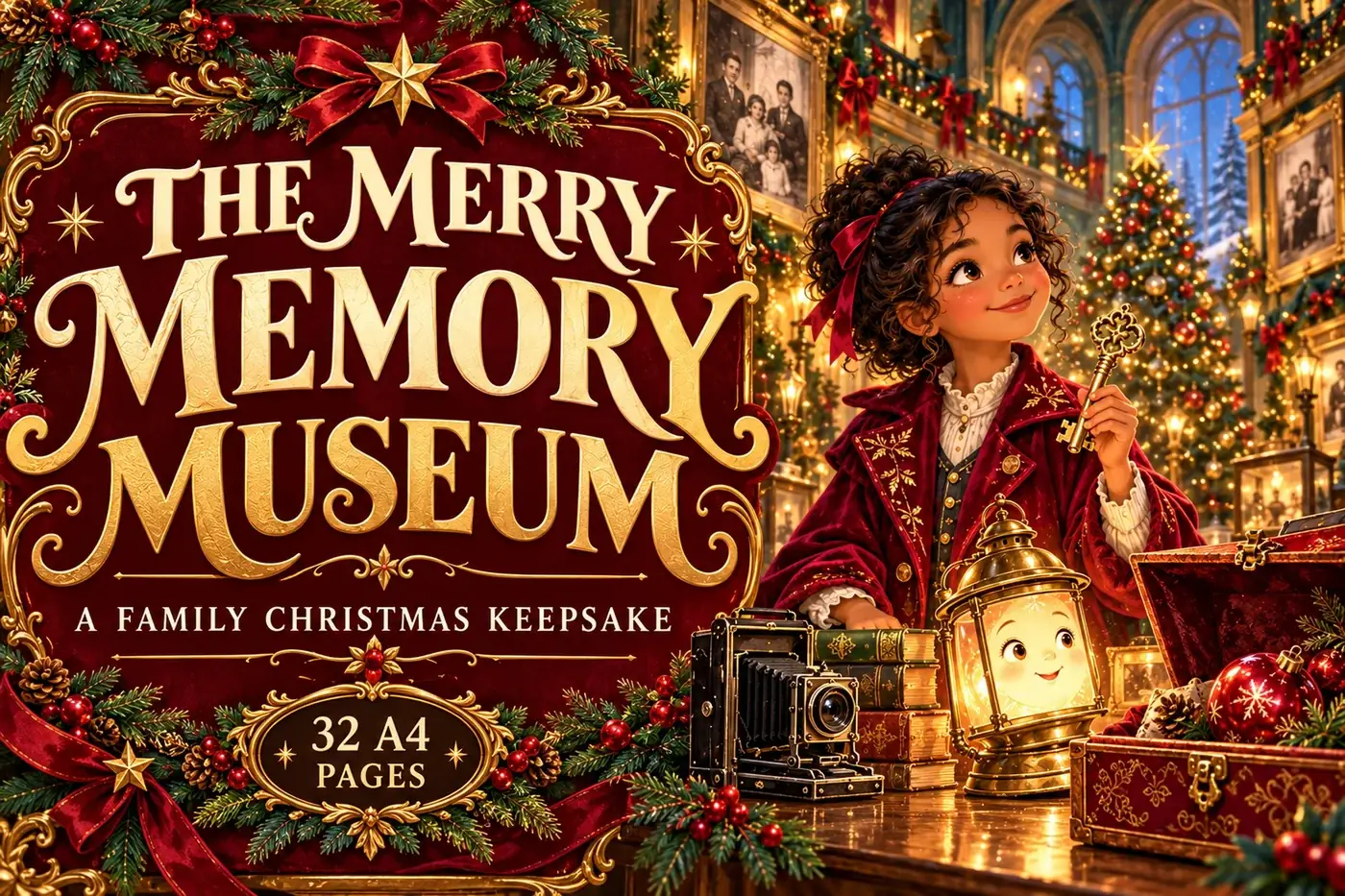
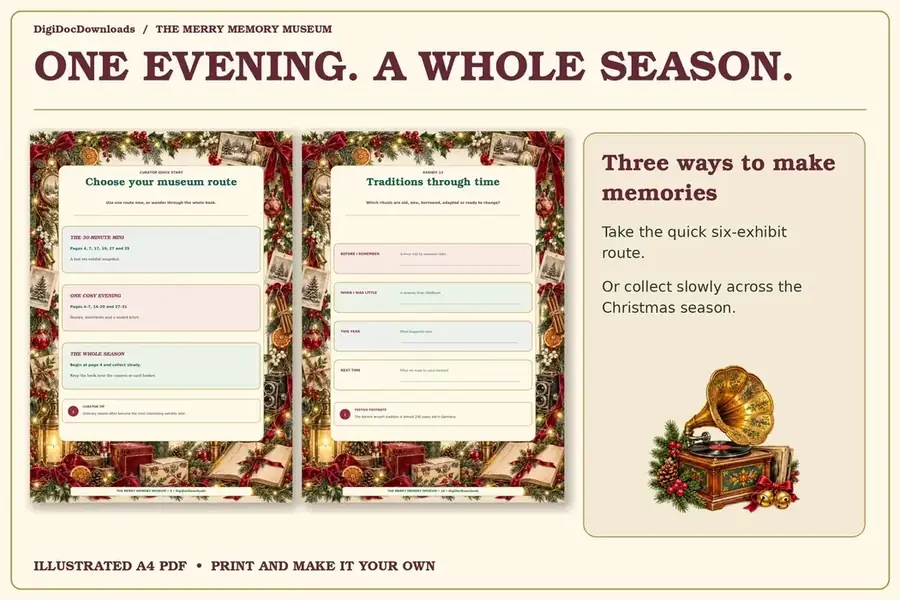
For a ready-made structure, The Merry Memory Museum Christmas memory book contains 32 A4 pages with quick six-exhibit, one-evening and whole-season routes. It includes family interviews, ornament stories, a recipe archive, photo spaces and a future-family letter. These are print-and-complete-by-hand pages; photographs and drawing materials are added separately. Its supplied route chooser makes a useful starting point.
Keep one exact sentence
Write down a remark that captures the day, with the speaker's permission: a child's description of the lights, someone's explanation of a family custom or a particularly good observation over breakfast. Record who said it, when and what was happening. If the wording is only approximate, call it a remembered remark rather than presenting it as an exact quotation.
An original fictional example: “The tree looks like it's wearing all its jewellery,” said Ellis while hanging the final decoration. A small note like that preserves a voice as well as an event. Let people pass, and keep private or embarrassing remarks out of a shared book. The collection need not account for every person equally on every page.
Give a decoration its own label
Pick one ornament, photograph or draw it, and ask how it joined the household. Was it bought on a trip, made at school, inherited or simply the decoration somebody always chooses first? Add the maker or giver if known. “Blue paper star, made by Jo in 2024; always placed beside the window” is more useful than “our favourite ornament”.
Keep recollection separate from certainty. “We think Aunt May brought it in the early 1990s” is a perfectly good label. The Oral History Society's beginner guidance explains that memories combine facts and opinions, and that dates and similar events can become muddled. Record whose memory it is, and leave room to add a corrected date later.
Save the kitchen note beside the recipe
Include a dish's name, who usually makes it and one detail that belongs to your household: the serving plate, a handwritten alteration or the person who always asks for the leftovers. The recipe itself may already be on a separate card. Photograph or copy that card, then add the story without overwriting the original.
Such ordinary records can become revealing historical objects. Martha Lloyd's Household Book at Jane Austen's House contains recipes and remedies in several hands, compiled over roughly 1796–1830 by Austen's friend and housemate. It was not a Christmas scrapbook; its interest lies in the practical knowledge people chose to collect and share. A modern family note can likewise preserve who contributed, not just what was eaten. Our family-recipe recording guide covers the cooking instructions in more detail.
Photograph an ordinary corner
Alongside a group photograph, save one view that shows the setting: the crowded coat hooks, the table before anybody sits down or the decorations on a familiar shelf. Add a caption explaining the room and the detail that matters. A photograph cannot tell a later reader that the small chair was borrowed especially for a visitor unless somebody writes it down.
A drawing works just as well when a photograph is missing or unwanted. Ask a willing contributor to sketch the table or describe three things they noticed. Use copies of older photographs in a craft project and keep the originals separate. Before circulating the finished pages or posting them online, check that the people involved are comfortable with what is included.
Notice one tradition that changed
Ask “What did we do differently this year?” rather than trying to produce a definitive family history. Perhaps a different person cooked, a walk moved to the morning or a celebration took place across two homes. Record what happened without deciding that the old arrangement was the correct one.
The original prompt “This year we kept …, changed … and would like to try …” gives a page a simple shape. Not every Christmas is cheerful or busy; a quiet sentence can acknowledge that it was a smaller gathering without explaining private circumstances. Chosen family, neighbours and friends can belong in the collection too.
Leave a message for next year's readers
Finish with a short note: something to remember, something that helped and one idea worth trying again. Date it and name its writer. If several people contribute, keep their different voices rather than editing everything into a single polished account.
The Merry Memory Museum includes predictions, a future-family letter and a time-capsule label for this purpose. A plain envelope can also hold a dated note. Store the pages somewhere you can find them, make a digital copy if useful, and add a reminder of where the original photographs live. The keepsake is complete when it holds a few recognisable pieces of your Christmas, not when every space is filled.
Explore Christmas Memory Book – The Merry Memory Museum
More to read, make and discover
A few useful, interesting and checked routes into the subject.
- Family history guidanceOral History Society: getting started
Memories include facts and opinions; dates and similar events can become confused. Ask about direct experiences and label uncertainty rather than inventing precision.
- Household historyJane Austen's House: Martha Lloyd's Household Book
A handwritten collection of recipes and remedies in different hands, compiled circa1796–1830; a material record of shared household knowledge. Not a Christmas memory book or a claim about the origin of scrapbooking.