In this guide
Measure the hanger before choosing a size
Use the slim hanger that will live inside the finished bag. Measure its widest usable span from shoulder to shoulder, then note where the hook rises and how much straight edge sits below it. A chunky wooden hanger and a thin wire one may share a nominal width while occupying quite different amounts of knitted space.
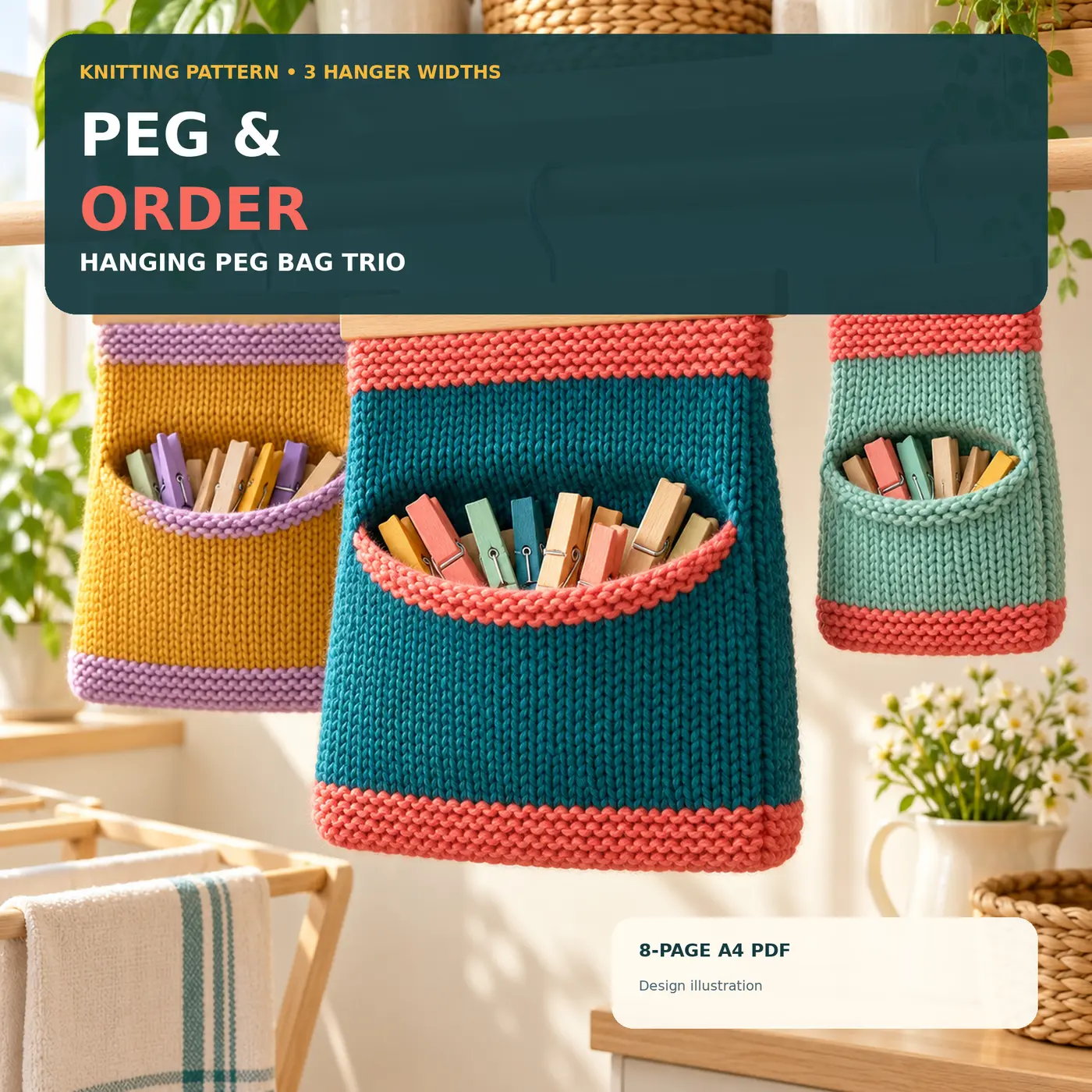
The Peg and Order hanging peg bag knitting pattern provides Compact, Standard and Wide sizes, plus a custom-fit formula and a worked 40 cm example. If your hanger sits between the written options, measure it rather than rounding hopefully. Hope is an excellent quality in a person and a less reliable unit of length.
Allow a little ease so the knitted fabric can settle around the hanger without stretching hard across the shoulders. At the same time, avoid adding so much width that the bag sags at the centre. The useful target is a relaxed fit: enough room to insert the hanger and close the seams, but not enough for it to roam about.
Let a washed swatch do the arithmetic
Gauge is the number of stitches and rows in a known area. It turns yarn and needle size into finished dimensions, and it matters even for a household accessory. The Craft Yarn Council’s gauge guide explains why a sample swatch should be made before the project and why needle size may need adjusting when the measured square is too large or too small.
Knit the pattern’s stocking-stitch swatch in the washable Aran yarn you plan to use, then wash and dry it as the yarn label allows. Measure across the centre, away from curled or distorted edges. If your stitch count is lower than the pattern gauge, each stitch is wider and the bag will grow; if it is higher, the fabric will come out narrower.
Use the custom-fit calculation supplied in the pattern rather than adding stitches by eye. The worked 40 cm example shows how the hanger measurement, stitch gauge and construction allowances fit together. Keep the pattern’s edge and opening requirements intact, because a correct total width is not much help if the front opening has wandered sideways.
Choose capacity without creating a woollen suitcase
Before knitting, place the clean, dry pegs you normally use in a loose layer beneath the hanger. You do not need to count every peg with the solemnity of a census. You are checking whether the proposed width and depth suit an ordinary wash day, with a little spare room for easy access.
Choose the smallest written size that comfortably serves that job. A larger bag is not automatically more useful: extra fabric can pull on the hanger, obscure the opening and encourage an unnecessarily heavy load. Peg and Order is intended for a light, even load of clean, dry clothes pegs, not wet laundry or an adventurous collection of small garden tools.
Keep the opening easy to find
The bag is knitted flat as a solid back panel and a matching front panel with a centred access opening. Cable cast-on forms the opening neatly before the two front sections continue together. Read that section once before knitting it; knowing where the opening begins and ends makes the row counts much easier to follow.
When assembling, align the lower corners and side edges first, then check that the opening sits centrally before completing the three-sided seams. Insert the hanger only when the knitted panels are ready for it. The hook should emerge cleanly without stretching the top edge, and the shoulders should support the fabric evenly.
Pick yarn for laundry-room life
A smooth, washable Aran yarn makes the stitches, stripes and duplicate-stitch motif easy to see. The pattern starts with 5 mm needles, but the swatch decides whether that size works with your hands and yarn. Very fluffy yarn can hide the opening edge; highly delicate yarn may be an odd choice for something regularly handled beside a washing line.
Keep the finished bag away from direct heat and prolonged bad weather, and inspect the hook, seams and fabric occasionally. Empty it before washing and follow the yarn label. Those small habits are less glamorous than colour planning, but they are also less likely to end with pegs rolling under the fridge.
A small object with a surprisingly visible history
Clothes pegs are humble enough to disappear into daily life, which is precisely why museum collections can make them interesting again. The Science Museum Group’s clothes-peg collection includes sprung wooden pegs and coloured plastic examples from 1999 alongside older specialist uses. A peg bag therefore stores more than laundry equipment: it holds a tiny design history of timber, springs, moulded plastic and the recurring human wish not to chase washing across the garden.
A final fit check
Before sewing the last seam, confirm five things:
- the washed gauge matches the pattern;
- the hanger shoulders sit without forcing the fabric;
- the hook emerges without stretching the top;
- the access opening is central and comfortable for your hand; and
- the intended peg load is light and evenly distributed.
The eight-page pattern supplies exact stitch counts, row totals and finished measurements for three sizes, together with the custom-fit method, opening and hanger-assembly diagrams, yarn estimates, colour ideas and care guidance. The measuring still belongs to the knitter, but the arithmetic need not be improvised over the laundry basket.
Explore Hanging Peg Bag Knitting Pattern
More to read, make and discover
A few useful, interesting and checked routes into the subject.
- Knitting gaugeCraft Yarn Council: Gauge and why it is important
Industry guidance on swatching, measuring gauge and adjusting needle size.
- Object historyScience Museum Group: Clothes-peg collection
Museum collection records wooden sprung pegs and coloured plastic examples among the history of this everyday object.