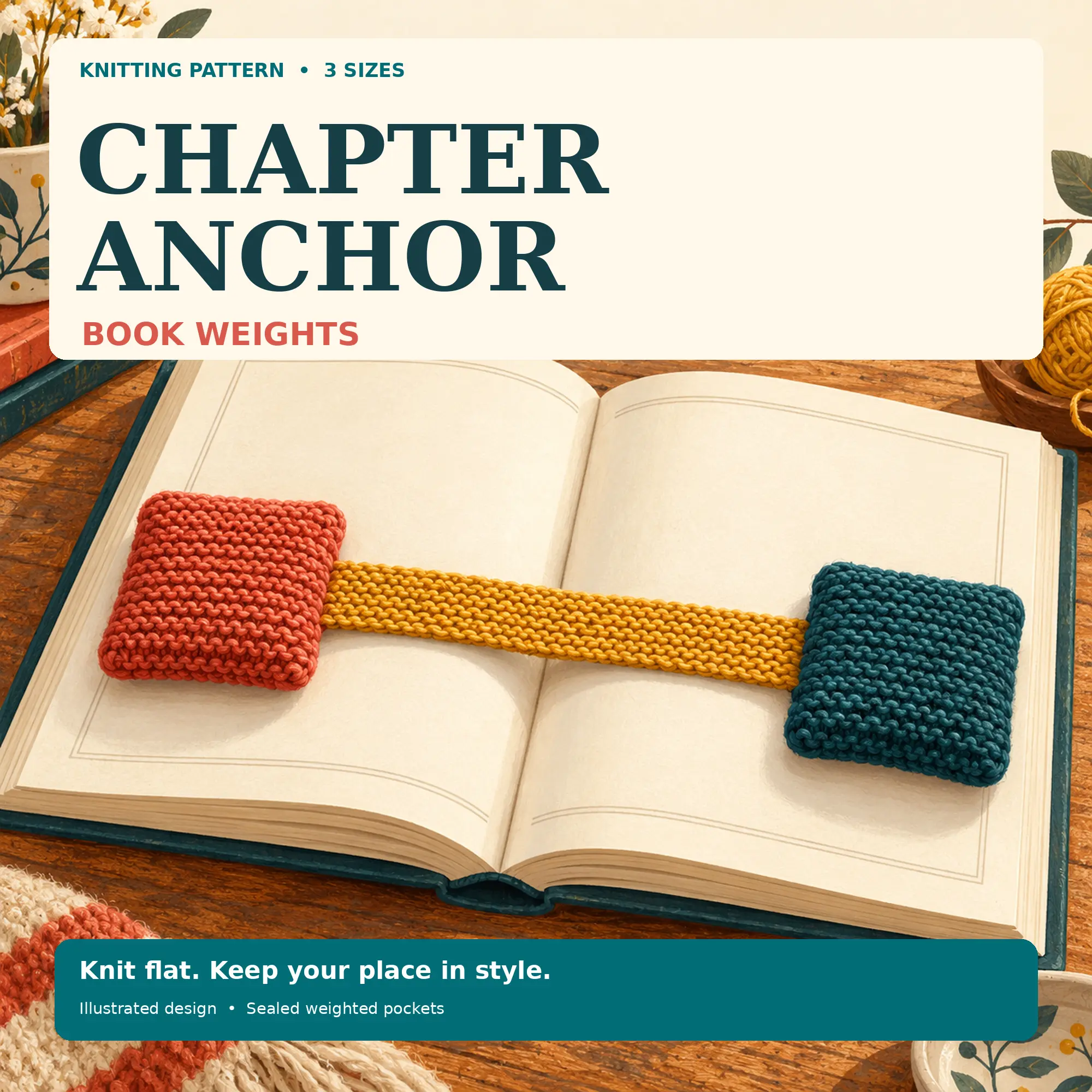
A book weight has a deceptively modest job. It should keep an ordinary open book readable without asking the spine to perform gymnastics, covering the text or rolling towards the floor at the interesting bit. That calls for three things working together: a strap sized for the open pages, two balanced pockets and securely contained filling.
Chapter Anchor is an eight-page A4 knitting pattern with Small, Medium and Large recipes plus a worked custom-fit calculation. Its two garter-stitch pockets and narrow connecting strap are knitted flat in smooth DK cotton, then assembled around separately sewn fabric sachets. This guide helps you plan and check that particular make; use the pattern for its exact stitch counts, row counts, fold markers, fabric dimensions and assembly sequence.
Start with the book, not the size label
Choose one ordinary, sturdy book that represents what you expect to read most often. Open it naturally on a clean, level surface without pressing the covers flat. Notice the distance the knitted strap needs to cross, the usable margin at each outer edge and how readily the pages try to close. A compact paperback, a wide craft book and a stiff new hardback do not ask the same thing of a page holder.
Compare those observations with the finished measurements in Chapter Anchor. Small, Medium and Large are starting recipes, not promises about every paperback or hardback bearing the same general label. If none fits the open span sensibly, follow the pattern's custom-fit method. Keep the strap clear of fragile paper, illustrations you want to see and any part of the binding that feels reluctant to open.
Make and wash the gauge swatch
The pattern uses smooth DK cotton with 4 mm needles, or the needle size needed to reach a washed garter-stitch gauge of 22 stitches and 44 rows per 10 cm. Knit a swatch larger than the measuring area, wash it according to the yarn label, let it dry completely and measure away from the edges. Count both stitches and rows; the pockets depend on width and fold placement, while the strap depends on length.
The Craft Yarn Council's gauge guide explains why different hands can produce different dimensions with the same named yarn and needle size. UK Hand Knitting likewise recommends a tension square and warns that yarn substitutions can change the final effect. If your washed swatch is too small, try a larger needle; if it is too large, try a smaller one, then wash and measure again. Do not alter the pattern's stitch count merely to rescue an unchecked swatch.
Choose yarn for a handled object
Use the pattern's smooth DK cotton specification as the starting point. A smooth yarn keeps the garter ridges and fold markers easy to read and avoids a fuzzy surface beside paper. Check the ball band before buying: fibre, weight, total metres or yards, dye lot, gauge and laundering instructions all matter. The Craft Yarn Council's yarn-label checklist is a useful reminder that two balls described as DK can still differ in construction and care.
If substituting a yarn, match the washed gauge and compare the total length on the ball rather than assuming equal ball weights contain equal yardage. Knit one complete book weight before buying for a fleet of matching reading accessories. Chapter Anchor's arithmetic has been checked, but physical test-knitting and yarn consumption remain unverified; your first finished piece provides the evidence for your particular yarn and tension.
Knit the pockets as a matched pair
Work the first garter-stitch pocket exactly to the chosen recipe, using a row counter or a simple tally. Place a removable marker at each fold point as the pattern directs rather than trusting that you will recognise a particular ridge later. Garter stitch is admirably even-tempered, but its rows are very good at looking like their neighbours.
Before casting off, count the stitches, confirm the row total and lay the piece flat without stretching it. Knit the second pocket with the same needles, yarn and counting method. Compare the two pieces side by side after any specified finishing step. A small mismatch becomes more noticeable once equal-looking inserts are enclosed, and correcting the knitting now is cleaner than asking assembly to disguise it.
Keep the strap flat and true
Knit the narrow strap to the pattern's count for the chosen size or to the calculated custom length. Check it on a flat surface, measuring the fabric in its relaxed state. Pulling it taut for the ruler creates a flattering number and an unhelpful fit. The finished strap should span the intended open book while allowing a pocket to sit beyond each page edge; it should not need to stretch across the text.
If the strap twists, first check the cast-on and cast-off edges and the way it is attached to each pocket. A flat-knitted strip can acquire a half-turn during assembly surprisingly easily. Dry-position both ends before sewing, place the pockets in matching orientations and pin or tack them temporarily. Then lift the arrangement as one unit to confirm that the pockets hang on opposite sides rather than attempting an unexpected reunion.
Treat the fabric sachets as the important seams
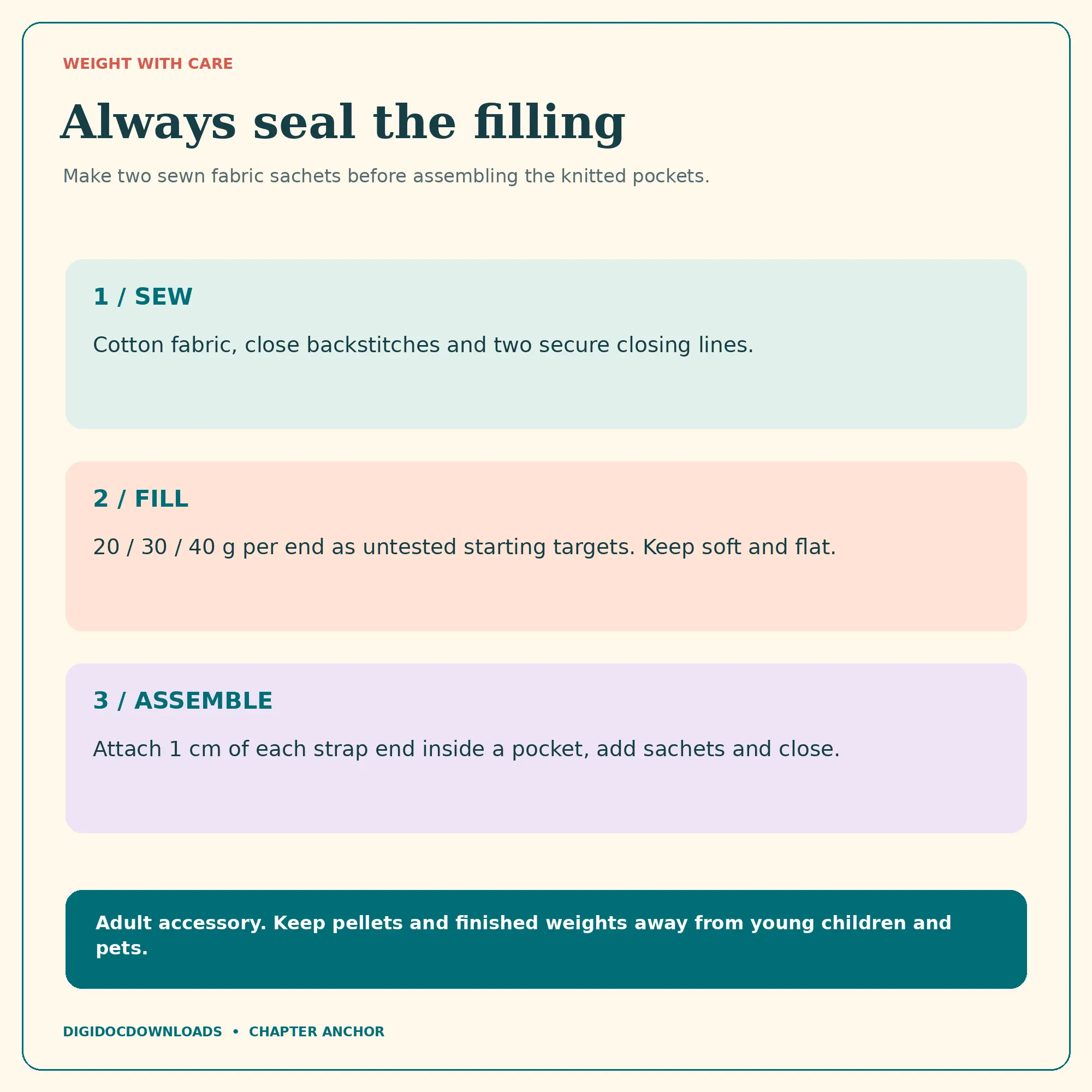
Cut the fabric inserts to the dimensions and seam allowances given in Chapter Anchor. Use closely woven, sound fabric with no holes, weak creases or fraying edges inside the seam line. Sew each sachet with secure, short stitches, fill only as the pattern directs and close the opening completely. The knitted pocket is a soft outer cover; it is not a substitute for a properly contained inner insert.
Inspect every seam in bright light before the sachet enters the knitting. Gently flex it over a tray and look for gaps, escaping particles or stitches pulling through the fabric. If anything moves where it should not, empty and remake the insert rather than adding an improvised patch. Keep loose pellets, filled sachets and the completed weight away from children, pets and anyone likely to mistake craft filling for something edible.
Assemble for balance before closing the pockets
Lay the two knitted pockets and strap on a table in their final order. Use the fold markers and construction diagrams to position the strap consistently, then attach it securely as directed. Insert both checked sachets and shape the knitting around them without straining the fabric. Before completing the final closure, compare the two sides in your hands: they should feel evenly filled and sit at matching distances from the strap.
Test the assembled piece over a clean folded towel before it goes near a book. Lift it by supporting both pockets, turn it over and set it down several times. Check the outer knitted seams, the strap attachments and the hidden sachet positions after every movement. This is not a laboratory load test, but it can reveal a missed opening, a rotated insert or a connection that deserves to be resewn.
Use minimal pressure on a suitable book
Prepare a clean, dry reading surface. Support the covers so the book can open at a comfortable angle, then lower the book weight into place with one pocket beyond each outer page edge and the strap resting lightly across the open pages. The Library of Congress handling guide advises against forcing a book completely flat and recommends supporting its covers; it specifically describes book weights as a way to hold pages with minimal pressure.
Do not use the weight on a fragile, damaged, rare or valuable book, or on paper and bindings that show strain. It is a practical reading accessory, not conservation equipment. If the book resists opening, support it at a narrower angle rather than increasing the weight. Keep the strap away from wet ink, loose media, brittle edges and raised decoration. When in doubt, use clean hands and turn the pages without a weight.
Lift the whole weight before turning a page
To turn a page, lift the complete book weight clear with both pockets supported. Do not drag the strap across the paper, swing one filled pocket from the other or pull the page from beneath it. Turn the page, check that it lies comfortably and lower the whole weight again. It takes an extra moment, which is rather less time than repairing a torn page or resewing a stretched strap.
After reading, remove the weight before closing the book. Inspect its outer seams and strap attachments periodically, especially if it has been carried in a project bag or dropped. Stop using it immediately if filling escapes, fabric becomes damp, a seam opens or the two sides no longer feel balanced. Follow the yarn's care instructions for the knitted outer fabric and the pattern's cleaning guidance; do not wash a filled insert unless its materials and construction explicitly allow it.
Keep a small first-project record
Record the chosen size, book dimensions, washed gauge, needle size, yarn and actual amount used. Add one note after the first reading session: Did the pockets sit beyond the page edges? Was the strap clear of the text? Did the book stay at a comfortable opening angle? These observations turn the first project into a reliable starting point for another size or a gift.
For a larger beginner-friendly knit-flat project, The Cosy Compendium combines practical home pieces with clear learning notes. The knitting collection gathers the full range by project type, while How to size a knitted book sleeve before sewing offers another practical route from measured book to useful knitted reading accessory.
Final checks before the first chapter
- The washed swatch matches the pattern's stitch and row gauge.
- Both knitted pockets match and all fold markers were followed.
- The strap lies flat and reaches across the intended open book without stretching over the text.
- Each fabric sachet is securely sewn, intact and fully contained.
- Both pockets feel balanced and every strap attachment is secure.
- The chosen book opens comfortably with its covers supported rather than forced flat.
- The whole weight can be lifted clear before every page turn.
Chapter Anchor keeps the knitting deliberately straightforward: flat garter-stitch pieces, no increases or decreases and a useful object at the end. The care belongs in the measuring, the inner seams and the way the finished weight meets the book. Get those details right and the accessory can do its quiet work while the story receives the attention.
More to read, make and discover
A few useful, interesting and checked routes into the subject.
- Official knitting guidanceCraft Yarn Council: gauge and why it matters
Explains how stitch and row gauge determine finished dimensions and why a sample swatch should be checked before a project begins.
- Official yarn guidanceCraft Yarn Council: yarn labels, gauge and care
Lists the fibre, weight, length, gauge and laundering information available on yarn labels and explains matching the pattern gauge.
- UK knitting guidanceUK Hand Knitting: tension-square and yarn-substitution FAQs
Recommends knitting a tension square and comparing total yardage when substituting yarn, noting that substitutions may alter the finished effect.
- Official book-care guidanceLibrary of Congress: handling and supporting books
Advises using a clean surface, not forcing a book flat, supporting the covers and using book weights with minimal pressure.