In this guide
Start with contributions, not office characters
For a small Christmas gathering, choose three to six awards, explain what each recognises and collect one concrete example per nomination. Set the closing date and tie rule before voting opens. Present each award with a short explanation and a personal thank-you. This is a suggested format for a friendly celebration, not a replacement for a formal workplace performance or reward process.
Choose categories people can understand without knowing an office joke. Helping a new colleague, sharing a useful method or catching an important detail gives a nomination something solid to stand on. Appearance, age, lateness and personal circumstances are poor raw materials for a public certificate. If the joke only works because its recipient looks uncomfortable, it has already used up its welcome.
Choose fewer categories and define each one
Write a single sentence beneath every category. A Helping Hand award might recognise someone who made a difficult task easier for another person. A Knowledge Sharer award might recognise a clear explanation that others could reuse. Distinguish the two before inviting nominations; otherwise every kind colleague becomes eligible for everything and the ballot does very little sorting.
Emory University's Awards Toolkit separates choosing categories, defining eligibility and gathering nominations. Its larger annual programme is not a template that a small party must copy, but that sequence is useful: decide what the award means before choosing the name that goes on it.
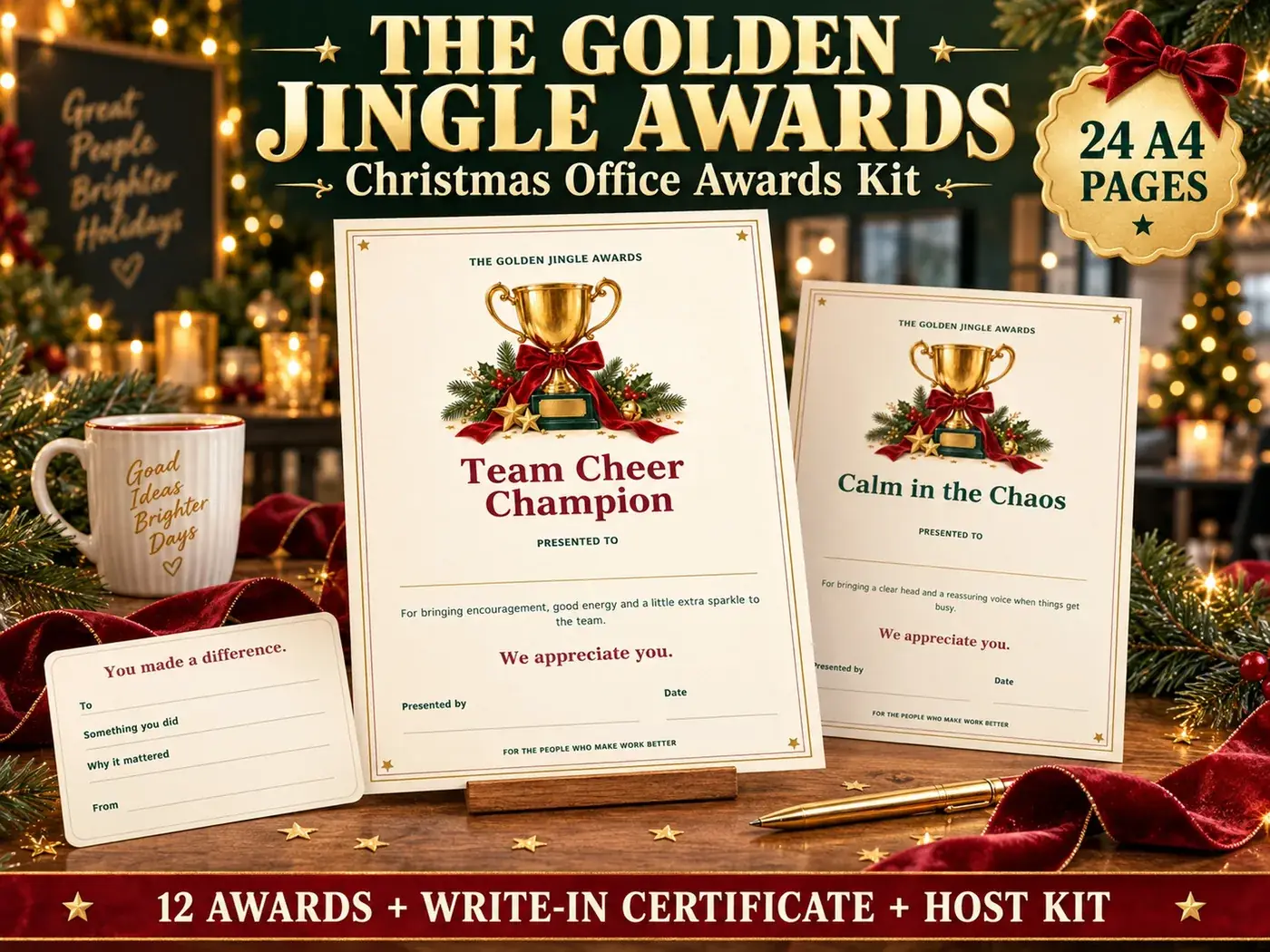
The Golden Jingle Christmas Office Awards Kit includes twelve named certificates, a write-in certificate, nomination cards and optional voting slips. Pick the categories that fit the team rather than treating all twelve as compulsory. The kit's event planner, ceremony script and running-order sheet provide a place for the practical decisions below.
Ask for a name, an example and the difference it made
A useful nomination has three parts: who helped, what they did and why it mattered. For example: ‘Sam explained the new booking process, made a one-page checklist and helped the weekend team use it.’ That gives the presenter something more personal than ‘Sam is brilliant’, while keeping the nomination short enough to read properly.
Invite contributions from colleagues who work different shifts or remotely, not just those attending the party. Tell people whether recipients are chosen by the organiser or by a team vote; do not present a curated selection as a vote. Ask the recipient how they would like to be thanked, and offer a quiet presentation or written note instead of a turn at the front.
Make the voting and tie rules pleasantly ordinary
For a small informal ballot, one vote per person in each selected category is an easy rule to explain. Name one person to collect the slips and another to check the count. Decide in advance whether someone may receive more than one award. None of these choices is universally correct; the useful part is making them visible before the result.
If the highest count is tied, a joint award is a straightforward option. The Golden Jingle results sheet includes space for joint winners; prepare an extra certificate and allow another presentation slot. Do not ask the room to settle a tie by applause. That turns a small arithmetic problem into a popularity contest with its own sound effects.
Time the thank-you, not only the announcement
Allow roughly a minute per presentation for the category, name, example and applause, plus two minutes to open and two to close. Six awards therefore make a ten-minute starting estimate; twelve make sixteen minutes. These are planning assumptions, not a promise. Add time for photographs, shared awards, acceptance remarks and remote connections. The timing planner on the product page lets the organiser compare three, six or twelve awards at different presentation lengths.
Put certificates in running order and check names before the gathering. A presenter can keep a card reading ‘Name — contribution — thank-you’ beside each one. For example: ‘Alex, thank you for rebuilding the handover notes so the next shift could find what it needed.’ The specific detail does the work; a long speech about the importance of teamwork is optional.
A certificate has a history of its own
Award certificates are not merely the less shiny part of a prize. The official history of the Nobel Peace Prize diploma records that Gerhard Munthe's lithographic design was used from 1901 to 1969; in 1991, the decision was made to commission original artwork annually from contemporary Norwegian artists. A team certificate operates on a rather smaller scale, but the useful idea survives: the page can be a considered keepsake, not just a label beside a gift.
Finish with a thanks to the whole team and hand over any private appreciation notes separately. Keep nominations and voting sheets with the organiser, rather than circulating personal comments afterwards. The lasting part should be the contribution someone noticed, written clearly enough to remember after the decorations come down.
Explore Christmas Office Awards Kit – The Golden Jingle Awards
More to read, make and discover
A few useful, interesting and checked routes into the subject.
- Practical recognitionEmory University: Awards Toolkit
Primary university guidance on award categories, criteria, nominations and presenting specific contributions.
- Certificate historyNobel Peace Prize: the history behind its diploma design
Official account records Gerhard Munthe's 1901–1969 diploma design and the 1991 decision to commission contemporary artwork annually.