Start with the week you actually have
Write down classes, paid work, travel, appointments and other fixed commitments before adding study sessions. Include ordinary needs such as meals and rest. The gaps that remain are the time available for a plan; they are not proof that every spare minute should become a revision slot. A realistic week has room for the unexpected.
Cornell’s time-management guidance separates a semester overview from a weekly schedule and recommends accounting for fixed commitments before filling study time. Use the wider view to spot several deadlines arriving together, then use the weekly view to decide what can reasonably happen next. Those two views answer different questions: what is approaching, and what will I do about it?
Enter deadlines from the course source
Use the assignment brief, course handbook or learning platform to confirm the date, submission time and any relevant time zone. Record the task’s exact name so it can be matched back to the course. If two sources disagree, ask the course team rather than choosing the more convenient deadline. A colourful alert is only as reliable as the date that created it.
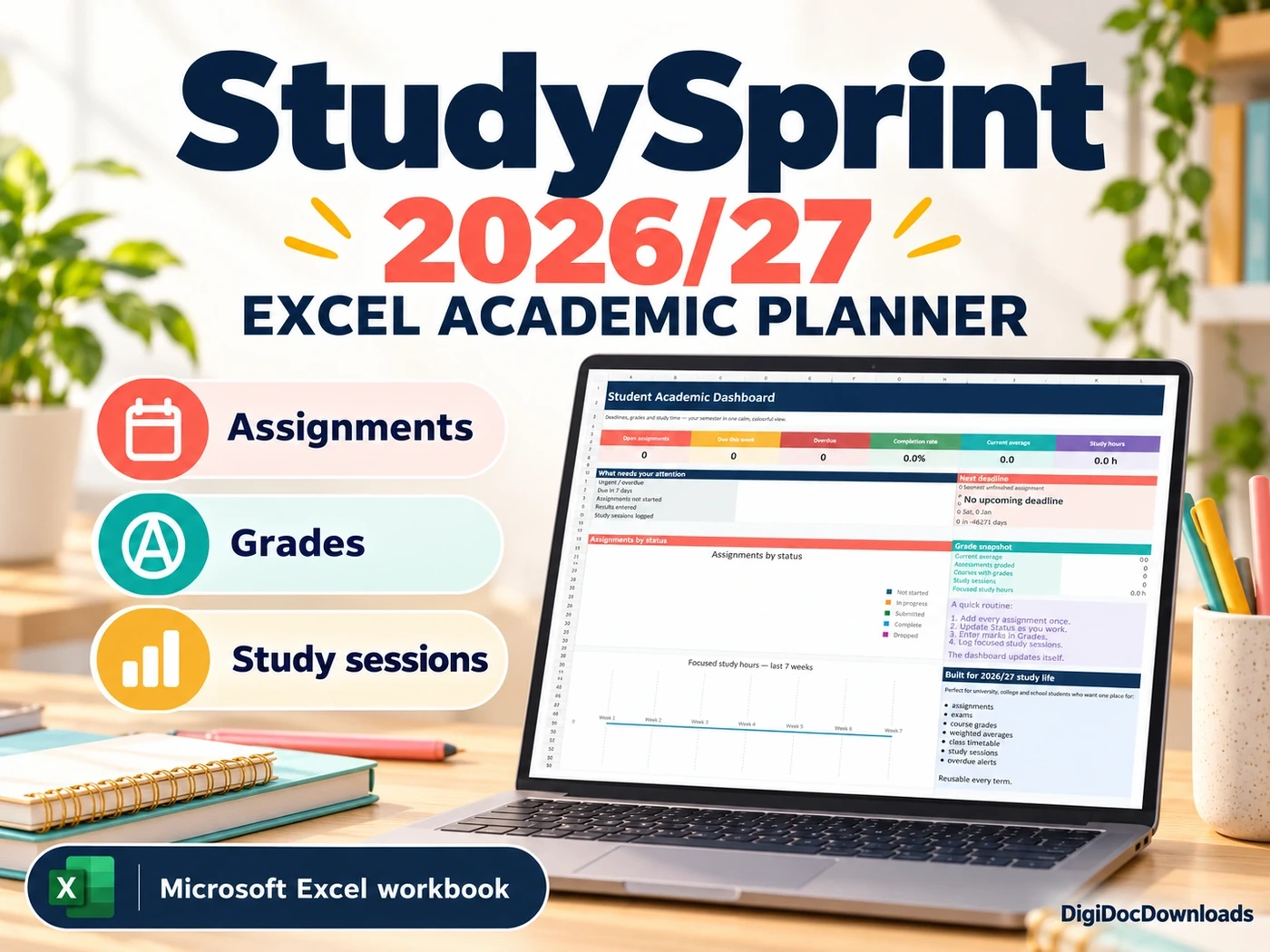
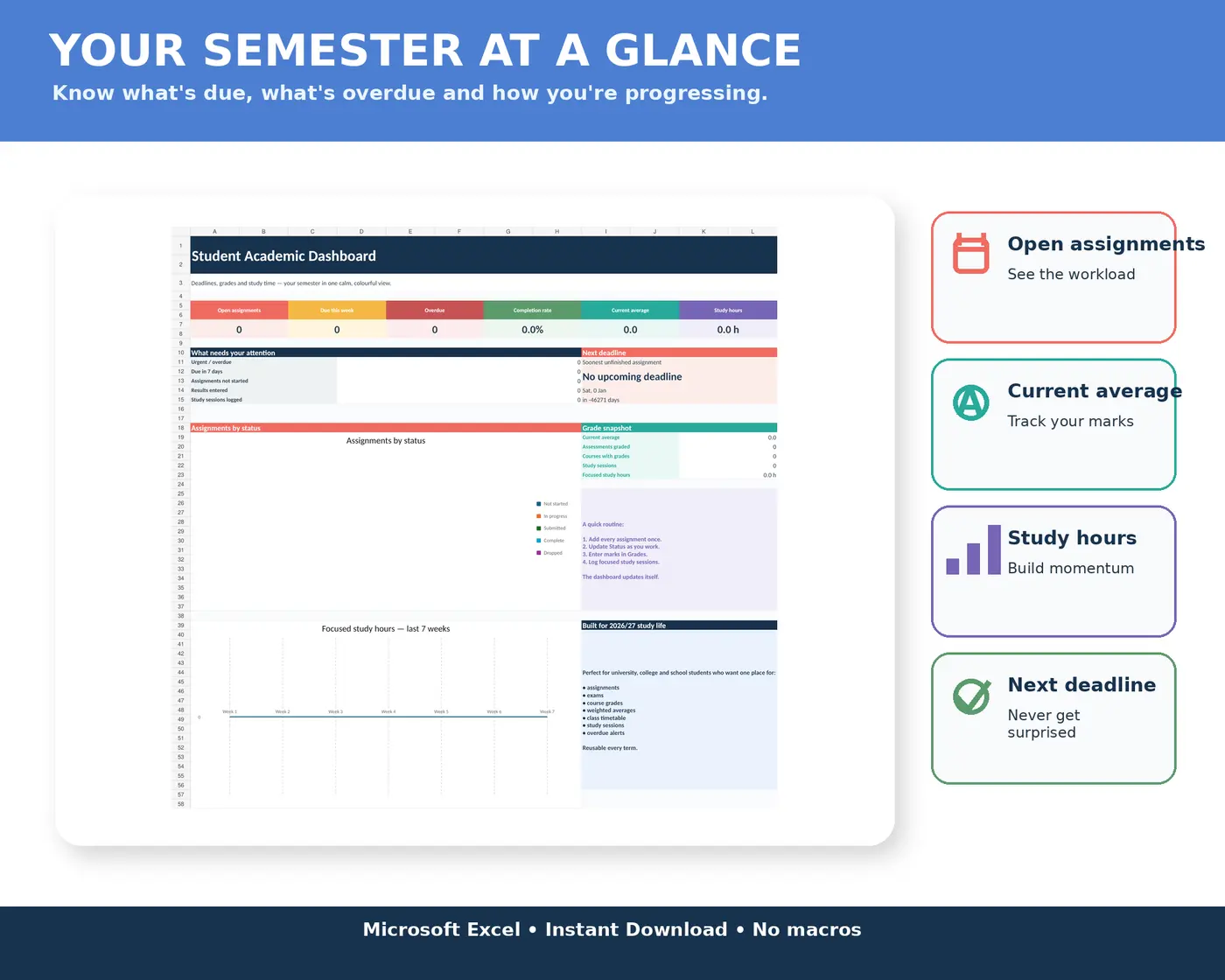
StudySprint 2026/27 brings course setup, an assignment tracker, a class timetable and study-session records into an Excel workbook. Its listing includes deadline alerts, days-until-deadline calculations and a next-deadline display. These are organising features, not a connection to the institution’s submission system. Enter and confirm your own records; continue to check the official course source for changes.
Replace ‘study’ with a next action
Give each session something observable to achieve. ‘Work on essay’ is broad; ‘write a paragraph plan from the assignment criteria’ is clearer. ‘Revise biology’ might become ‘answer five questions on cell transport, then check the gaps’. The task should fit the session rather than quietly expanding to occupy the whole evening.
- Reading task: read the specified section and note three questions for class.
- Writing task: draft the argument for one section, keeping references beside the claims.
- Practice task: attempt selected problems without the worked answers, then check and correct them.
- Admin task: confirm the submission instructions and name the final file as required.
These are examples, not universal study rules. An art project, laboratory report and language exam require different kinds of work. If the next action remains vague, return to the brief or ask a tutor what a useful first step would look like. Clarity often begins with a better question, not another colour in the timetable.
Use a small worked plan
Suppose an essay is due on Friday and a quiz is scheduled for Thursday. A possible plan is: Monday, check the essay criteria and make an outline; Tuesday, draft one section and try a short quiz practice; Wednesday, continue the draft and revisit the questions that were missed; Thursday, take the quiz and revise the essay; Friday, check the final file and submit before the official cutoff. Keep a spare block for a task that takes longer than expected.
That sequence is an illustration, not a promise that an essay can be completed in five short sessions. Scale the work to its actual requirements and move the start earlier when necessary. A week’s plan should include intermediate work, not only the submission day. Seeing ‘essay due’ five times does not turn it into five tasks.
Track the learning as well as the time
Cornell’s study-strategy guide explains retrieval practice: trying to recall ideas from memory, then using the result to identify gaps. A session can therefore finish with a brief note about what was understood and what needs another attempt. Returning to a topic across separate sessions is a different plan from leaving all its work to one long evening.
StudySprint’s listed features include focused-session tracking, calculated study hours and a seven-week trend chart. Those records may help describe effort, but time spent is not the same as material learned. Its weighted-grade and course-average features also depend on correct inputs and course rules. Independent formula and cross-app checks remain outstanding, so confirm important results against the institution’s records and do not treat the workbook as an official grade report.
Review the week without rewriting your life
At the end of the week, ask which tasks were completed, which estimates were unrealistic and what needs to move. Carry forward the unfinished action, not a vague instruction to ‘catch up’. Leave completed work visible enough to learn from the pattern, while keeping the next week uncluttered. A plan is allowed to change; the useful question is what the change teaches about the workload.
A paper timetable or ordinary calendar is enough to try this approach. If the workbook suits the task, keep an untouched original and use a working copy in Microsoft Excel; do not assume another spreadsheet app behaves identically. For learning-method questions beyond planning, Cornell’s study resources offer several starting points, and the course team remains the source for course-specific expectations. The aim is a week with clear next steps, not a dashboard so immaculate that no work has happened.
More to read, make and discover
A few useful, interesting and checked routes into the subject.
- Weekly planningCornell Learning Strategies Center: managing time
Semester and weekly planning guidance, including fixed commitments and specific study tasks.
- Learning methodsCornell: effective study strategies
An introduction to retrieval practice, spacing and interleaving, rather than simply counting hours.
- Further supportCornell: how to study
Further routes into reading, note-taking, exam preparation and getting questions answered.