Begin with one real product
Choose an item you have made more than once and price that item first. A familiar product gives you real quantities, a realistic making time and fewer hopeful estimates. Keep the calculation in one currency and use current supplier prices, including any delivery charge needed to get those materials to you. This is an internal working price, not a promise that every customer or marketplace will accept it. The aim is to find out what the product actually asks of the business before deciding what to charge.
Record the materials that leave with the order
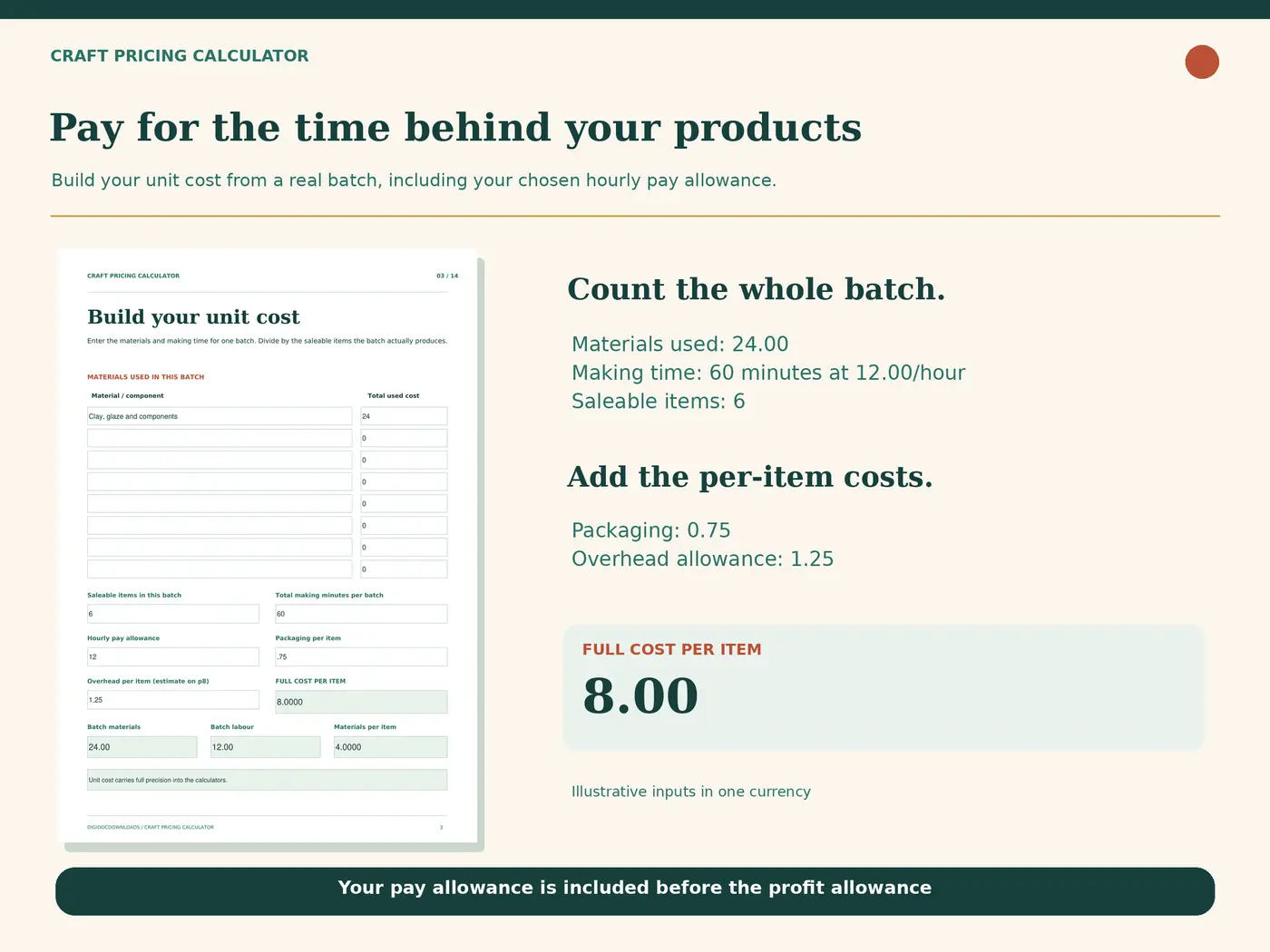
List every material used in one finished item: yarn, clay, card, findings, fabric, thread, labels and the part of a bottle, sheet or roll that was genuinely consumed. Add the packaging that travels with the order, such as a box, tissue, tape and printed care card. Where a pack makes several items, divide its usable cost by the number it produces rather than assigning the whole purchase to the first one. Allow for ordinary waste when the process reliably creates it; do not quietly assume every last centimetre will become saleable stock.
Give working time a visible value
Time the process over several ordinary makes, not the unusually swift sample completed while everything was already on the table. Include preparation, making, finishing and the product-specific part of packing. Photography, customer messages and general shop administration may fit better under overhead if they support many products. Decide on an hourly labour figure and multiply it by the hands-on time. This is a planning input, not a universal wage rule, but omitting it implies that the maker is the one component expected to arrive free of charge. The Etsy Seller Handbook's pricing guide likewise treats materials, time, labour and overhead as foundations of the calculation.
Separate variable costs from overhead
A variable cost changes when another unit sells: materials, per-order packaging and a transaction charge are typical examples. Overhead keeps the business running more broadly: equipment, insurance, software, market subscriptions, workspace and general marketing may belong here. Choose a sensible period, total the relevant overhead and divide it using a method that reflects the business. A simple maker might divide annual overhead by realistic annual units; a mixed range may allocate more to products that use costly equipment or take greater studio space. Write down the method so next month's calculation does not develop a mysterious new personality.
Use fees as current inputs, not folklore
Selling fees vary by platform, payment method, country, advertising arrangement and order value. Check the current official fee pages for every channel you use and enter your own assumptions. A percentage fee and a fixed charge may need separate lines. Shipping charged to a customer can also attract fees on some platforms, so calculate from the amount the platform actually treats as the order total. Recheck the figures when a marketplace changes its terms. This guide deliberately avoids supplying a universal fee percentage: a neat number would be convenient for about five minutes.
Add profit deliberately
Once materials, labour, overhead and selling costs are visible, decide what profit the product should contribute. Profit is not the same as payment for making time; it is what remains for resilience, growth, replacement equipment and the risk of running the business. Margin and markup are also different. A 25% markup adds one quarter of cost to the cost figure; a 25% margin means profit is one quarter of the final selling price. The British Business Bank notes that product and service profit margins are worth monitoring because they help a business respond as circumstances change. Label the figure you are using so two percentages do not wander into the same worksheet wearing identical hats.
Compare the result with the market
Now compare the calculated price with genuinely similar products: the same type of item, quality, size, materials, finish, personalisation and customer. A mass-produced reference can show the lower end of the wider market, but it is rarely a direct comparison for a small-batch handmade piece. If your calculated price sits higher, identify why. Better materials, a distinctive design, careful finishing or custom work may support it; an inefficient process or an unrealistic sales assumption may not. If the market will not support the price, change the product, process, channel or target customer. Removing your own time from the calculation only hides the decision.
Stress-test discounts before announcing them
Test the normal price, proposed discount and selling fees together. A 20% reduction in the customer's price can remove far more than 20% of the expected profit because the materials and working time have not become cheaper. Repeat the exercise for a bundle and for any shipping offer. Keep public savings claims accurate and lawful in the markets where you sell; the pricing sheet should inform a promotion, not manufacture a fictional reference price. If a discounted order no longer meets the purpose you set for it, choose a different offer or leave the price alone.
Treat wholesale as a separate model
Do not simply halve a retail price and hope volume performs the rescue. A wholesale calculation needs its own order quantity, production time, packaging, payment terms and profit. Larger batches may reduce setup time or material cost, but they can also tie up cash and create a substantial packing job. Calculate the lowest order that makes the arrangement worthwhile, then check whether the retailer has enough room for their own costs and margin. If both sides cannot make the numbers work, that product may be better kept for direct sales.
Find a craft fair's break-even point
For an event, total the stall fee, travel, display costs, card-processing assumptions and any other event-only expense. Then estimate the contribution left by an average sale after its variable costs. The U.S. Small Business Administration's break-even guide expresses the core calculation as fixed costs divided by selling price minus variable cost per unit. When several products are involved, use a cautious average contribution and test more than one sales mix. The result is an estimate, but it reveals whether a pleasant Saturday requires six sales or sixty before it pays its way.
Keep price, profit and cash flow distinct
A profitable product can still create a cash squeeze if materials must be bought months before customers pay, while a busy sales week can look reassuring even when each sale contributes too little. Price each product, monitor its margin and keep a separate cash-flow view of when money enters and leaves the business. The British Business Bank's small-business finance guidance treats cash flow and profit margin as related but distinct evidence of business health. For a short forward view, the 13-Week Cash Flow Planner provides a separate fillable forecast rather than folding cash timing into a unit-price calculation.
Review the price when something changes
Set a simple review trigger: a supplier increase, a fee change, a longer making time, new packaging, a sustained change in demand or a regular quarterly check. Keep the previous inputs beside the new ones so the reason for a price movement is visible. One planned review is usually clearer than a series of tiny unexplained adjustments. It also makes it easier to communicate an increase plainly: the materials changed, the process improved or the earlier price no longer covered the work.
Use a calculator as a record, not an oracle
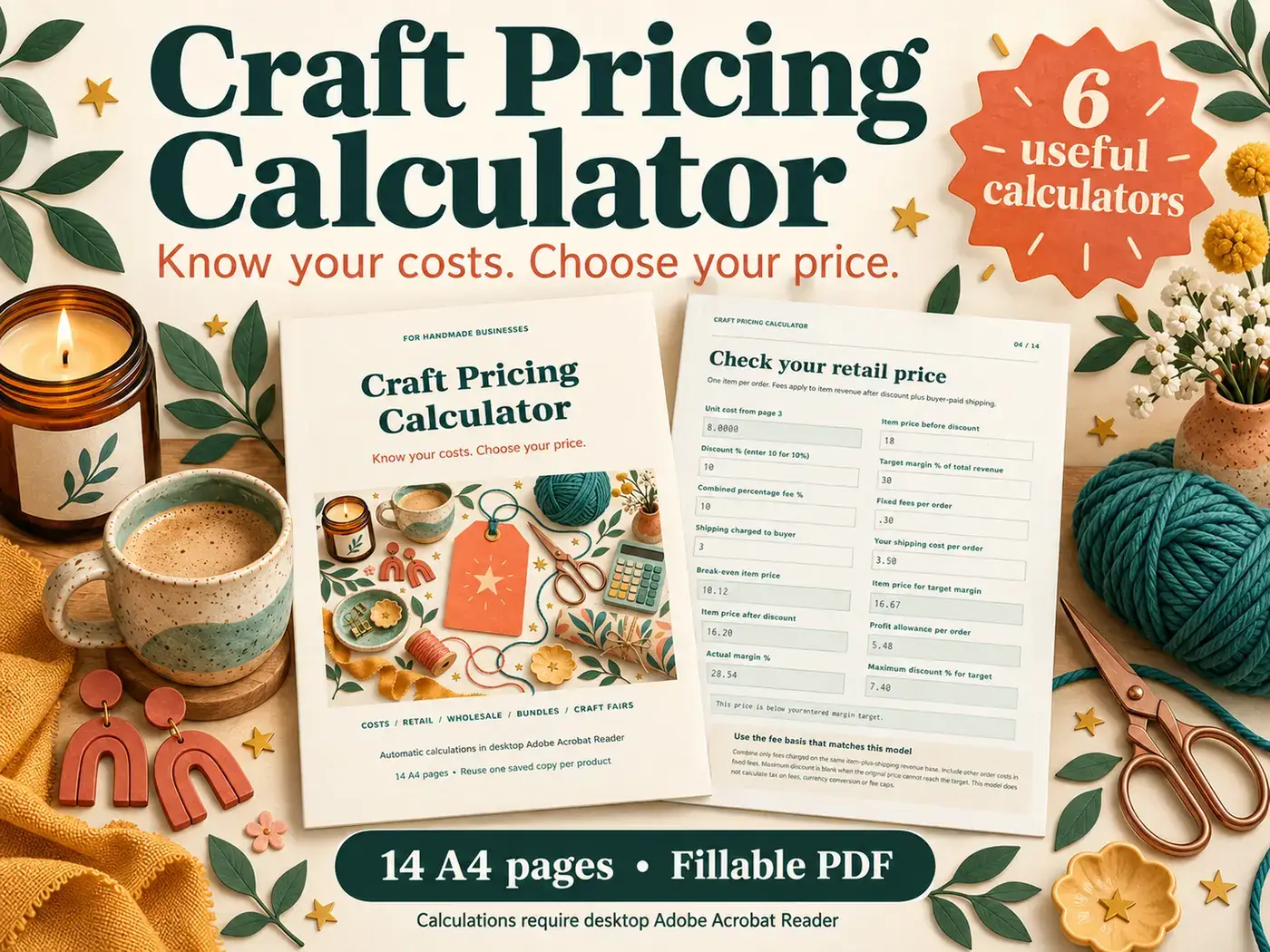
A notebook or spreadsheet can handle this method perfectly well. The Craft Pricing Calculator brings unit cost, retail, wholesale, bundles, overhead, discounts and craft-fair break-even into six fillable calculators, with a worked example and supplier comparison. It has 14 A4 pages and 190 form fields; automatic calculations require desktop Adobe Acrobat Reader with Acrobat JavaScript enabled, while browser previews, Apple Preview and mobile viewers may not calculate. It excludes tax calculations and relies on the fees and assumptions entered by the user. Save a separate copy per product, keep the source figures, and treat the output as evidence for a decision rather than the decision itself. This guide is general planning information; seek suitable professional advice for tax, accounting or decisions specific to your business. The wider small-business tools collection offers other records when pricing is only one part of the job.
Explore Craft Pricing Calculator
More to read, make and discover
A few useful, interesting and checked routes into the subject.
- Marketplace pricing guideEtsy Seller Handbook: Pricing Basics
Etsy's current guide separates materials, labour and overhead, then recommends comparing the resulting price with the market and reviewing it as costs change.
- Break-even guideU.S. Small Business Administration: Break-even point
The SBA explains fixed and variable costs and gives the standard fixed-costs divided by unit contribution formula for estimating break-even units.
- Small-business financeBritish Business Bank: Getting your business ready for finance
The British Business Bank identifies product or service profit margins as figures worth monitoring and distinguishes profitability from cash flow.