A paint night at home is easier to host when it is treated as a gathering with paint, rather than an art examination that happens to contain snacks. Guests need somewhere comfortable to sit, a clear starting point and enough time to discover that the apparently disastrous first layer was merely being dramatic.
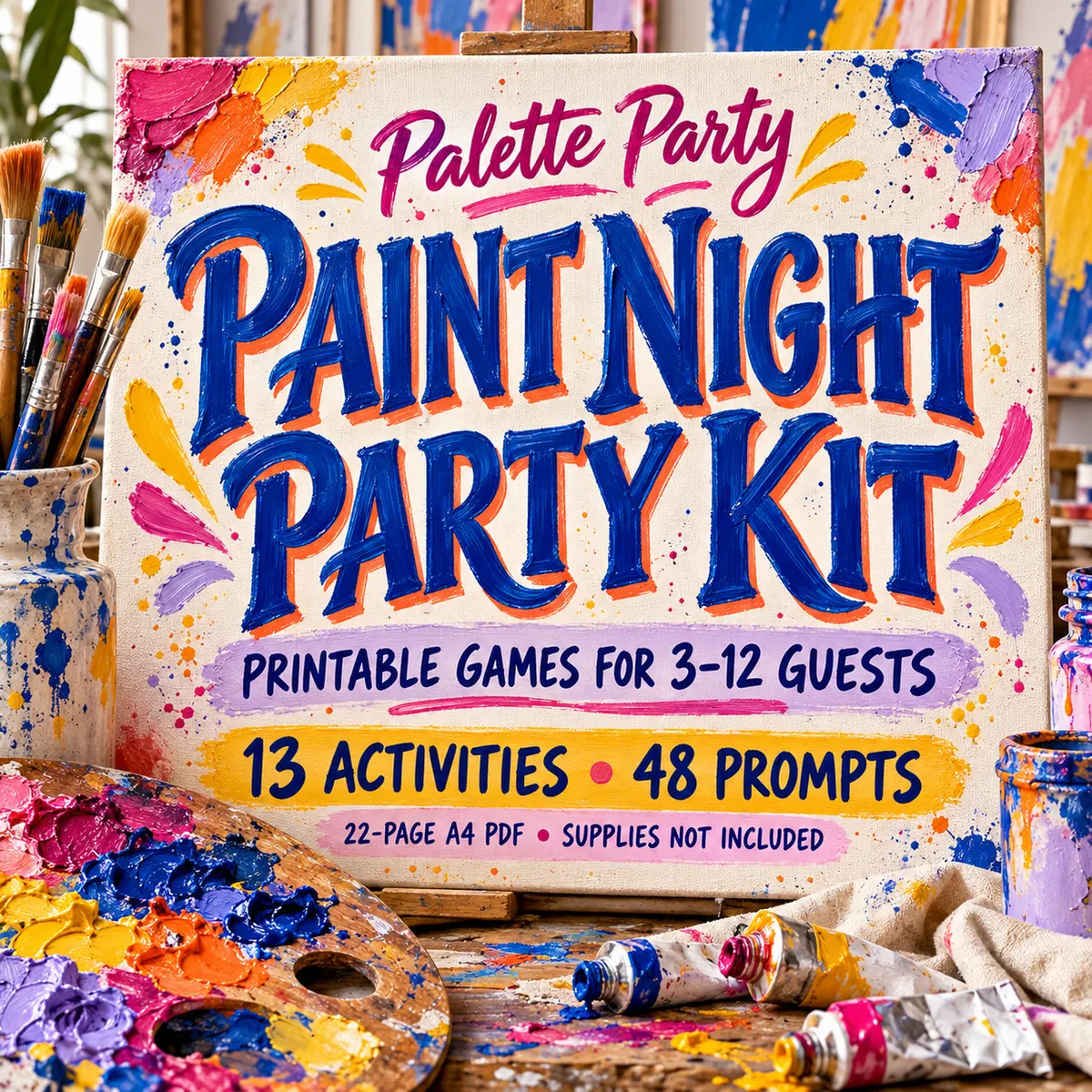
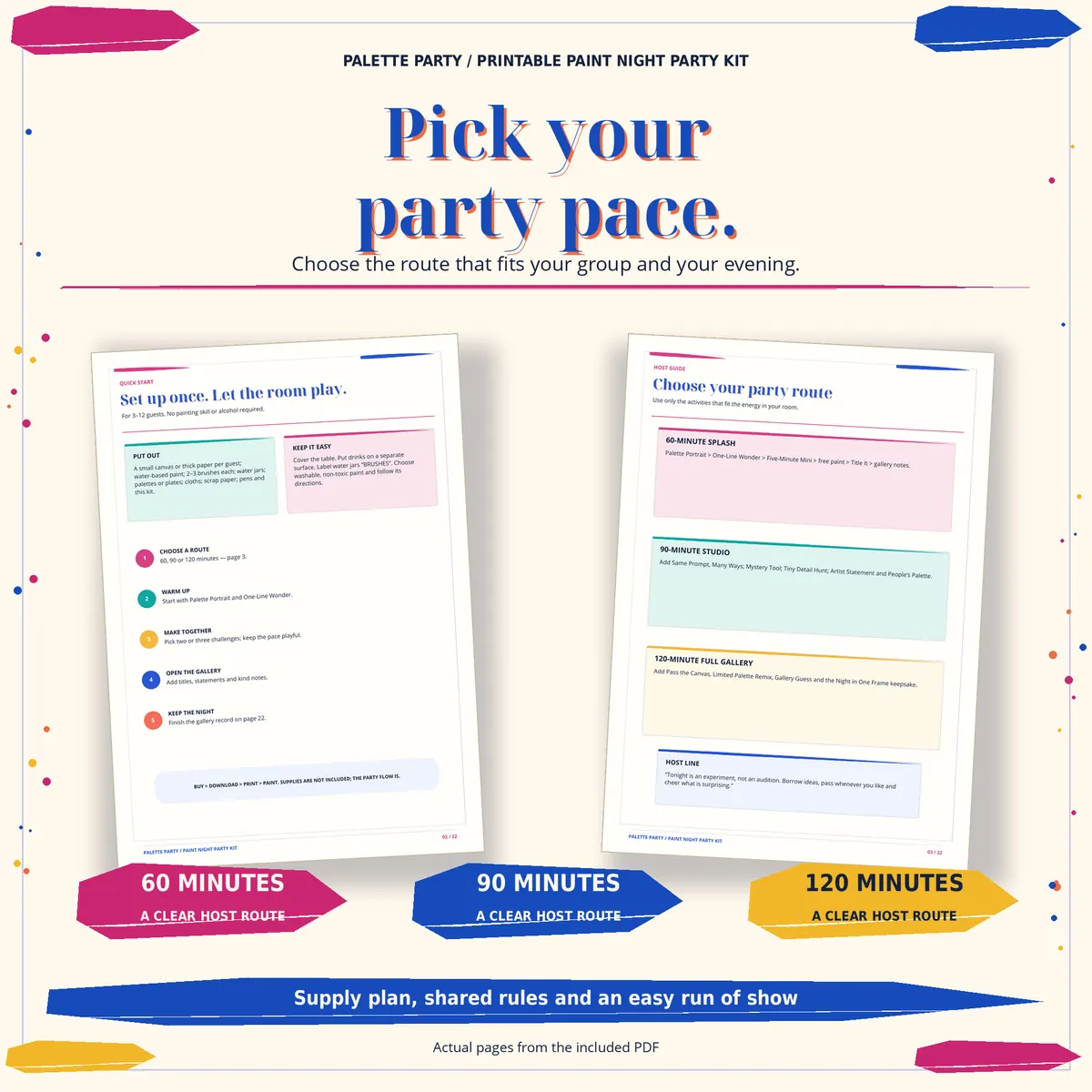
This plan works for a small group of beginners and does not require alcohol, matching outfits or one identical sunset copied twelve times. Plain paper, a few colours and a simple prompt can produce a lively table. Palette Party adds 13 activities, 48 paint prompts, 60, 90 and 120-minute host routes, gallery labels, kind notes, six awards and a shared keepsake for 3–12 guests.
Choose one simple version of the evening
Decide first whether everyone will work from the same broad prompt, choose individual prompts or pass a piece around the table. A shared prompt makes comparison interesting because the results can diverge; individual prompts give guests more control; collaborative painting keeps hands moving when a blank page feels rather too blank.
For a first event, choose one warm-up and one main painting activity. Add a mini gallery only if the schedule still has breathing room. Thirteen possible games are a menu, not a challenge to complete before midnight. The host's most useful skill is leaving an enjoyable activity alone while people are still enjoying it.
Invite people with useful details
Tell guests the start and finish time, whether clothes might meet washable paint, and that beginners are welcome. Ask privately about seating, lighting, sensory or access requirements. State that watching, swapping to collage or drawing, and passing on any activity are ordinary options rather than special arrangements.
Scope's guide to checking event and venue accessibility suggests finding out about breaks, seating and a quiet place before attending. At home, the equivalent may be a chair with firmer support, a route clear of bags, a lower-noise corner or an agreed pause halfway through. A short message beforehand is much better than making somebody negotiate the room while carrying a water jar.
Gather a deliberately small supply kit
Provide small canvases or thick paper, washable non-toxic water-based paint, a few brushes in different widths, pencils, water jars, reusable palettes or sturdy plates, cloths and table covering. Follow the labels on the materials you choose. Keep drinks in distinctive cups away from painting water; both may be technically liquid, but only one should be approached with optimism.
Limit the opening palette to three or four colours plus white. Guests can mix plenty from that set without spending the first twenty minutes choosing among near-identical tubes. Put shared supplies in the middle, but give each painter a separate water jar and enough elbow room to reach the page without crossing somebody else's wet work.
Protect the room before opening the paint
Cover the whole working surface, not only the neat rectangle directly beneath each canvas. Move precious textiles and unstable ornaments elsewhere. Place a cloth and a clearly labelled waste container within reach, check that the route to the sink is clear, and decide where wet paintings will dry before the first brush is loaded.
Good light matters more than decorative light. Use a steady room light that lets guests distinguish colours and edges without leaning forward. If the table is crowded, create a separate supply station and bring paint to the group in small amounts. A whole open bottle beside every elbow is generous in the way an indoor paddling pool is generous.
Begin with a five-minute mark-making warm-up
Give everyone scrap paper and ask for six marks: a thin line, a broad line, a dry-brush texture, a dot pattern, one mixed colour and one shape made without outlining it first. The purpose is not to keep the sheet. It gives guests a chance to learn what the brushes and paint do before the main page acquires ceremonial importance.
Avoid demonstrating a single correct result. Show how to load and rinse a brush, then let the marks differ. If somebody needs another route, offer a sponge, a cotton bud, a pencil draft or a larger-handled brush if one is available. Adaptation is part of making, not an announcement that the evening has gone off script.
Use prompts that leave room for decisions
A useful prompt names a subject and a constraint without dictating every brushstroke: a tiny landscape using three colours, a favourite snack painted as a grand portrait, weather shown without clouds, or an ordinary object given an implausibly magnificent background. Keep two or three alternatives available so nobody is trapped with a subject that feels impossible or uninteresting.
When the group wants visual inspiration, the Smithsonian Open Access collection offers millions of collection images that can be searched and reused. Look for a colour combination, silhouette or texture rather than trying to reproduce an entire work. Inspiration should help the next mark happen; it need not turn the kitchen table into a very small copying department.
Keep the middle of the session calm
For a 90-minute evening, allow 10 minutes for welcome and setup, 5 minutes for the warm-up, 35 minutes for the main painting, 10 minutes for a break, 15 minutes for finishing and titles, 10 minutes for the gallery and 5 minutes of spare time. A 60-minute version can omit the gallery awards; a 120-minute version can add a collaborative round after the break.
Give time checks at the halfway point and with ten minutes remaining. Do not hover over each page offering improvements. Instead, ask practical questions: would more drying time help, is another colour needed, or would the painter prefer to stop here? Knowing when a picture is finished is part of the activity, even when the answer arrives several brushstrokes after the picture knew.
Turn feedback into close looking
Display the finished work at table height or prop it safely against a wall once it is dry enough to move. Give every piece a title card if the painter wants one. Begin the gallery with observations rather than verdicts: a colour that draws the eye, a shape that changes the mood, a small detail noticed on a second look.
The Met's Looking to Connect encourages viewers to trust their observations and make connections from what they see. That principle travels well to a home gallery. Try 'What did you notice first?', 'Where does your eye go next?' and 'Which detail would you like to ask about?' The painter may pass or simply say what they enjoyed making.
Use awards lightly, or not at all
If the group enjoys awards, celebrate particular qualities rather than ranking whole paintings. An unexpected colour pairing, a brilliant title, a brave last-minute change or a detail that rewards close looking can all be recognised. Let one work receive more than one note, and make voting optional.
Palette Party includes six People's Palette awards and eight Kind Gallery Notes, but the evening works perfectly well without competition. A photograph of the gallery can be a useful keepsake if every painter agrees. Ask before sharing it anywhere, especially when names, faces or somebody's home are visible.
Finish with a tidy route, not a scramble
Move wet work to the drying place first. Close paint containers, scrape reusable palettes if appropriate for the material, rinse brushes according to their labels and wipe the table before removing its covering. Check chair legs, the floor and sleeves while marks are still easy to find. Send paintings home only when they can travel flat without touching clothes or one another.
Keep a note of which timing, prompts and supplies worked. For another creative gathering with a different sort of screen, How to host a PowerPoint night offers a short-deck format with similar passing and privacy rules. The medium changes; the useful host habits remain surprisingly loyal.
Paint-night checklist
- Choose one warm-up, one main activity and an optional mini gallery.
- Tell guests the timing, clothing advice and beginner-friendly choices.
- Ask privately about seating, lighting, sensory and access needs.
- Provide thick paper or small canvases, a small palette, brushes, water jars and cloths.
- Use washable non-toxic materials and follow their labels.
- Protect the table, clear the sink route and choose a drying place.
- Offer two or three prompts, plus permission to draw, collage, watch or pass.
- Keep a real break and give gentle halfway and ten-minute time checks.
- Make gallery comments specific, observational and optional.
- Ask before photographing or sharing finished work.
A paint night does not need to reveal hidden genius. It needs enough structure for the first mark to feel possible and enough freedom for the second mark to become somebody's own. Protect the table, keep the choices manageable and let the gallery be curious rather than competitive; the paintings will take care of being different.
Explore Paint Night Party Kit – Palette Party
More to read, make and discover
A few useful, interesting and checked routes into the subject.
- Museum looking guidanceThe Metropolitan Museum of Art: Looking to Connect with European Paintings
A museum education resource built around close looking, personal observation and open questions rather than a single correct interpretation.
- Open collection inspirationSmithsonian Open Access
Millions of openly reusable collection images that can provide optional colour, shape and subject inspiration when guests want a starting point.
- Inclusive event planningScope: checking the accessibility of an event or venue
Practical prompts for checking access needs, breaks, seating and a quiet place before an event.