In this guide
Empty one project bag, not the whole cupboard
Choose one unfinished make and spread its contents on a clear surface. Keep unrelated fabrics and patterns aside. Gather the instructions, paper pattern pieces, cut fabric, thread, fastenings, offcuts and any notes or photographs. Check pockets and folded instructions before deciding that a small piece has vanished.
Make three short lists: present, missing and uncertain. A zip may be present but its length uncertain; a pocket may be cut but not attached. That distinction is useful because it separates a shopping job from a question that can be answered at the table. Do not cut a replacement piece until its identity and required orientation are clear.
Match the fabric to the exact pattern version
Find the pattern name or number, chosen view and size. Check whether the pieces were altered, and keep any marked-up copies with the project. A download saved later may not be the version used for cutting. Compare the actual pieces and old notes before assuming the newest file explains every pencil mark.
Read the pattern's seam-allowance instructions rather than borrowing a familiar figure. Sewdirect's explanation of seam allowance defines it as the distance between the stitching line and cut edge. It is not the same as the finished garment measurement. If the pieces were cut with a different allowance or a fitting change, record that fact; do not quietly switch to another width halfway through construction.
Reconstruct the last completed step
Read the construction sequence with the fabric in front of you. Mark each relevant step as done, not done or unclear. Look at both sides of the work: a seam that appears complete may still need the finish or pressing specified by the pattern. Note loose basting separately from permanent stitching so that the next session does not begin by treating a temporary join as a finished one.
Take a simple photograph of the current arrangement and label loose pieces in a way appropriate to the fabric. If an instruction remains unclear, write the question down and seek the pattern maker's guidance before doing an irreversible step. “I cannot tell whether this facing has been attached” is a more useful question than “Where was I?”. Keep uncertainty visible until it is resolved.
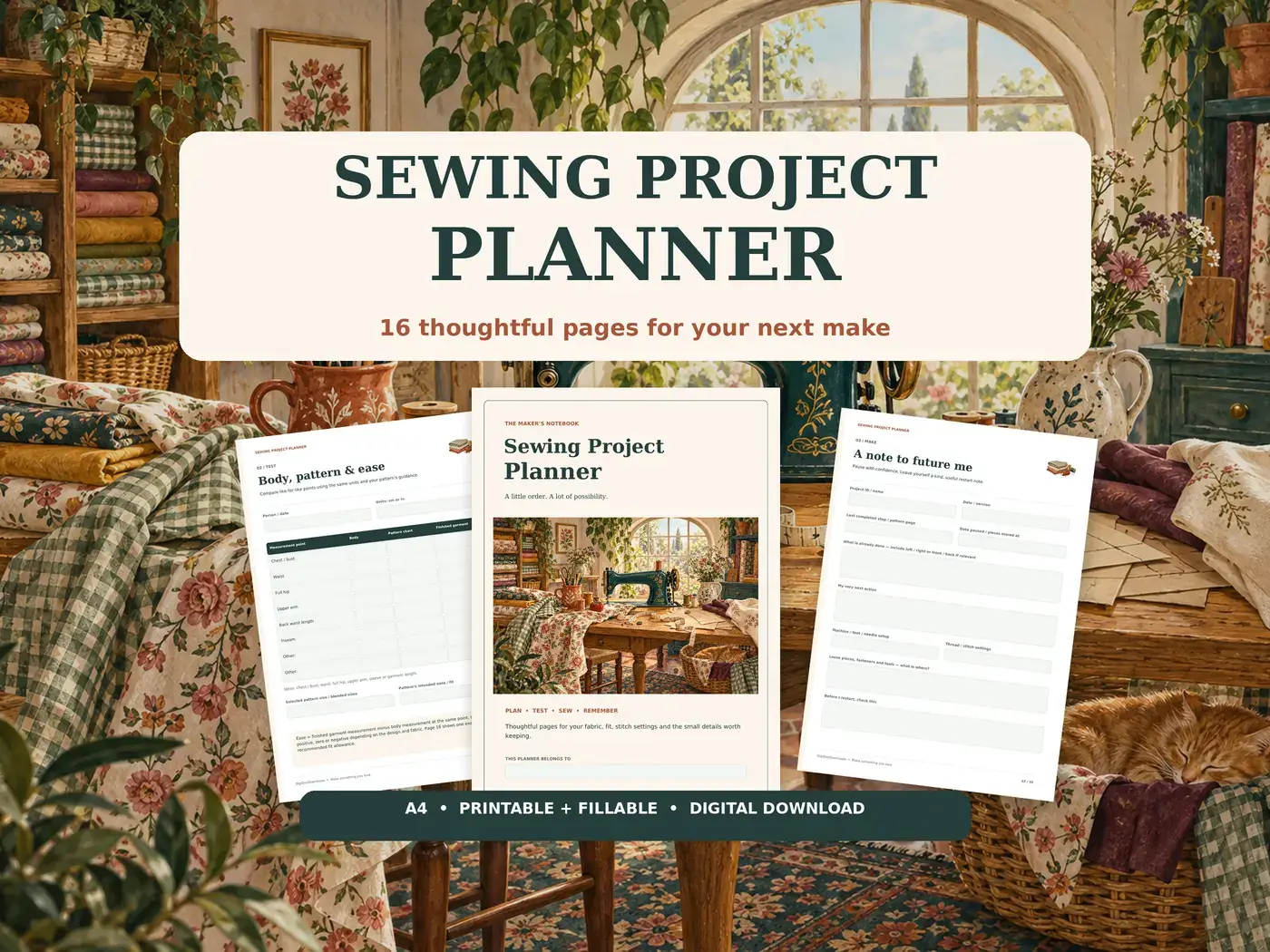
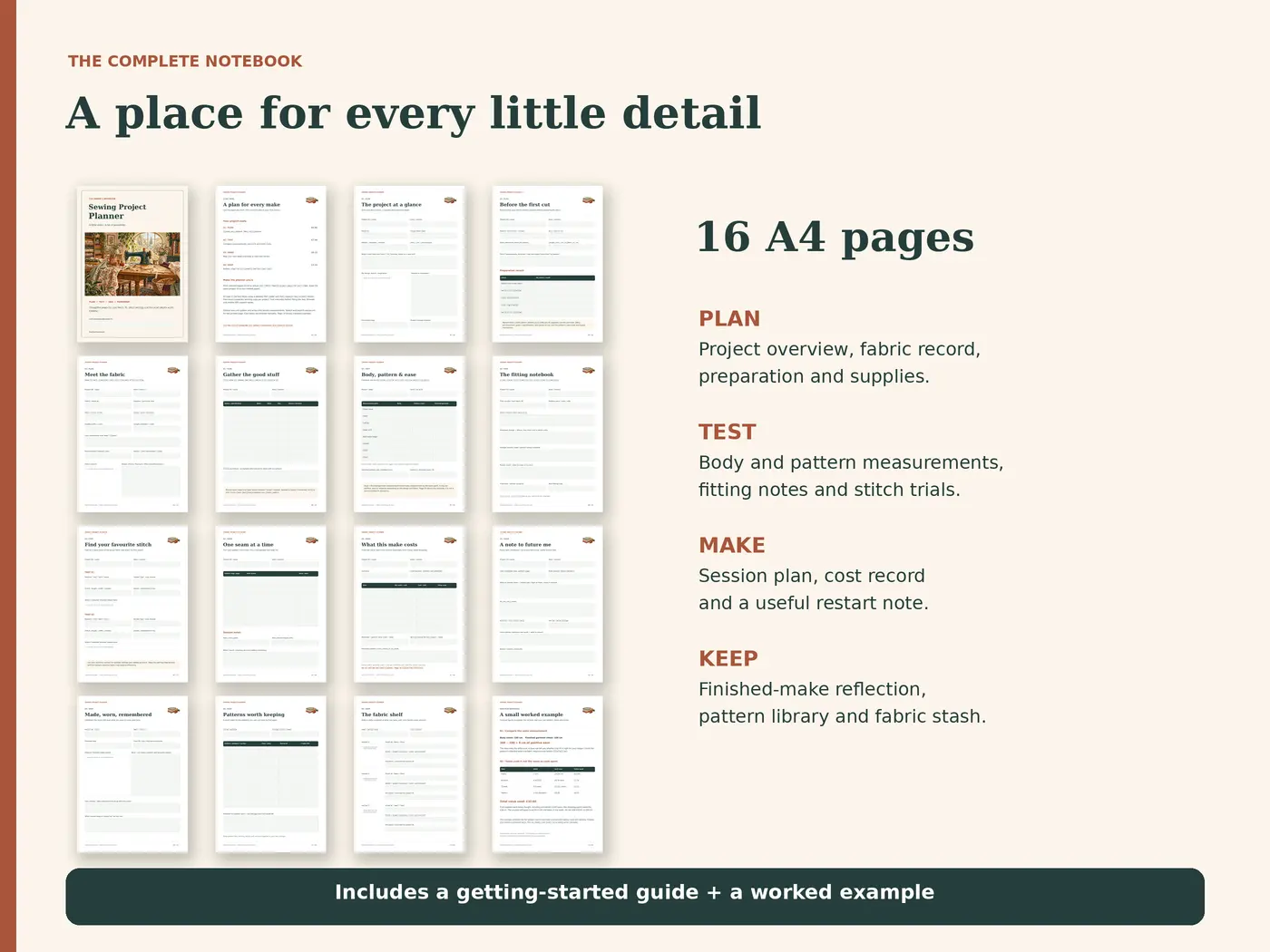
The Sewing Project Planner includes a restart page, preparation records, fitting notes and stitch-test records within its 16 A4 pages. Use the restart page to capture the current state, then add only the records needed to resolve the next step. It is a printable and fillable journal to use alongside a separate sewing pattern, not a replacement set of construction instructions.
Choose the job that removes the blockage
Ask why the project stopped. A missing fastening calls for a supply check; an unexplained fitting change needs its measurement or alteration notes; an unfamiliar technique may need a practice sample. “Finish the dress” contains all three possibilities without identifying any of them. Choose a next action with a visible result, such as locating the correct instructions or confirming which pieces form the waistband.
Before returning to machine stitching, check the machine manual and the settings suitable for the actual fabric and task. Sewing.org's Simple Seaming Techniques guide recommends a test seam on two layers of scraps from the project fabric and examining both sides. Keep the useful sample with a note of the settings. A sample made for a different fabric does not settle this project's question.
Try a bounded restart session
For example, imagine a paused skirt with its main seams joined, a waistband waiting and an unidentified zip in the bag. Start by finding the exact view and size, checking the completed steps against the instructions and identifying the required fastening. Compare the zip with that requirement. The first session's outcome might simply be a confirmed supply list and a clearly labelled next step; that is an original planning example, not a prescribed construction order.
Once the uncertainty is resolved, choose the next operation from the pattern and decide where to stop. Leave time to put pieces and notes away together. If the project no longer suits its intended wearer or purpose, record that too. Deliberately setting it aside is different from repeatedly opening the same bag and conducting the same investigation.
Leave a restart note that gives a real instruction
Before packing away, record the date, pattern and version, view and size, completed step, unresolved question and next action. Add where the pieces are stored and which settings or fitting changes must be retained. “Next: compare the zip length with the fastening requirement before attaching it” gives a future session something concrete to do. “Carry on” delegates rather a lot to your future memory.
Print the planner pages needed, or complete their text fields in a desktop PDF reader with form support. Save a fresh working copy for the project and reopen it to check your entries; browser and mobile support varies. Sketches and attached swatches belong on printed pages, and calculations are manual. Plain paper can hold the same essentials if a designed record is unnecessary.
For projects still at the preparation stage, our guide to planning a sewing project before cutting covers the earlier decisions. For a paused make, end this session with the fabric, instructions and one clear next action together. That is a practical place to begin again.
Explore Sewing Project Planner
More to read, make and discover
A few useful, interesting and checked routes into the subject.
- Pattern guidanceSewdirect: Understanding seam allowance
Pattern-company guidance defines seam allowance and explains why the actual pattern instructions matter.
- Practical sewing referenceSewing.org: Simple Seaming Techniques (PDF)
Explains seams and recommends checking stitching on two layers of scraps from the project fabric.