A good idea is not always punctual
An interesting sentence appears halfway through a book. A practical question arrives while washing up. By the time there is a suitable place to write either down, the wording has wandered off. A commonplace book offers a simple solution: give selected ideas one recognisable home, with enough context to find them again.
It need not become a diary or a complete record of everything encountered. Selection is the useful part. A few notes that remain meaningful are better than pages of quotations whose connection to your own thinking has gone missing.
Older notebooks were pleasantly various
The Smithsonian Libraries’ digitised commonplace book, dated 1723–1726, offers an original manuscript to browse. Looking at the actual pages is more revealing than reducing the practice to a fashionable notebook format. A historical object has its own arrangement, handwriting and purpose.
The Smithsonian also provides Mary Smith’s science and mathematics notes, dated around 1769–1780. This example broadens the picture: a collected notebook can hold technical learning as well as pleasing sentences. The important link is the maker’s decision that something deserves keeping.
Record why the idea caught your attention
Write the source beside a quotation, including the page or link when available. Then add one sentence of your own: “This explains why the ending felt abrupt,” or “Try this colour balance in the next project.” The comment turns a copied fragment into a useful note.
Keep quotations short and accurately marked. A paraphrase belongs in your own words, with attribution. The notebook is for remembering and thinking; collecting a long passage is not permission to republish it as original writing.
Organise for finding, not for admiration
Start with three broad headings: things to try, things to understand and words to remember. If a note fits more than one, choose the place where you would first look for it. A beautiful taxonomy is not especially helpful if recording a sentence requires a committee meeting with yourself.
Once a month, reread a handful of entries. Add a connection, move a note or leave it alone. There is no obligation to turn every saved idea into a finished project. The point is to make useful material available when it becomes relevant.
Paper and digital can serve the same purpose
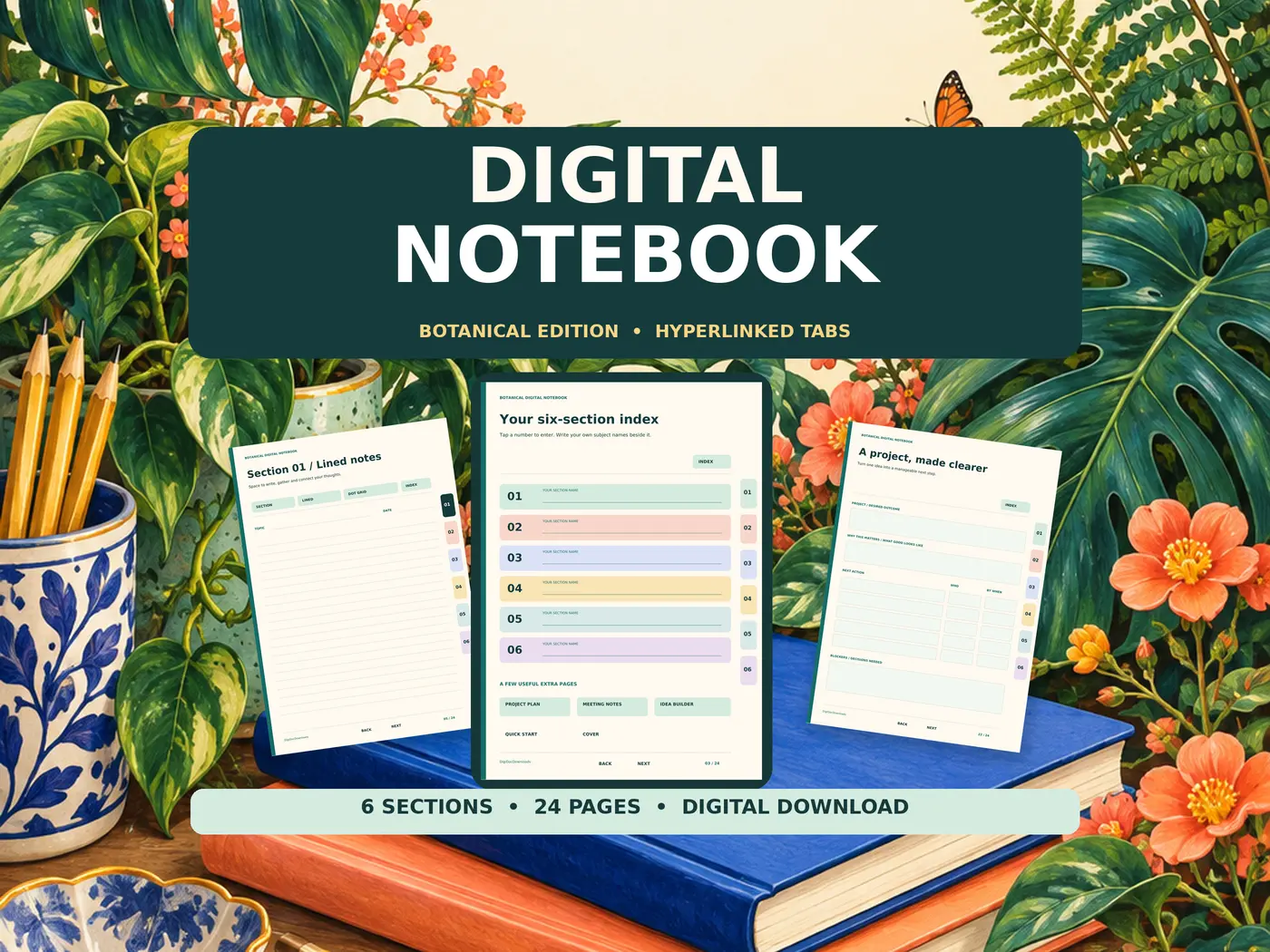
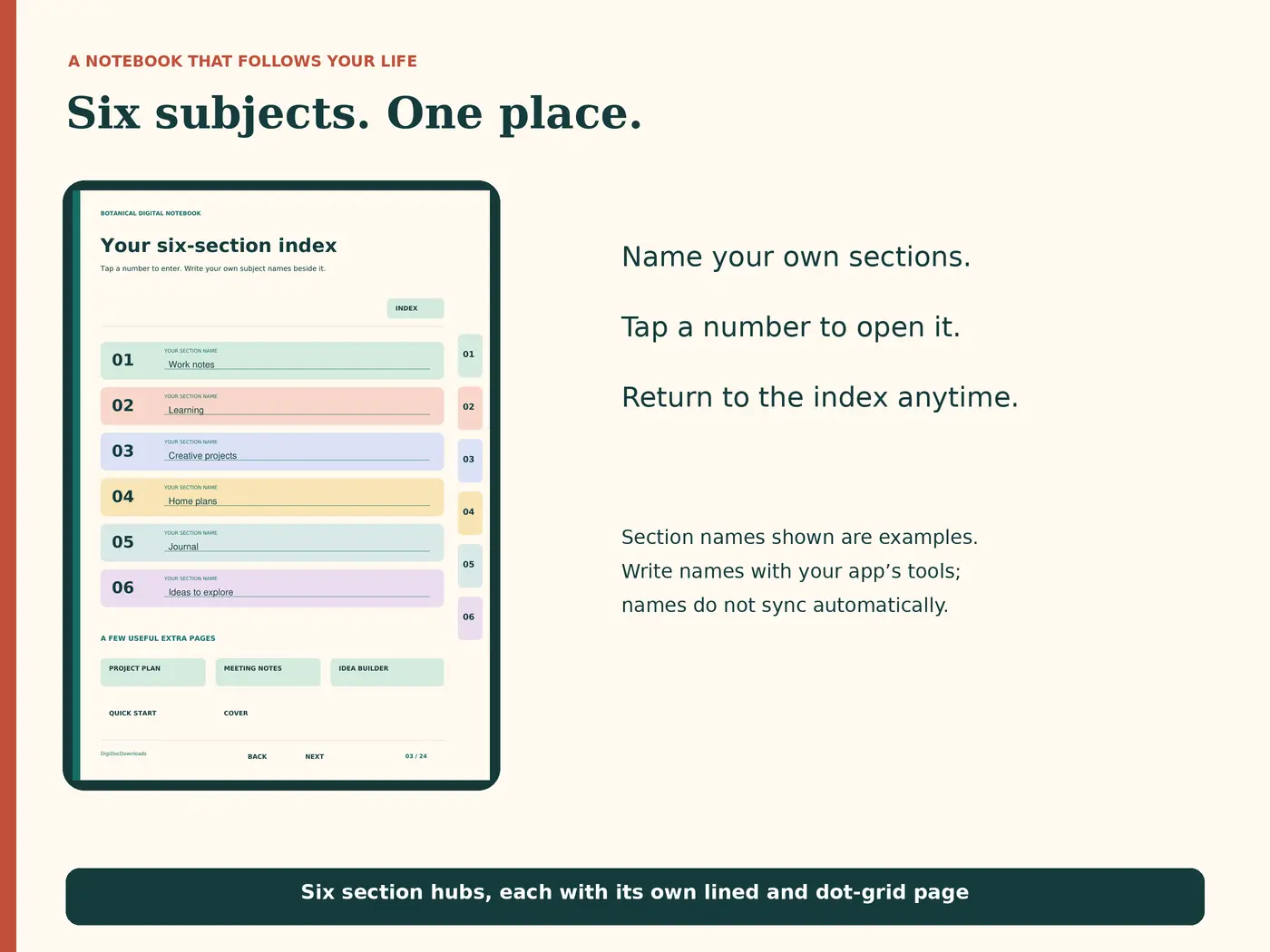
Our Botanical Digital Notebook has six linked sections, lined and dot-grid pages, plus project, meeting and idea-builder templates. Its fixed numbered tabs can provide a ready-made structure for different kinds of notes. Rename sections with an annotation app’s tools; the printed tab names do not update automatically.
It is a PDF to annotate, not a fillable database. Goodnotes’ official hyperlink guidance illustrates why app mode matters when moving around an imported document. Our digital PDF notebook guide explains testing links, writing tools and saving a working copy before committing a collection of notes.
Let the collection remain yours
A recipe question, an architectural sketch and a reading observation can sit in the same notebook without needing to justify their friendship. Add dates and sources so that the connections stay understandable later. If a page grows crowded, begin another and leave a small cross-reference.
The value is not in producing a notebook that looks scholarly on a shelf. It is in being able to return to a thought and recognise why it mattered. The idea arrived when it pleased; at least it now has somewhere to stay.
Explore Botanical Digital Notebook
More to read, make and discover
A few useful, interesting and checked routes into the subject.
- Further readingSmithsonian Libraries: a commonplace book
Browse a digitised manuscript dated 1723–1726.
- Further readingSmithsonian: Mary Smith’s science and mathematics notebook
A digitised eighteenth-century collection of scientific and mathematical notes.
- Further readingGoodnotes: hyperlinks in imported PDFs
Official guidance; features and menus depend on platform and version.