In this guide
Give the long list and the next-read list different jobs
TBR means “to be read”: books you might like to try, not a queue you have promised to finish. A recommendation from a friend, a library display and a novel mentioned in an interview can all go into the same main list. Keep the title and author together; a half-remembered cover colour is a less reliable filing system.
Then make a separate shortlist of three to five possibilities. This is the decision-making page, not a second copy of the entire wishlist. Choose books you can obtain and genuinely feel like opening soon. A long list collects possibilities; a short list gives those possibilities a useful front door.
Record why you wanted the book
Beside each title, add one brief reason: “Asha recommended the family story”, “set in a coastal town” or “an introduction to growing herbs”. These notes preserve the attraction that a title alone may not bring back. Add where the suggestion came from if returning to that person's recommendations would be useful.
Keep the fields modest: title, author, reason and availability are enough to begin. Availability might be “owned”, “library hold” or “not yet found”. Do not spend a whole reading evening reconstructing publication details you do not need. This is a personal choosing tool, not a library catalogue.
Choose by the reading experience you want now
Use a few flexible descriptions rather than an elaborate genre tree. Try “absorbing story”, “something to learn” and “short pieces to dip into”. A book can belong in more than one group. Mood is not a promise about how a book will make you feel; it is a note about the kind of reading you are looking for.
Consider the next week as well as the book. Several short gaps may suit essays or stories; a quieter weekend may leave room for a longer narrative. Use a sample or a quick look through the contents to judge whether the style suits you. Page count alone cannot tell you how demanding a book will be, and an audiobook's running time is a different measure again.
Try this five-book shortlist
Here is an original example using descriptions rather than invented published titles. The first candidate is a family novel recommended by a friend, already on the shelf. The second is a nature essay collection available from the library. The third is a beginner's gardening book with a chapter relevant to a current project. The fourth is a mystery audiobook for journeys. The fifth is a long biography that can wait until there is more time.
If this week's aim is something easy to pick up between commitments, start by sampling the essays. If the gardening question is urgent, read that relevant chapter first instead. The biography has not failed the selection process; it simply has a different moment. Write the reason for your choice so the system remains understandable when you return to it.
Let the categories change
Book organisation has long had to accommodate readers whose interests refuse to stay in neat compartments. Yale University Library's exhibition on commonplace books shows a seventeenth-century example: Robert Southwell left some subject headings unused while others overflowed, then replaced headings to suit the material he actually collected. Commonplace books gathered reading extracts under topics; they were not modern TBR lists. The useful parallel is that the headings served the reader, not the other way round.
If your “history” section contains two entries and “other” contains forty, change the headings. Equally, abandon a category that no longer helps. You need not predict all your future interests before writing down the first book.
Use a journal without completing every tracker
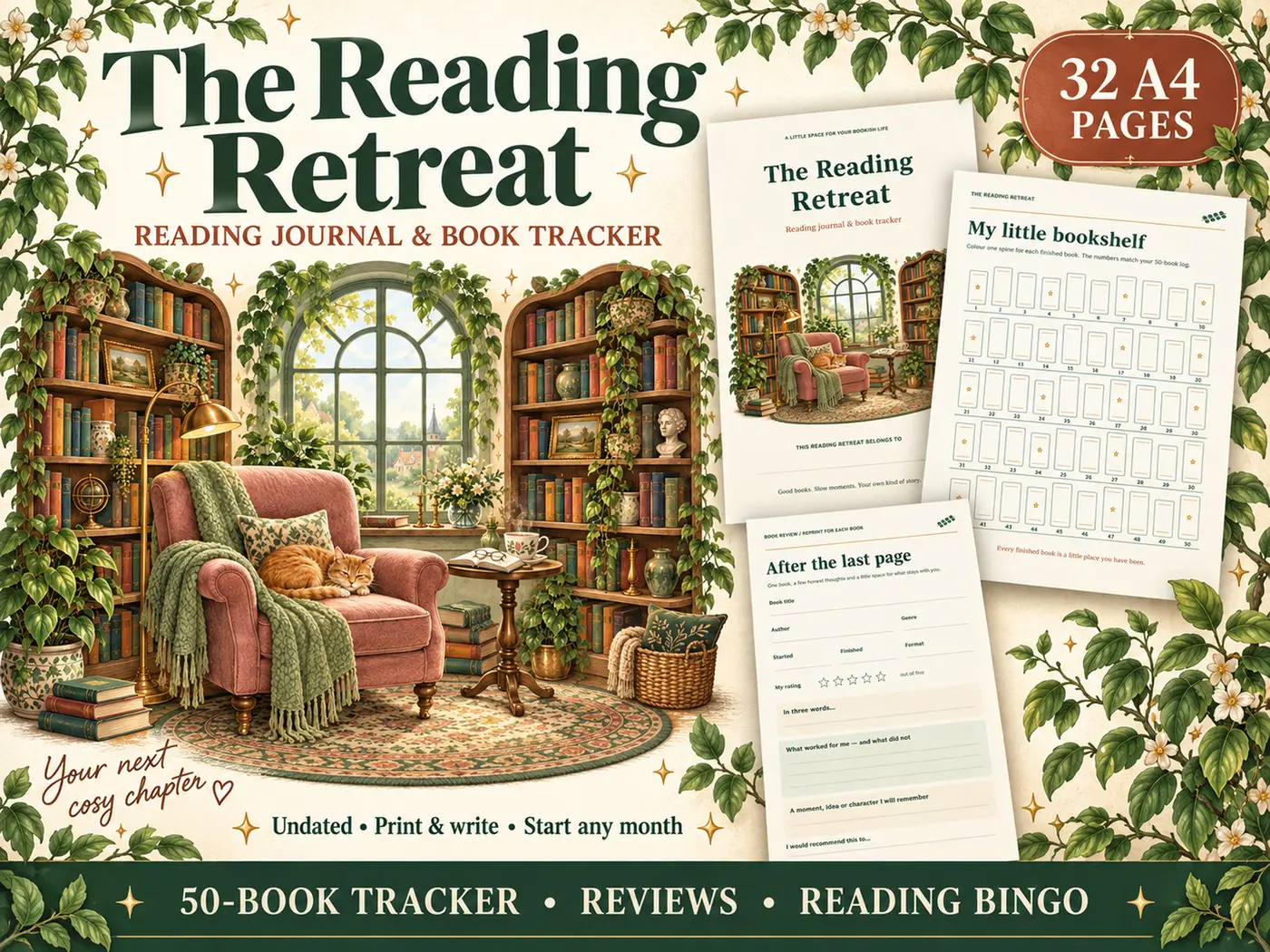
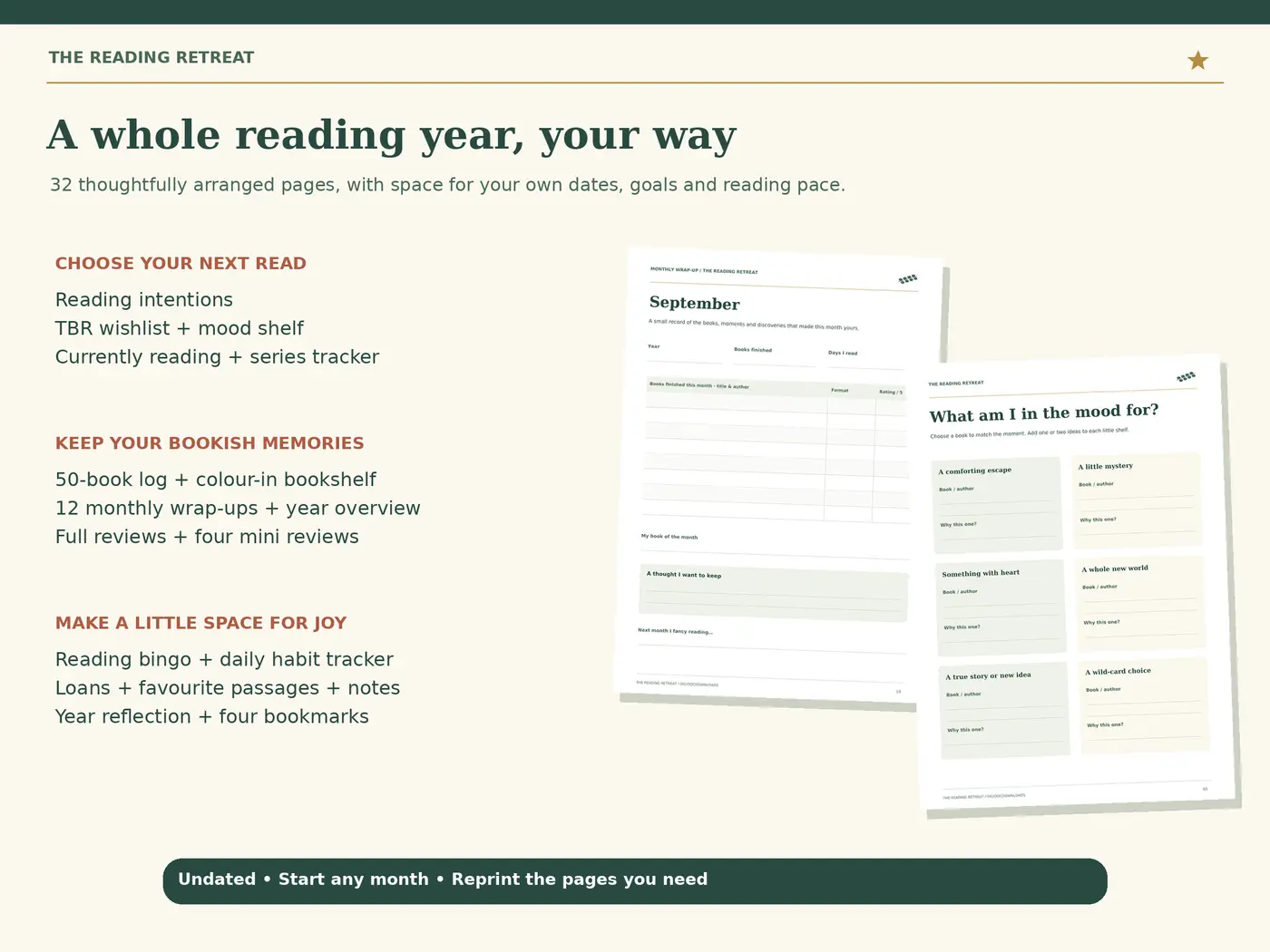
An ordinary notebook or a simple note on your phone can hold this system. For ready-made paper pages, The Reading Retreat reading journal includes a TBR wishlist, mood shelf and currently-reading pages within its undated 32-page A4 PDF. The wishlist can hold possibilities while the mood shelf helps separate the reading experiences you are considering. It is designed to print and write on by hand, not an automatically sorting app.
Its 50-book log, review pages and monthly wrap-ups can record what happened after the choice, but they need not become targets. Print the pages that support your habits rather than filling every available box. Our guide to reading notes beyond star ratings offers a different next step once you have something worth remembering.
Refresh the shortlist, not the whole system
When you finish or put aside a book, remove it from the current shortlist and choose a replacement. If a title no longer interests you, cross it out or move it to a “perhaps later” page. Keep unfinished books distinct from finished ones without turning the distinction into a judgement.
At the next monthly check-in, ask whether the shortlist helped you find something you wanted to read. If not, reduce the number of fields or change the categories. Leave yourself one clear next action: borrow the essay collection, open the owned novel or sample the audiobook. Then close the list and read.
Explore Reading Journal & Book Tracker – The Reading Retreat
More to read, make and discover
A few useful, interesting and checked routes into the subject.
- Reading historyYale University Library: commonplace books
An exhibition about early modern English reading shows how Robert Southwell adapted topic headings when his notes outgrew the allotted space. A historical example of flexible organisation, not an origin claim for TBR lists.