In this guide
- Start with the six things a guest may need in sixty seconds
- Make arrival instructions follow the guest’s actual route
- Keep safety information clear, specific and separate
- Explain house systems one room at a time
- Give local recommendations a reason to exist
- Describe access with useful facts, not broad promises
- End with one calm checkout page
- Review the book as if you have just arrived
Start with the six things a guest may need in sixty seconds
The first page should answer the questions that become urgent when somebody is tired, cold or balancing a suitcase against the front door. Give the property’s full address, the best host contact, Wi-Fi details, the simplest heating instruction, the checkout time and where to find emergency information. If mobile reception is unreliable, say so here rather than leaving guests to discover it one disappearing signal bar at a time.
Use short labels and put one action beneath each. ‘Heating: press the up arrow to 20°C’ is more useful than a paragraph about the boiler’s distinguished career. Repeat the most important details on any relevant display sign, but keep the front page as the single place a guest can use when they are unsure where to begin.
Make arrival instructions follow the guest’s actual route
Write arrival notes in the order a visitor encounters them: how to recognise the entrance, where to park, how to reach the door, how the key or lock works and what to do if access fails. Include landmarks only when they are stable and unambiguous. ‘Turn after the red post box’ is helpful; ‘turn where the old café used to be’ asks rather a lot of a first-time guest.
Mention steps, gravel, narrow gates, dim paths or lifts before arrival. These are practical facts, not decorative detail. A guest deciding which bag to carry first will appreciate knowing about twelve stone steps rather more than knowing the hallway paint is called Sea Whisper.
Keep safety information clear, specific and separate
Give guests a short, unmistakable section explaining what to do if there is a fire, how to leave the property, where the agreed assembly point is and how to contact emergency services. The Home Office’s current fire-safety guide for small paying guest accommodation in England says guests should receive clear fire procedures. It also notes that a simple plan drawing may help and that precise location information can matter when a postcode does not identify the property accurately.
A welcome book does not replace a suitable, sufficient and property-specific fire risk assessment or the rules that apply where the accommodation is located. The linked guidance covers England; official requirements and guidance differ in Wales, Scotland and Northern Ireland. Treat the guest page as the clear communication of a checked plan, not as the plan itself.
Explain house systems one room at a time
Group instructions by where the guest will use them: kitchen, living room, bedrooms, bathroom and outdoor space. Concentrate on controls that are unfamiliar, easy to misuse or specific to the property. Guests should not have to play detective with an induction hob, but they probably do not need a tutorial on opening a cutlery drawer.
For each system, use the same small pattern: what it is, the first action, one useful limit and who to contact if it does not work. A photograph or labelled diagram can help when several switches look alike. Keep manufacturer manuals available separately; the welcome book should point to the right answer without becoming an archive of every appliance ever purchased.
Give local recommendations a reason to exist
Organise local suggestions by real guest needs: breakfast, an easy supper, a rainy afternoon, a walk without a car, groceries and out-of-hours essentials. Add one useful sentence to each choice. ‘Small bakery, five minutes on foot, good for early coffee’ tells a guest why it made the list. A bare procession of business names could have been produced by any map app.
Check opening days, seasonal closures, booking requirements and accessibility information before publication, then date the page internally so it is easy to review. Link to the venue’s own current page where possible rather than copying long details that may change. Two reliable recommendations beat twelve charming establishments that closed last winter.
Describe access with useful facts, not broad promises
Record the details a guest can act on: number of steps, handrails, path surface, doorway widths if measured, shower type, lighting, parking distance and the quietest contact method. VisitEngland’s guidance on accessible and inclusive communication recommends concise language, consistent terms, supporting images, clear contrast and offering several ways to make contact.
Ask what access requirements would make the stay work rather than asking for a diagnosis. Be exact about what the property offers and what it does not. ‘Three steps at the entrance; no handrail’ is more informative than ‘easy access’, which may mean something entirely different to the person reading it.
End with one calm checkout page
Put the checkout time, key return, bins, used towels, windows and any essential appliance steps on one page. Mark requests as requests and true requirements as requirements. A short list protects the property and reduces uncertainty; an elaborate final-day obstacle course merely ensures the last memory of the stay involves sorting recycling under pressure.
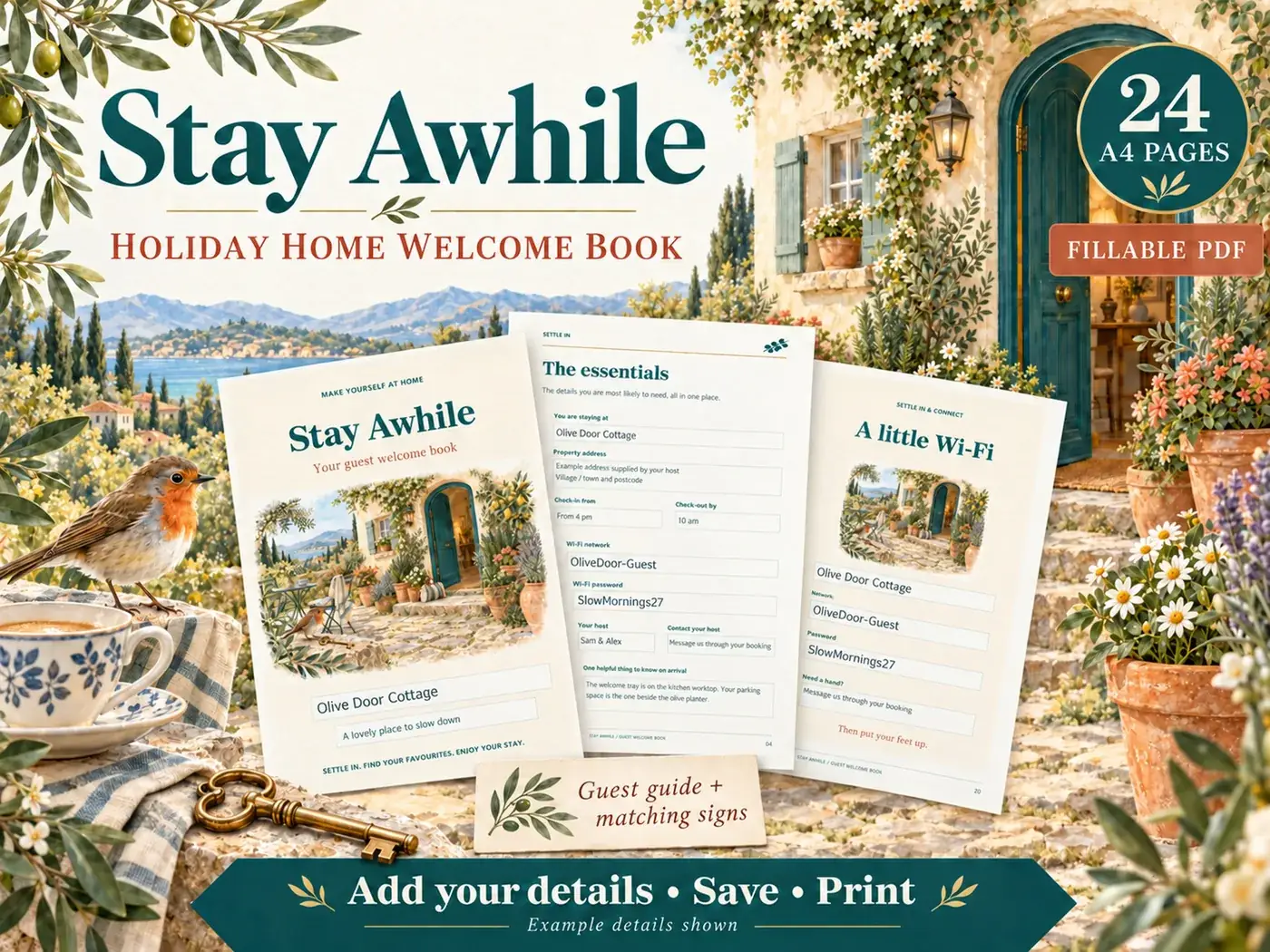
The Stay Awhile holiday-home welcome-book template provides 24 coordinated A4 pages, including 19 guest-book pages, matching Wi-Fi and checkout signs, an extra property-notes page and two host preparation pages. Its blank fields can be completed in a desktop PDF reader with form support, while headings, artwork and layouts remain fixed. Use only the pages that suit the property, and check every filled detail before printing.
Review the book as if you have just arrived
Read the finished guide from the front door onwards. Can a guest find Wi-Fi without searching the kitchen section? Is the emergency location complete? Do the heating note and checkout sign agree with the main pages? Ask somebody unfamiliar with the property to find three answers and notice where they hesitate.
Review contact details and local recommendations at least each season, and update the book whenever an appliance, access route or house rule changes. Keep the revision date on a host-only checklist. If you want more practical ways to make downloads and plans easier to use, the DigiDocDownloads Guides collect clear, source-checked ideas without requiring a shopping basket.
Explore Holiday Home Welcome Book – Stay Awhile
More to read, make and discover
A few useful, interesting and checked routes into the subject.
- Guest fire informationGOV.UK: Making your small paying guest accommodation safe from fire
Current Home Office guidance for small paying guest accommodation in England, including clear guest fire procedures and useful location information for emergency calls.
- Accessible guest communicationVisitEngland: Accessible and inclusive communication
Practical guidance on concise language, readable type, consistent terms, useful images and offering more than one way to make contact.