Start with the kitchen, not the entire life
“Tell me about your childhood” is generous in intention and enormous in scope. A person has to decide where to begin, what matters and how much detail to supply. “Where did everyone sit at the kitchen table?” offers something smaller to hold. A chair, a window or a particular cupboard can bring a room into view.
Everyday questions are useful because they leave space for stories to emerge. They do not guarantee a dramatic recollection, and they need not. Knowing how an ordinary day worked can make family history more vivid than another list of dates.
A conversation belongs to both people
The Oral History Association’s principles put preparation and respect at the centre of recording people’s memories. For a small family project, decide together what you are doing: private notes, an audio recording or a book shared with relatives. Agreement should come before the recorder does.
Its guidance for interview participants also offers a useful change of perspective. The person answering has choices about the topics and use of their words. A family connection does not remove the need to ask whether recording and sharing are welcome.
Objects can make questions specific
A photograph, recipe or familiar object gives the conversation a starting point. Ask who used it, where it was kept or what happened just before the picture was taken. If nobody knows, write “unknown” and carry on. Guessing confidently does not improve the archive.
The Library of Congress’s family preservation guide helps with caring for original material. Use a copy during a busy conversation if the photograph or document is fragile. Keeping it safe and recording the story are related tasks, but they are not the same task.
Keep the phrases that carry personality
When writing up an answer, preserve a distinctive expression if the speaker is happy with it. “We made do” and “we managed” can describe the same broad situation while carrying different rhythms and emphasis. Smooth every phrase into formal prose and the account may lose the person who supplied it.
At the same time, distinguish a direct quotation from your summary. Read a short passage back and ask whether it feels accurate. The purpose is to keep meaning, not to produce a theatrical transcript of every pause or hesitation.
A prompt book can reduce the blank page
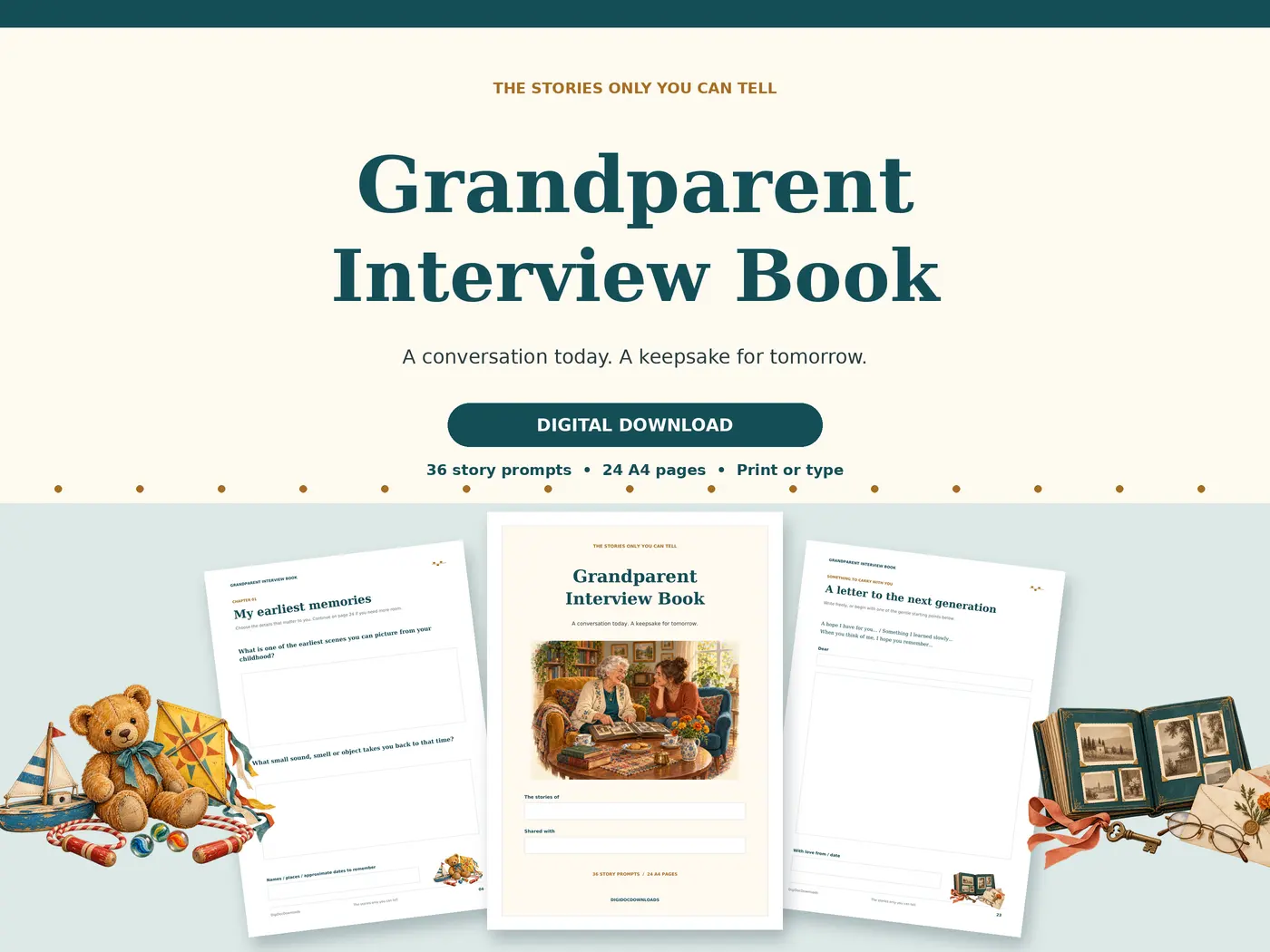
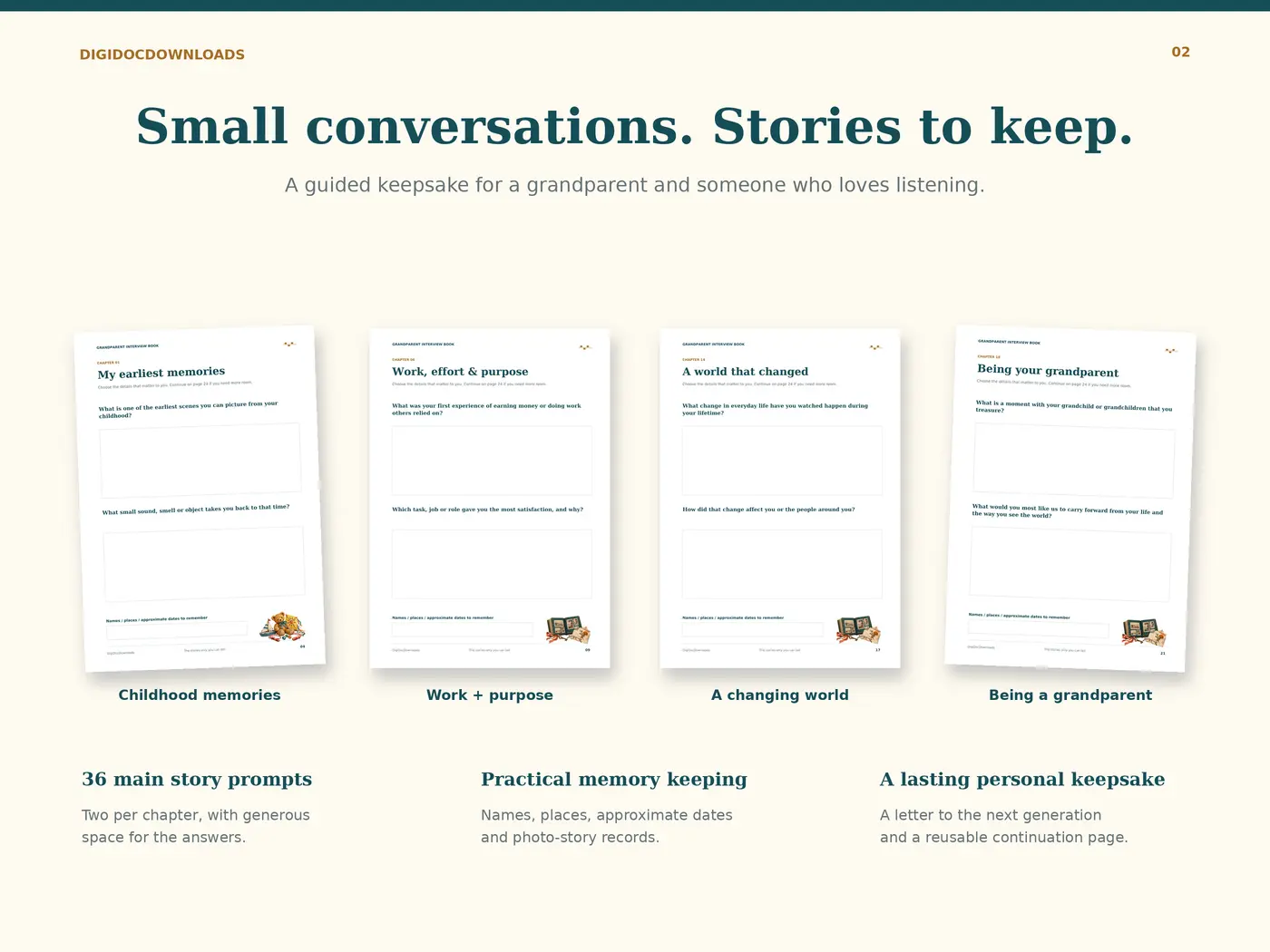
Our Grandparent Interview Book provides 36 story prompts within a 24-page A4 PDF. Choose a few for a conversation rather than treating all of them as a questionnaire to complete. It supports handwritten answers or text fields in a compatible desktop PDF reader; the photo area takes an attached printed photograph.
The practical grandparent-interview guide gives a short first-session plan, including permission, pacing and a follow-up note. A useful prompt removes the need to invent every question; it should not dictate where a willing storyteller is allowed to wander.
Leave room for more than one memory
Relatives sometimes remember the same event differently. Keep the accounts attributed: “Pat remembers…” and “Alex recalls…”. That approach is clearer than merging them into one apparently certain version. Later evidence may clarify a date, but uncertainty need not prevent a story being worth keeping.
Finish while the conversation still has energy. Record one detail to ask about next time and send a copy of the notes for corrections. A small, accurate account of a kitchen table can be a fine beginning; the whole life can wait for another afternoon.
Explore Grandparent Interview Book
More to read, make and discover
A few useful, interesting and checked routes into the subject.
- Further readingOral History Association: principles and best practices
Planning, consent and respect for the narrator’s own words.
- Further readingOral History Association: interview participants
The person telling the story should understand and choose how it is used.
- Further readingLibrary of Congress: preserve family records
Care for original family documents, photographs and objects.