A family time capsule is a conversation with people you already know, just several years later. Its charm rarely comes from a perfect summary of world events. It comes from handwriting, peculiar household phrases, the snack somebody requested every day for six months and a confident prediction that proves gloriously wrong. The aim is not to curate a museum in one afternoon. It is to preserve enough honest detail for your future family to recognise the people you were.
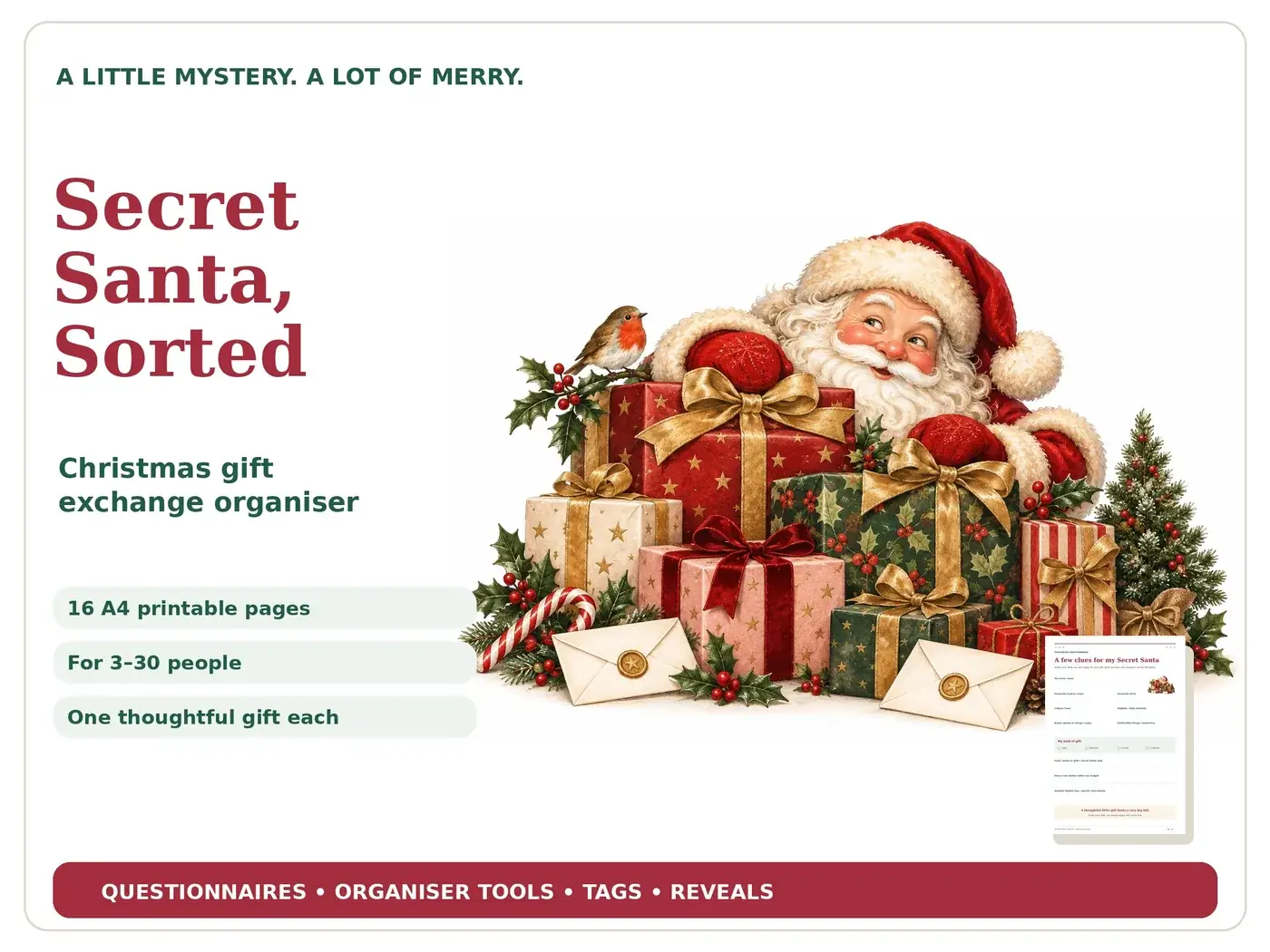
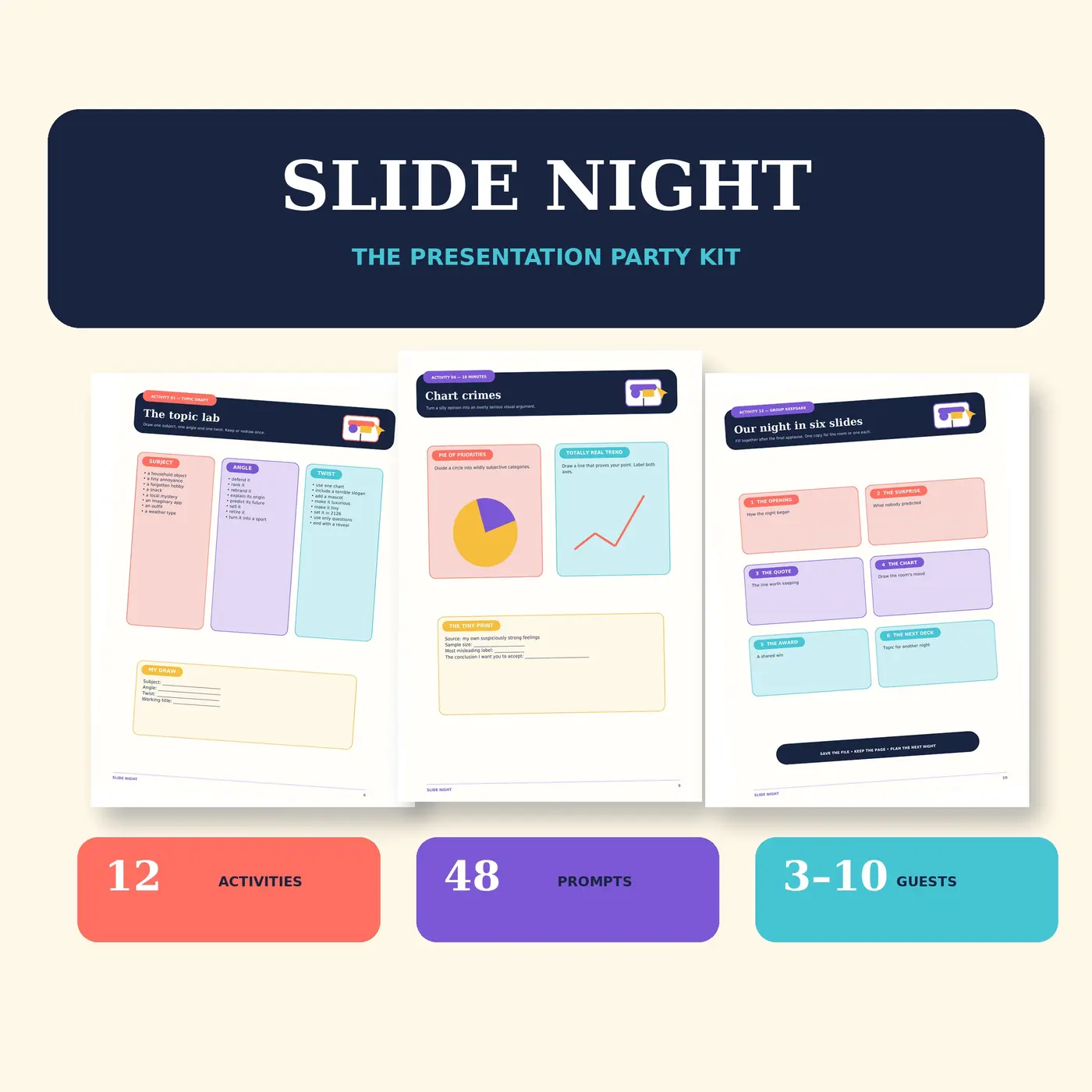
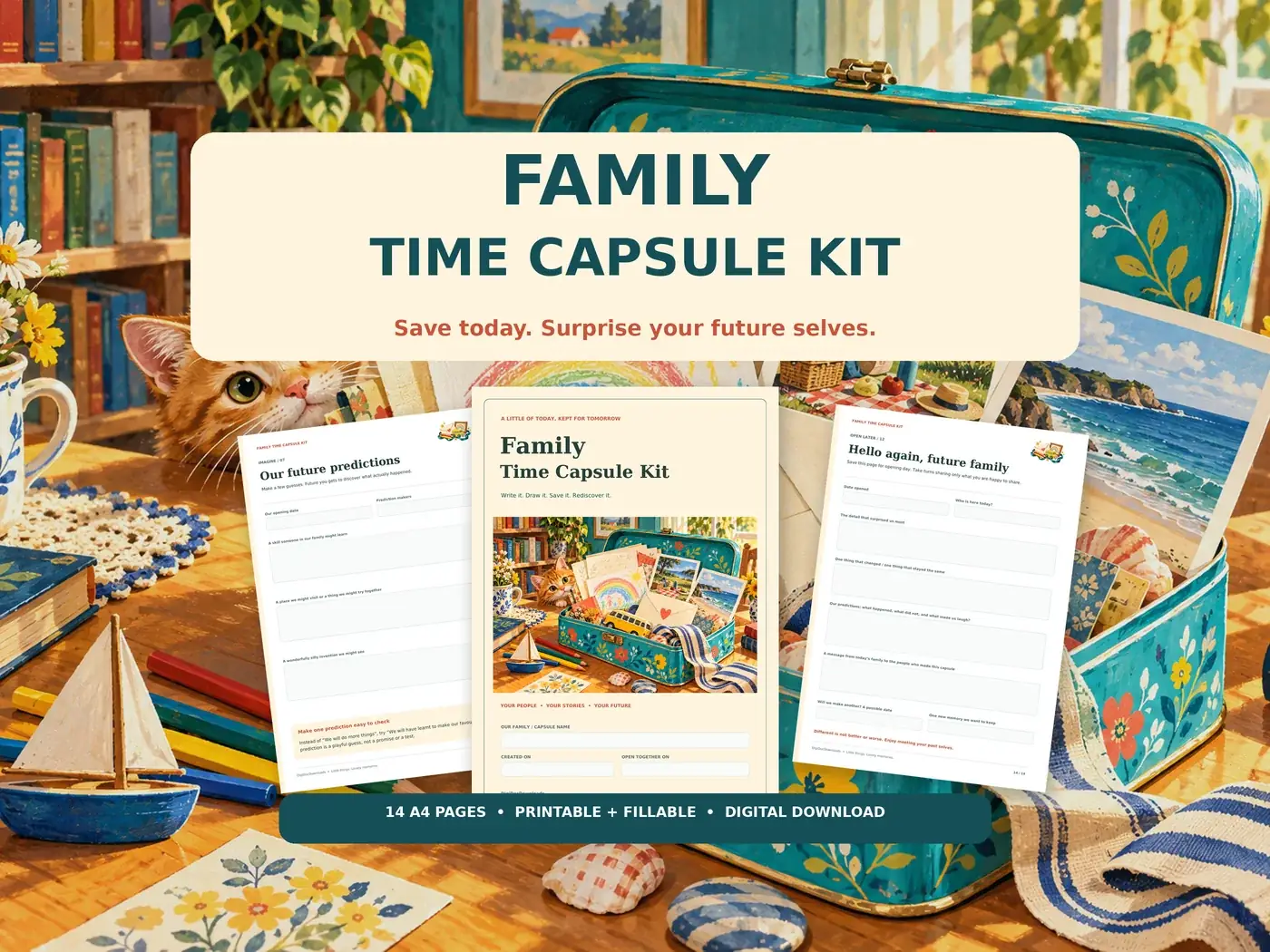
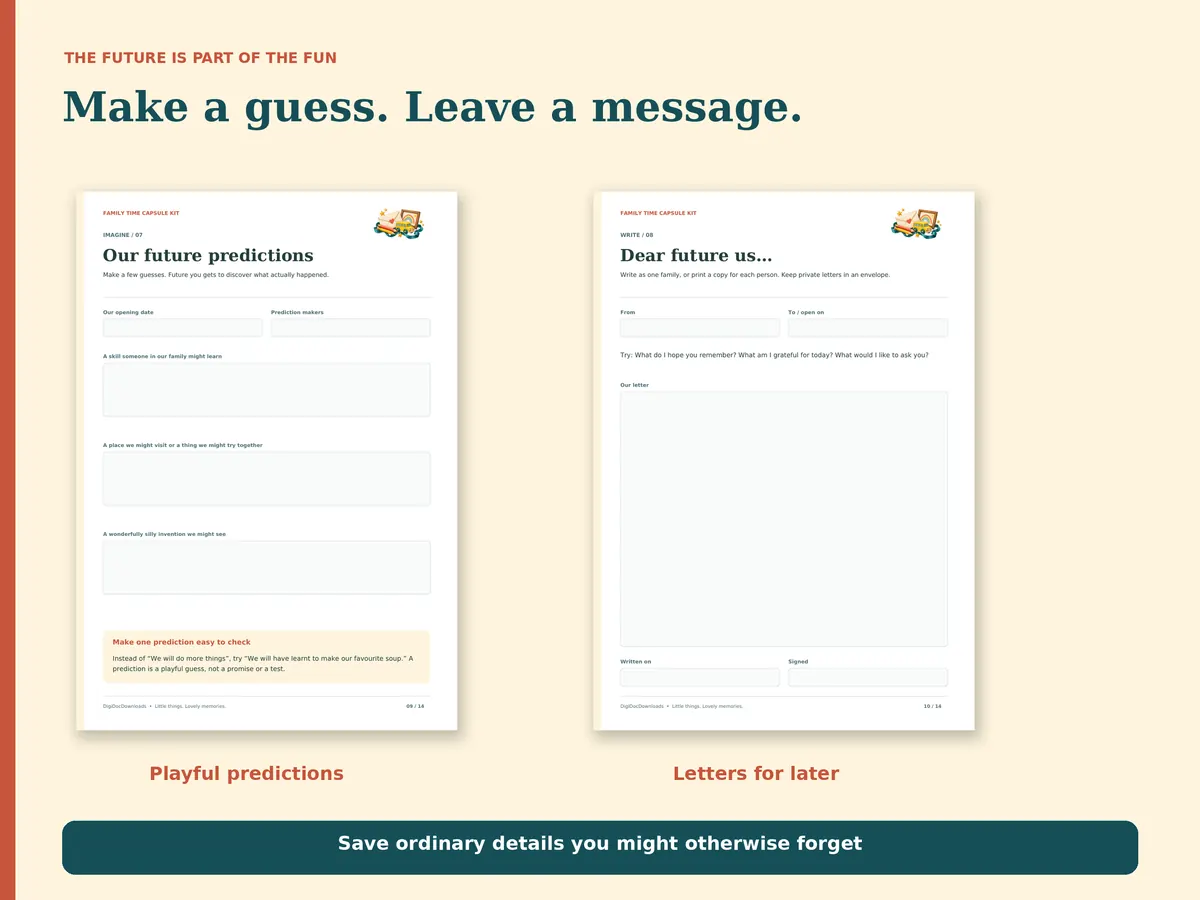
This guide gives you a complete home plan that works with plain paper and a sturdy box. If you prefer a coordinated set of prompts, the Family Time Capsule printable kit contains 14 illustrated A4 pages for family snapshots, personal prompts, drawing space, everyday memories, favourites, playful predictions, letters, an inventory, storage record, sealing page and opening-day reflection. You can print only the pages that suit your household. The PDF also has text fields for use in a desktop PDF reader with form support, although drawing, photo and tick-box spaces are intended for print.
Choose a purpose before choosing the contents
Decide what you want the capsule to mark. It might capture an ordinary weekend, a new home, the end of a school year, a birthday, a reunion or the beginning of a family tradition. An everyday capsule often ages particularly well because it records details that nobody thinks to save elsewhere: who sits where, which song gets requested in the car and what currently counts as an unacceptable vegetable.
Write one sentence at the top of the plan: “We are saving a picture of our family in October 2026 to open when…” That sentence settles the date, audience and scale. A capsule for next year can include fragile jokes and near-term predictions; one intended for a decade deserves clearer labels, stronger storage and fewer objects whose future behaviour is uncertain.
Set an opening date people can realistically remember
Choose a date with a natural reminder attached: the same birthday five years later, the final day of primary school, a future anniversary or the first weekend of a particular month. For younger children, one to three years is long enough to feel remarkable without becoming abstract. Older families may enjoy five or ten years. Avoid a heroic fifty-year promise unless someone is genuinely prepared to look after the box and its record.
Record the opening date in at least three places: on the sealing page, on the outside label and in a calendar that will survive a change of phone. Tell another relative where the capsule lives. A secret location is exciting for approximately the length of time it takes everybody to forget the secret.
Capture one ordinary day in useful detail
Begin with facts that seem too ordinary to deserve recording. List the breakfast table, the journey to school or work, favourite clothes, current books, games, television, music, hobbies, pets and a typical Saturday. Add prices only when you can copy them accurately from a receipt; an actual café bill or handwritten shopping list tells a clearer story than an approximate claim remembered later.
Ask each person to describe the home through their own eyes. Which room feels cosiest? What sound means somebody else has arrived? What object is always missing? Let younger children draw a floor plan, their lunch or the view from a window. Adults can add a few lines about routines they suspect will change. The National Museum of Australia's time-capsule activity suggests looking to family, friends, hobbies and pets for ideas; those themes work because they connect a date to lived experience.
Ask questions that produce stories, not school reports
Use prompts with room for a specific answer. “What are you proud of this year?” is more revealing than “How are you doing?” Ask what made each person laugh recently, what they can now do that once felt difficult, what they hope never changes and what they would teach their future self. Include a choice between two harmless possibilities — seaside or mountains, pancakes or toast, early bird or determined duvet resident — then ask why.
Do not correct spelling, grammar or drawing unless the writer asks. Handwriting and phrasing are part of the record. A child may dictate while an adult writes, then add their own mark, picture or signature. Give everyone permission to skip a question and keep private matters out of a shared capsule. Honest does not have to mean exposed.
Write letters with a clear future reader in mind
Address each letter to a named person and opening date. Start with where you are writing, who is nearby and what happened earlier that day. Then include three things: something you appreciate now, something you wonder about the future and one piece of kindness for the reader. Predictions can be funny, but a letter becomes more valuable when it also carries reassurance, affection or a useful memory.
Adults can write to children without trying to forecast careers, relationships or personalities. Describe what the child enjoys, the small habits you love and a recent moment that showed their character. Children can write to adults too. Their view of the household may contain both touching wisdom and a firm request that future parents improve the pudding arrangements.
Make predictions that can be checked on opening day
Mix personal questions with wider ones, and make them specific enough to revisit. Predict a favourite hobby, the height of a growing child, whether a pet will still steal the same chair, a journey the family might have made or an everyday technology that could change. Record the date and the predictor beside every answer. Avoid turning uncertainty about health, money or relationships into entertainment.
Give each person a few serious predictions and one deliberately extravagant one. On opening day, classify them as right, partly right, wrong or impossible to judge. The point is not to crown a household oracle. It is to notice which futures felt plausible from the starting line.
Choose photographs and small objects with restraint
Take one group photograph, one picture of the home and several close details: shoes by the door, a favourite mug, a much-used toy, the family noticeboard or the contents of a school bag. Print captions with names, date, place and the reason each image matters. A future viewer should not have to identify the year from a haircut alone.
If you include physical objects, choose clean, dry, stable items that are inexpensive and replaceable: a ticket, a postcard, a paper label, a small drawing or a copy of a recipe. Exclude food, liquids, batteries, plants, soil, medicines, cosmetics, rubber bands, adhesive tape and anything damp or dirty. Keep irreplaceable originals, jewellery, official documents and the only copy of a treasured photograph elsewhere. A time capsule should preserve memories, not hold them hostage.
Store paper and photographs with preservation in mind
The Library of Congress time-capsule guidance recommends packaging individual items, or groups of similar items, in suitable acid- and lignin-free paper enclosures or stable uncoated plastics to reduce unexpected interactions. For a home project, keep photographs separate from newspaper clippings, receipts, craft materials and objects with inks or adhesives. Label enclosures in pencil before putting the contents inside.
The US National Archives family-archive advice offers straightforward care guidance for papers and photographs, while the Library of Congress recommends photo-safe boxes and enclosures. Use clean, dry hands, avoid paper clips, elastic bands and ordinary sticky tape, and do not laminate original photographs or letters. When an object has uncertain materials, photograph it and include the labelled print rather than sealing the object with the paper.
Place the completed enclosures in a sturdy archival-quality box or other suitable indoor container. Store it in a cool, dry, dark, stable part of the home, away from direct sunlight, radiators, pipes, kitchens, bathrooms, attics, garages and damp basements. Do not bury an ordinary domestic box: soil, water, insects, temperature changes and future gardening make poor custodians.
Create an inventory before sealing
Number every envelope and write a simple inventory: item, contributor, date, material and any handling note. Add the opening date, storage location and the name of the person who will look after the capsule. Photograph the laid-out contents and keep that image outside the box. The inventory prevents a future mystery in which a blank-looking envelope is discarded moments before somebody remembers what it contained.
Let everyone sign the sealing page, then close the box in a reversible way. There is no need to cover it with layers of tape or wax unless the household enjoys wrestling with packaging. A paper band, ribbon or signed label can show whether it has been opened while allowing the container to be checked if the storage area suffers a leak or other problem.
Plan the opening day while the original day is fresh
Write a short running order and store a copy outside the capsule. Begin with the group photograph and memory pages, then open letters privately or aloud according to the writer's instruction. Compare predictions without mocking younger contributors, identify objects from the inventory and finish with the opening-day reflection. Take a new photograph in roughly the same place if possible.
Decide whether to retire the capsule, replace fragile copies or create a new one beside it. The opening is not a test of whether the family became exactly what it expected. It is a chance to notice continuities, surprises and people who may not be present. Leave space for mixed feelings and let participants choose what they share.
Family time-capsule checklist
- Choose the occasion, future audience and realistic opening date.
- Record ordinary routines, favourites, handwriting and drawings.
- Write named letters with affection, questions and a clear date.
- Make specific predictions that can be checked later.
- Print and label photographs with people, place and date.
- Include only clean, dry, stable and replaceable objects.
- Keep irreplaceable originals and official documents elsewhere.
- Package photographs, papers and other materials separately.
- Use an inventory and photograph the contents before sealing.
- Store the box indoors in a cool, dry, dark, stable place.
- Record the location and opening date outside the capsule.
- Plan an opening ritual that respects private letters and mixed memories.
A successful family time capsule does not need rare objects or sweeping declarations. It needs names, dates, context and the texture of an ordinary life honestly recorded. Save the handwriting, label the photographs, protect the paper and make the opening plan before enthusiasm wanders off. Future you will supply the historical importance.
More to read, make and discover
A few useful, interesting and checked routes into the subject.
- Time-capsule preservationLibrary of Congress: Making a Time Capsule
Practical preservation guidance for choosing and separately packaging time-capsule contents.
- Family archive careUS National Archives: How to Preserve Family Archives
Simple guidance for handling and storing family papers and photographs.
- Photograph careLibrary of Congress: Care, Handling and Storage of Photographs
Collections-care advice on photo-safe enclosures, handling and storage conditions.
- Time-capsule ideasNational Museum of Australia: Time capsule
A museum activity suggesting family, friend, hobby and pet themes for a home time capsule.