1. Choose one question
Begin with a question narrow enough to test: does a gentler launch change where the plane lands, or does correcting one uneven wing reduce turning? Choose one. If the paper, folds, launch angle and thrower all change together, the result cannot identify which difference mattered.
NASA’s glider explanation gives the right starting category: a paper plane is unpowered after launch. Use that description even if the design looks like a rocket. The experiment is about paper flight, with limitations that are interesting rather than embarrassing.
2. Prepare a repeatable baseline
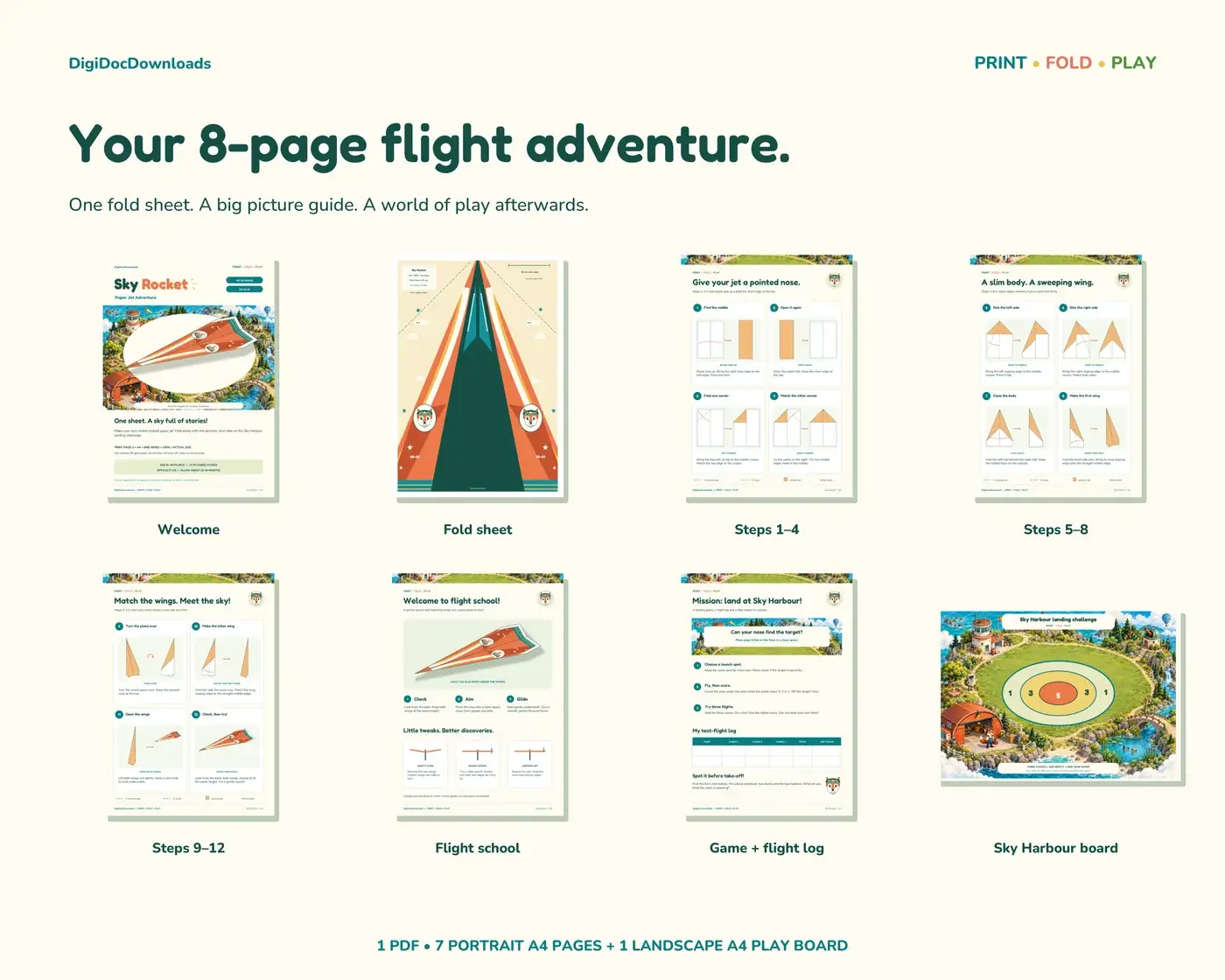
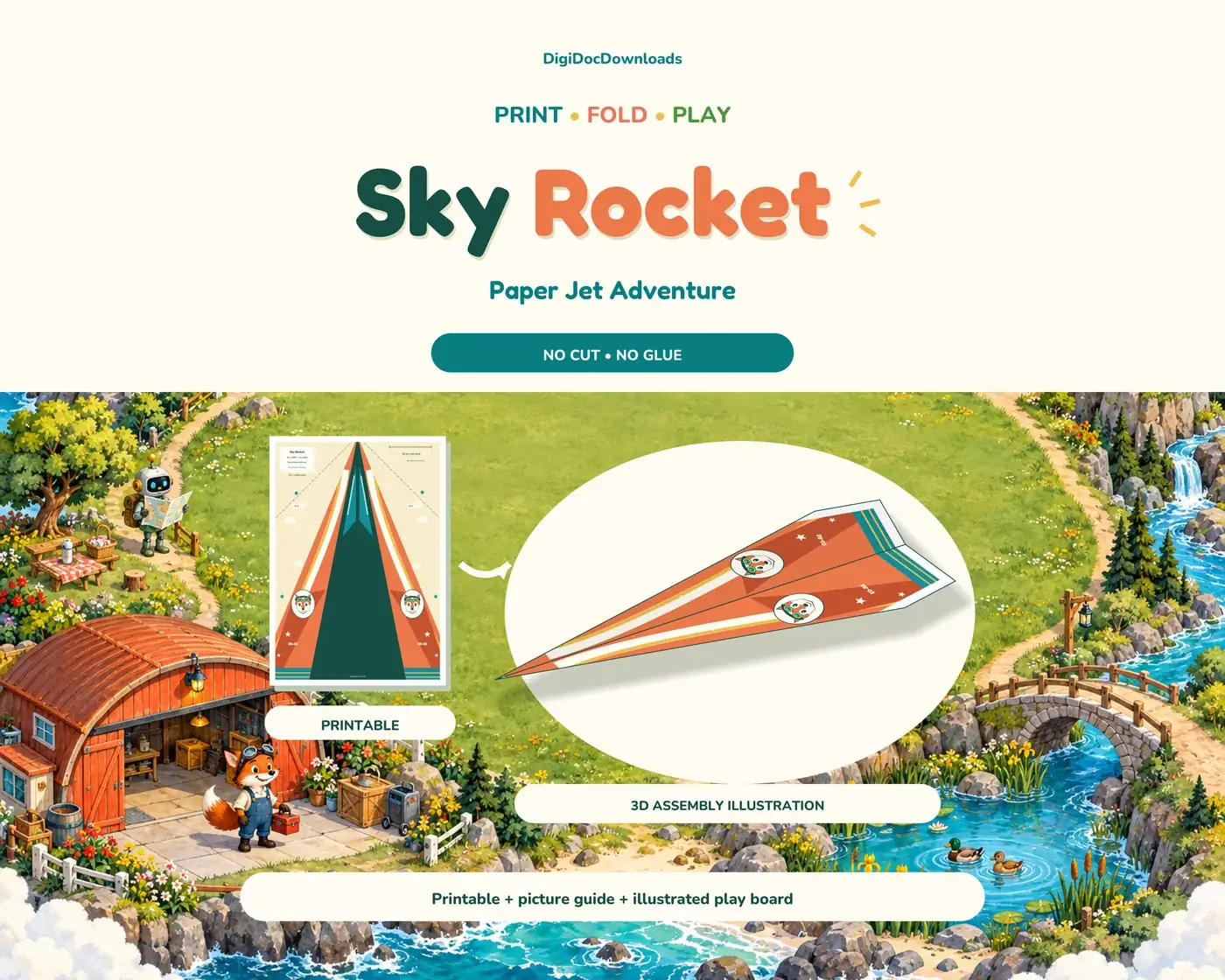
Use the same printed model and specified paper for both versions, or make one plane and carefully record its before-and-after adjustment. Our Sky Rocket specifies ordinary 80 gsm A4, single-sided printing at Actual Size and a 50 mm check line. Print the folding sheet; instructions can remain on screen.
Follow its twelve illustrated stages without trimming the sheet. Compare the completed left and right sides before testing. Label the starting version A and the changed version B on your record. A pencil note on a separate sheet is sufficient if you do not want to mark the plane.
3. Set a clear launch area
Choose a space away from people, pets, breakable objects and stairs. Mark a launch line with a visible object that does not create a trip hazard. Launch gently from the same place, with the same person where practical. Stop whenever someone enters the flight area.
Decide what you will measure: distance to first landing, direction or a marked target zone. Use the same definition for every attempt. Measuring “the farthest point after sliding” on one flight and “first contact” on another quietly changes the question midway through the experiment.
4. Record three flights for each version
Use the kit’s three-flight log for version A, then a fresh copy or another clearly labelled record for B. Write each result, including an unexpectedly short flight. Note obvious interruptions such as a gust or accidental bump, and decide whether to repeat that attempt without silently removing it.
For an illustrative distance comparison, A might record 2.1, 2.4 and 1.8 metres; B might record 2.0, 2.2 and 2.3 metres. These invented example results do not prove one version better. Their overlap is exactly why keeping all three measurements is useful.
5. Compare what happened with the prediction
Look for a repeated difference and for variation within each set. “B landed in a narrower area today” is a more defensible observation than “this fold always improves flight”. Three attempts are a small home experiment, not a controlled aerodynamic study.
For a timely extension, World Space Week runs from 4–10 October. The UN’s 2026 Rocket Revolution theme provides a prompt to discuss how rockets differ from your glider. Our World Space Week story connects the occasion without calling a paper plane a miniature spacecraft.
6. Keep the next test small
Record the change that seems worth trying again. Restore the baseline where possible, or make a fresh labelled version if the crease cannot be undone cleanly. Keep the question narrow and repeat the same measurement method.
If the landing board is used, it becomes a different game: agreeing the target and score is the main task. Both play and investigation are useful. Write down which one you are doing, so the result answers the question you actually asked.
More to read, make and discover
A few useful, interesting and checked routes into the subject.
- Further readingNASA: gliders
How an unpowered aircraft differs from an engine-powered one.
- Further readingWorld Space Week
The annual 4–10 October space celebration and its event directory.
- Further readingUnited Nations: World Space Week
Official 2026 Rocket Revolution theme and observance dates.