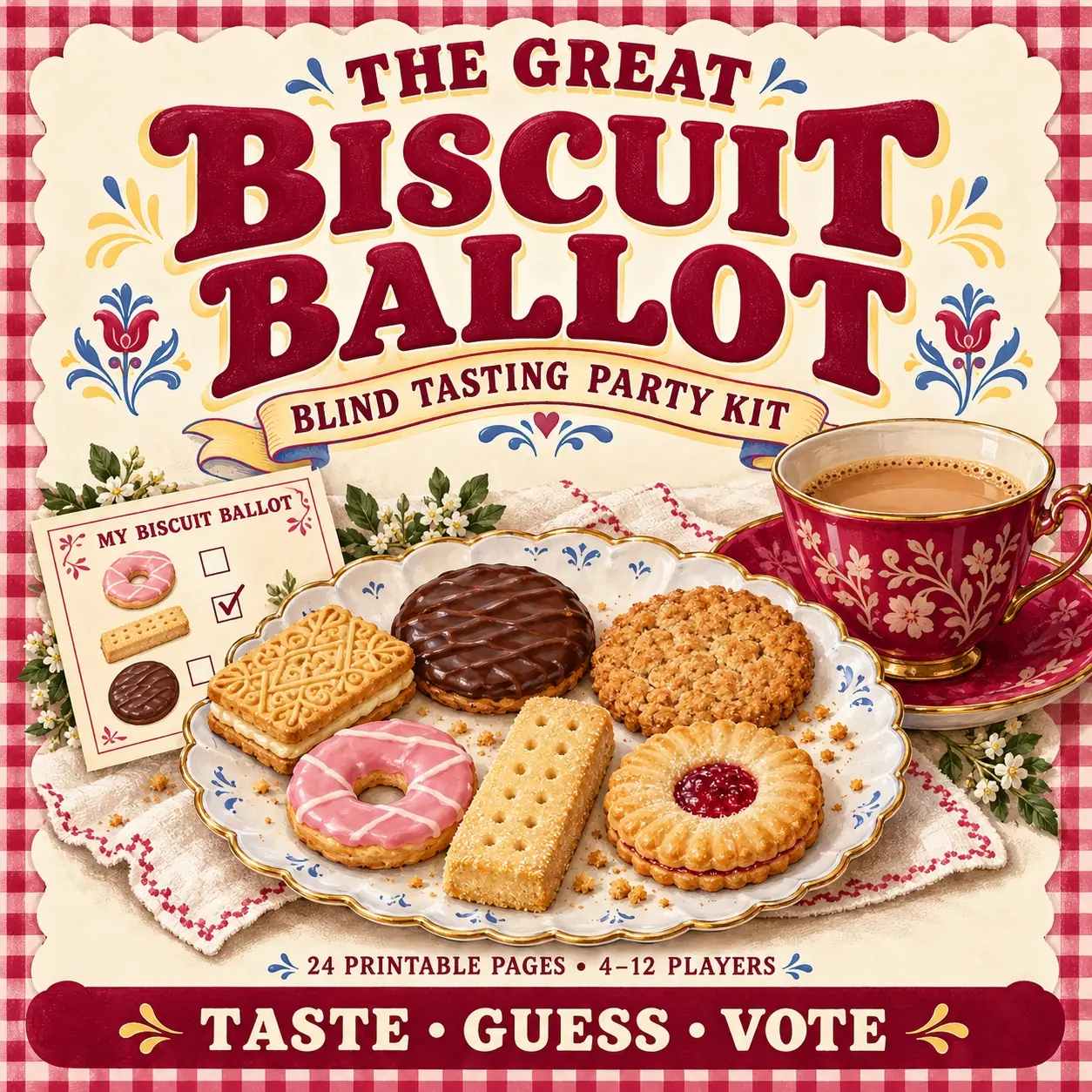
A biscuit tasting party needs very little apparatus: six contenders, water, pencils and people willing to express surprisingly firm opinions about crumbs. The trick is to give those opinions a fair structure. If one biscuit arrives on a silver cake stand with its famous wrapper peeping from behind a teapot while another appears as three broken corners on a saucer, the result is not blind tasting so much as a small public-relations campaign.
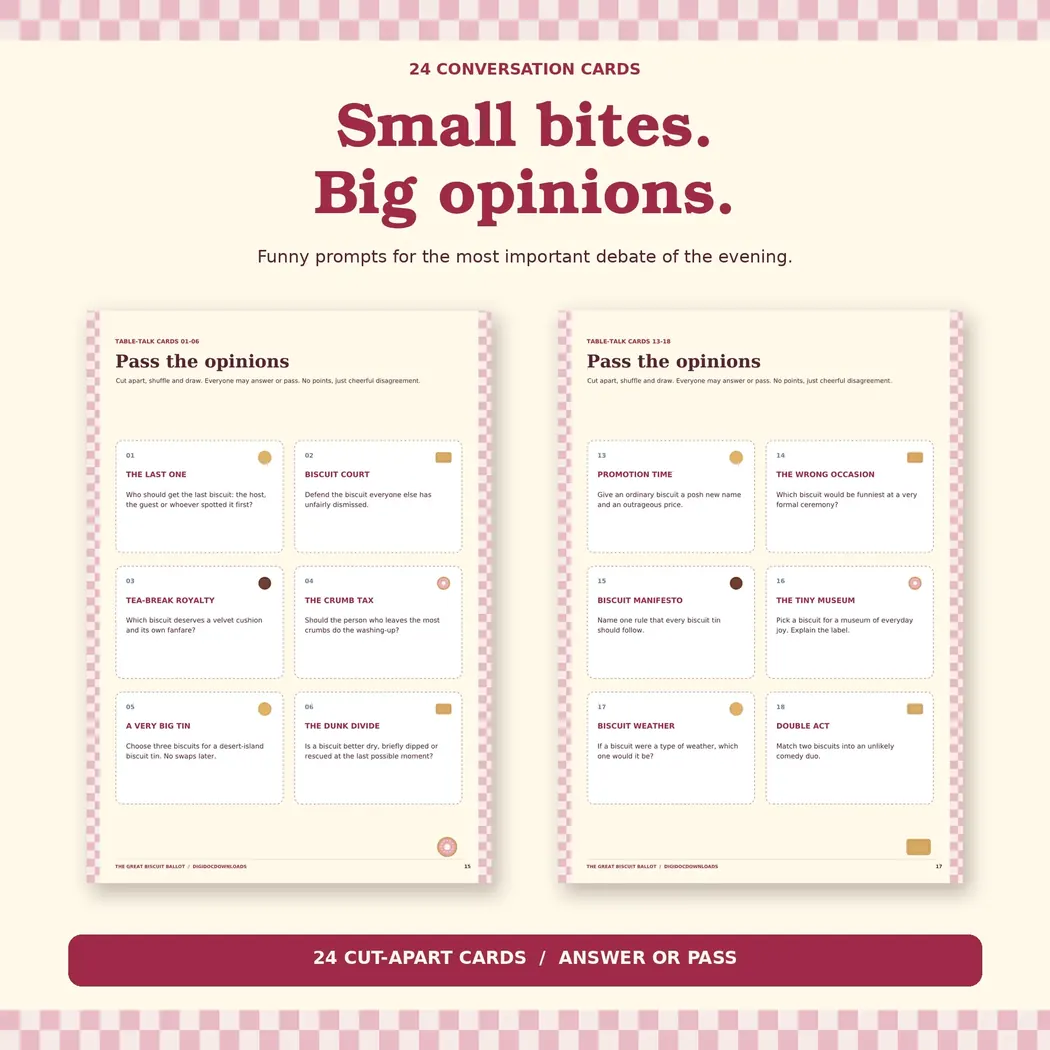
This guide gives you a complete route for a relaxed home tasting. The Great Biscuit Ballot contains the printable host key, numbered labels, tasting mat, scorecards, guesses, price round, ballots, tally sheet and optional games for four to twelve players plus a host. You can use its 30-minute tasting-and-voting route or the full 60-minute evening. The plan below is useful with that kit, but the hosting principles also work with plain paper and six carefully concealed packets.
Ask about food needs before buying the biscuits
Invitees should have an easy, private way to tell you about allergies, intolerances, coeliac disease or ingredients they avoid. Food Standards Scotland's guidance for cooking for people with allergies recommends asking guests what they can and cannot eat, checking pre-packed labels and keeping allergens separate. Your guest understands their own needs best; ask what would make the tasting suitable rather than deciding for them.
Keep every original packet and ingredient label until the evening is over. Do not decant the biscuits and throw away the only reliable information. Note any “may contain” statements as well as the named ingredients, use separate serving utensils where required and avoid presenting an ordinary biscuit as allergen-free because it does not visibly contain a nut, splash of milk or determined stalk of wheat. For a serious allergy, shared plates and crumbs may make this style of event unsuitable. A guest should always be able to skip a sample or the whole tasting without becoming the evening's administrative subplot.
Choose six biscuits that can be compared without being identical
Six samples are enough to create contrast without tiring everybody's palate. Build a line-up with distinct but reasonably comparable styles: perhaps a plain short biscuit, an oat biscuit, a chocolate-coated option, a filled biscuit, something spiced and one wildcard. If every entry is a double-filled caramel creation, the simpler qualities disappear. If one entry is a wafer and another is a fruit cake wearing a biscuit-shaped hat, you may spend the evening debating the eligibility rules.
Buy enough for one complete sample per guest, plus a few spares for breakage and the host key. For large biscuits, serve equal halves or quarters and cut every sample in the same way. Avoid using one premium giant beside five tiny everyday biscuits unless size and value are deliberately part of the question. Check that all packs are within date, intact and stored according to their labels.
Hide identity without making the table mysterious
Assign each biscuit a neutral number from one to six and record the name, brand and price on a private host key. Cover or remove branded wrappers before guests arrive, but keep them together somewhere safe with the labels visible to you. Use identical plates or plain sections of a tasting mat, and place the same portion of each biscuit in the same numbered position for everyone.
The host may taste and vote, but anyone who knows the key should sit out the identity and price-guessing prizes. If several guests help with setup, give one person the key and let the others remain pleasantly uninformed. Concealment should feel playful, not theatrical: nobody needs to be blindfolded near a hot teapot.
Set up the table for unhurried tasting
Give each person an individual plate, a scorecard, a pencil and a glass of room-temperature water. Put plain napkins within reach and keep tea or coffee as an optional companion rather than the only palate reset. Strongly flavoured drinks can change how the next sample seems, so encourage a sip of water between biscuits. Fragranced candles and bowls of scented flowers can take the evening off in an unexpectedly perfumed direction.
Serve in numbered order, one biscuit at a time, or place all six portions out together if the scorecard makes the sequence unmistakable. Allow a short quiet tasting period before conversation begins. It prevents the quickest speaker from announcing that sample two is “obviously cinnamon” and turning every later thought into a referendum on cinnamon.
Score qualities people can actually notice
Food sensory work commonly considers appearance, aroma, flavour and texture; the UC Davis sensory-evaluation overview uses these characteristics in a formal food-science context. A home party does not need laboratory precision, but the same categories give guests something more useful than a single like-or-dislike number.
Ask tasters to notice colour and shape before biting, then aroma, sweetness, flavour, texture and the length of the finish. Keep the scale simple — five points per category is plenty — and print what each end means. For texture, one might mean soft or stale and five might mean crisp or satisfyingly tender, depending on the style you are testing. Include an overall enjoyment score separately. A biscuit can be technically crisp and still inspire no desire whatsoever for a second meeting.
Encourage descriptive words rather than grand claims: buttery, toasted, malty, cocoa-rich, gingery, crumbly, snappy, sandy, chewy or dry. People may use different words for the same sensation, which is part of the fun. The scorecard should capture a personal response, not produce a court-approved definition of the perfect dunker.
Keep discussion fair while opinions gather
Let everyone finish scoring a sample before opening the conversation. Invite one observation from each person, with passing completely ordinary. Ask what changed between the first smell and the final bite, which texture felt deliberate and whether the sweetness supported or obscured the main flavour. Avoid asking who disliked a biscuit before the scores are in; nobody should have to cross-examine their own taste buds.
If the group enjoys guessing, record identities privately rather than calling them out. A price-detective round can compare value, but calculate on a common basis such as price per 100 g rather than packet price alone. Reveal the packets only after the final ballot. Brand loyalty is a powerful seasoning.
Use a ballot that separates favourite from curiosity
Total the category scores if you want an overall table, then hold a separate ballot for the biscuit each guest would genuinely choose with a cup of tea. The two winners may differ. One sample can score beautifully for aroma and texture while another quietly becomes the biscuit people would buy. That is not a flaw in the method; it is the useful distinction between admiration and appetite.
Agree the tie rule before counting: share the title, use overall score as the tiebreaker or hold a second ballot between the tied samples. The Great Biscuit Ballot includes four award cards, so “best crunch”, “most surprising” and “tea's favourite companion” can sit beside the main winner without turning the table into an awards season lasting until breakfast.
Add the dunk test only if the group wants it
A dunk experiment is an entertaining extra, not a test of personal courage. Use equal pieces, identical cups, the same depth of room-temperature water and one timer. Choose a fixed dunk time and decide whether you are judging structural survival, texture after dunking or both. Keep this round separate from the main tasting because water-soaked samples behave differently from the originals.
Run the experiment over a tray and keep fresh pieces for anyone who would rather taste than retrieve biscuit sediment. The printable kit includes an optional dunk activity, but the evening remains complete without it. Knowing when to omit a messy extra is one of the host's finer arts.
Reveal the packets and leave room for a little history
Bring out the original packs, read the identities and prices, then compare them with the guesses. If the table is curious about the objects around the biscuits as well as the biscuits themselves, the V&A's bite-sized history of biscuit tins traces how changes in law and printing helped decorative tins and individually packaged food become more common in nineteenth-century Britain. It is a pleasing reminder that biscuit presentation has been influencing expectations for rather longer than tonight's numbered plates.
Photograph the final ranking or completed scorecards only with everyone's agreement, especially if names are visible. Wrap unopened food for another day and dispose of handled leftovers appropriately. Keep the host key with the winner record if you want to repeat the evening with a different line-up.
Blind biscuit tasting checklist
- Ask guests privately about allergies, intolerances, coeliac disease and ingredients they avoid.
- Choose six varied but reasonably comparable biscuits.
- Keep every original packet and ingredient label until the tasting is finished.
- Number the samples and write a private host key.
- Serve equal portions on identical plain plates or tasting spaces.
- Provide water, individual plates, pencils, napkins and clear scorecards.
- Let everyone score before discussing each sample.
- Rate appearance, aroma, flavour, texture and overall enjoyment.
- Keep identity guesses private and compare prices on a common basis.
- Agree the tie rule before counting the final ballot.
- Run any dunk test as a separate optional round.
- Reveal the packets only after the votes are safely recorded.
A good blind tasting does not prove that one biscuit is objectively superior for all time. It gives a table of people the same samples, enough quiet to notice them and a cheerful way to compare what happened next. Keep the identities secret, the portions fair and the right to pass completely unremarkable; the crumbs will supply the rest of the conversation.
Explore The Great Biscuit Ballot
More to read, make and discover
A few useful, interesting and checked routes into the subject.
- Food allergy guidanceFood Standards Scotland: Cooking for people with allergies
Current UK guidance on asking guests what they can eat, checking labels, keeping ingredients noted and avoiding allergen cross-contact.
- Sensory evaluationUC Davis: Sensory Evaluation of Foods
A university food-science overview identifying appearance, aroma, flavour and texture as useful sensory characteristics.
- Biscuit design historyV&A: Biscuit tins — a bite-sized history
A short museum history of decorated biscuit tins, printing and the growth of individually packaged food in nineteenth-century Britain.