Choose a friendly mystery and a manageable space
Start with the children, rather than the decorations. Decide whether they enjoy spooky surprises or would prefer a cheerful detective story. For ages six to ten, ordinary rooms and familiar objects are enough to make a clue trail interesting. Choose the rooms you will use, keep everyone together and leave the places you do not want explored outside the game. A hunt works perfectly well in daylight; curtains are not obliged to supply dramatic atmosphere.
You can make a simple version with paper, pencils and a handful of your own clues. Choose the finish first, then work backwards through a sequence of hiding places. Write one clue for the next location on each card and keep a separate host list of where every card belongs. Check the trail yourself before the children begin: a clue hidden at the place it describes will send the detectives in a rather short circle.
Give the group one clear way to play
For a small group, one team is usually the easiest arrangement. Invite the children to take turns reading, suggesting a location and carrying the next card. A confident reader can share a clue with a younger child, or a grown-up can read it aloud while everyone works out the answer. Let children point, talk and think together; the fun is in solving the mystery, rather than finding out who reads fastest.
If you choose separate teams, give each a complete set and think through how they will share the hiding places. Keep the route clear and agree whether everyone waits for the finish. More teams mean more preparation and a greater chance that one group collects another’s card. For a family afternoon, that may be more administration than the occasion needs.
Prepare the trail before telling the story
Gather the selected clue pages, pencils, scissors for the adult preparing cards and any finish reward. Lay the cards out in order, place them using your host list, then walk the route without skipping ahead. Keep the opening clue with you. Use accessible, ordinary objects and locations; nobody should have to climb, open a medicine cupboard or rummage beside something hot to continue the story.
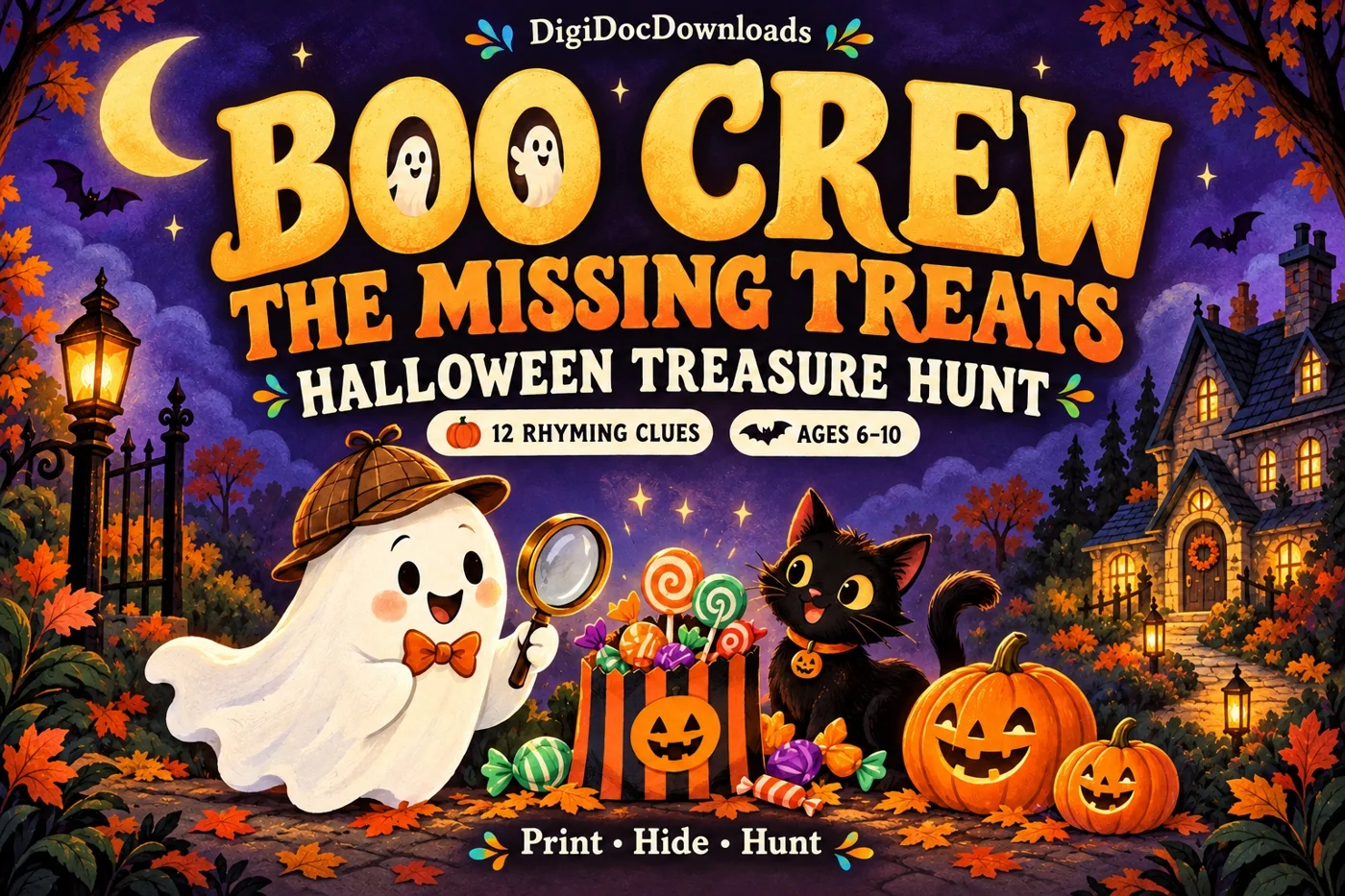
If a clue relies on something your home does not have, replace the location or use a clear picture of the object. With the Boo Crew: The Missing Treats pack, the host map explains the placements and two blank replacement cards are included. Make any change before hiding the cards and update your own map, so the clue, answer and location still agree.
Let the clue hunt set its own pace
Tell the opening story, hand over the first clue and let the team begin. Keep your host list nearby, but give the children a little thinking time before offering help. If they are stuck, ask which words suggest a room or an object. A small hint is often enough. You do not need a timer, a locked box or a running commentary from a particularly eager chief detective.
Where the cards include secret letters, appoint a recorder or take turns writing them down. Pause occasionally to check that the letters have been kept in order. Boo Crew uses twelve rhyming clues and a final secret message, with the missing treats waiting behind the curtain at the finish. Keep the reward out of sight until the group reaches that part of the trail.
Make the finish a shared achievement
Choose an ending that everyone can enjoy. A certificate, a small non-food surprise or a shared activity can work as well as sweets. If you use food, agree what is suitable for the children beforehand. Halloween rewards have changed over time: the Library of Congress’s account of Halloween traditions includes historic examples of fruit, nuts, coins and toys alongside sweets. Your own finish can fit your own group.
Keep an optional quieter activity ready rather than immediately launching another hunt. Boo Crew’s 25-page A4 pack includes a detective certificate, a word hunt, a pencil maze, six friendly riddles and a treat-bag colouring page, as well as the story, clue cards, host guidance and bonus answers. Print the pages you plan to use; the whole pack does not need a separate copy for every child.
Follow the Halloween curiosity a little further
For a short discovery after the game, look at the National Museum of Ireland’s ghost turnip. The museum explains the Irish tradition of carving turnips at Halloween. Its striking example is a painted plaster model, rather than a remarkably well-preserved vegetable. Ask the children which expressions make a face look friendly, surprised or mysterious, then draw their own lantern designs on paper.
Or turn from paper detectives to real evening hunters. The Natural History Museum’s bat guide explains that British bats feed on insects and use echolocation to navigate and hunt. Compare their use of sound with the clues your team followed. A few minutes of looking, drawing or talking can give the afternoon a gentle ending, with a useful question left for another day.
Explore Boo Crew: The Missing Treats
More to read, make and discover
A few useful, interesting and checked routes into the subject.
- Irish traditionNational Museum of Ireland: the ghost turnip
A museum object with a surprisingly expressive face, and the story of carved turnips in Irish Halloween traditions.
- Halloween historyLibrary of Congress: the origins of Halloween traditions
Historic newspaper examples of costumes, lanterns and the changing things people gave to Halloween visitors.
- Nature discoveryNatural History Museum: identifying bats in flight
Learn how British bats hunt, navigate and differ from one another, then recognise some familiar species.