A sheet with possibilities
Paper folding begins with an unusually clear bargain: the material is ordinary, but what happens next need not be. A crease changes the shape; another creates a pocket, a point or the suggestion of a sail. Before long, a scrap of paper has acquired a job. It can carry a tiny story, mark a place at dinner or simply make someone look twice.
There is pleasure in that visible transformation. Keep a first attempt beside a second rather than immediately throwing it away. Seeing where an edge became neater is often more useful than comparing your work with somebody else’s immaculate crane. Paper is a patient teacher, provided it is allowed the occasional untidy lesson.
A history with more than one crease
Web Japan’s history of origami describes both formal gift-wrapping traditions and folding for enjoyment. It identifies an early crane-folding book published in 1797. The detail is a helpful reminder that paper folding has carried ceremony, play and skilled craftsmanship; it has never belonged to children alone.
The Japan Origami Academic Society’s historical account also cautions that the exact beginning of Japanese origami is unclear. Enjoy the history without squeezing centuries of different practices into a tidy invention date.
A small celebration in October
World Origami Days runs from 24 October to 11 November. The Japan Origami Academic Society explains how the interval brings together two established folding dates. In 2026, its page also links to this year’s activities. Treat the dates as an invitation to try something, rather than a deadline for becoming impressive.
A little folding session works perfectly well without an official event. Put a sheet, a clear set of instructions and enough elbow room on the table. One finished model is a better starting point than a dozen competing projects.
Let the model start the story
After the last fold, ask a question that gives the object a purpose. Where is this boat going? What has the passenger forgotten? Which harbour has the best biscuits? The story can be spoken, drawn on a separate sheet or acted out beside a simple paper map. There is no need to turn the whole afternoon into a worksheet.
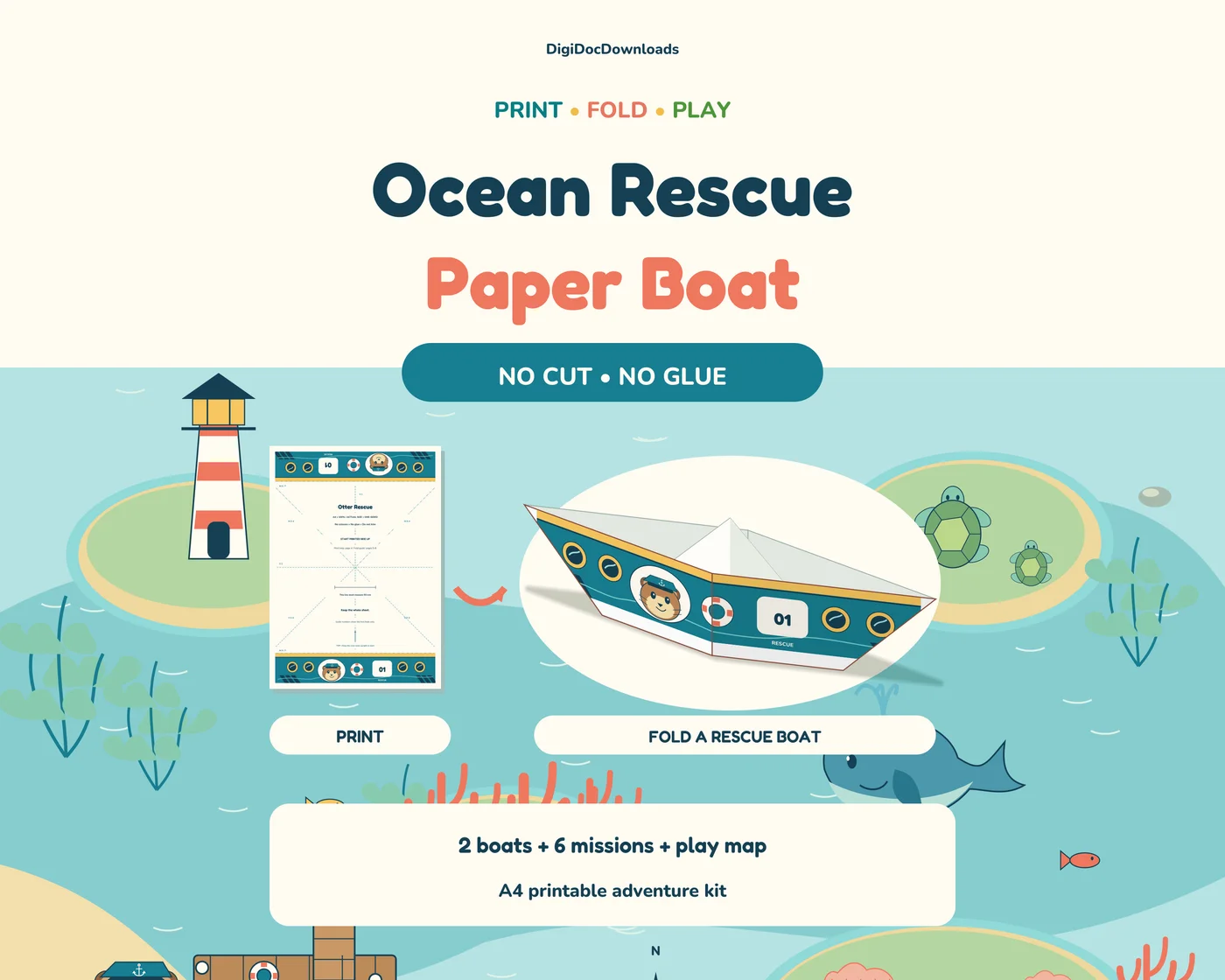
Our Ocean Rescue Paper Boat combines an A4 folding sheet and illustrated instructions with ocean rescue adventure and learning pages, plus an optional play board. The verified pack needs neither cutting nor glue. It is one particular project, rather than a collection of every origami model mentioned here.
Make the table easy to join
Choose instructions that suit the people taking part and show one stage at a time. A helper can make a fold while another person chooses the next story detail; participation need not mean identical hands-on work. Leave space for someone to watch first, ask a question or keep a simpler version.
For printed projects, read the stated paper size and scaling before folding. Ocean Rescue calls for its folding sheet to be printed single-sided on A4 at Actual Size. More general construction projects have different requirements; our first paper-model guide explains how to check those before beginning.
Keep the next idea small
A finished boat might become a shelf decoration or the starting point for another story. Give it a name and a place to rest. A short note about what you changed can be more valuable than an elaborate display, especially if you want to make it again.
For the next session, change one thing: the story, the colour of the practice paper or the person explaining a step. The appeal is not that every fold turns out perfectly. It is that a familiar sheet still has something left to show you.
Explore Ocean Rescue Paper Boat
More to read, make and discover
A few useful, interesting and checked routes into the subject.
- Further readingWorld Origami Days — Japan Origami Academic Society
The 24 October–11 November interval and current 2026 event links.
- Further readingWeb Japan: the history of origami
Formal paper ornaments, folding for enjoyment and the 1797 crane-folding book.
- Further readingJapan Origami Academic Society: historical account
Historical context, including uncertainty about the exact origin.