

A cleaning quote has two jobs. It tells the customer what the service will cover and tells the business whether the work is worth accepting. A number produced before the rooms, tasks and access have been discussed does neither particularly well. Start with the job itself; the price can then be built from evidence rather than confidence and a hopeful glance at the calendar.
Define the job before estimating the hours
Record the property type, number of rooms, approximate size, current condition and the areas the customer wants included. Ask about stairs, parking, pets, delicate surfaces, clutter, key collection and any time restriction. A short video call, photographs or a visit may be appropriate for an unfamiliar or larger property, with the customer's agreement. Avoid promising a fixed result from a vague description such as ‘a normal clean’. Normal is a surprisingly roomy word.
Choose the right level of service
A regular maintenance clean, a first deep clean and an end-of-tenancy or move-out clean are different jobs. Write a checklist for each service level and adapt it to the property. Identify what is included, what is optional and what is outside scope. Inside ovens, interior windows, carpet extraction, high-level work and heavy stain removal may need extra time, equipment or specialist treatment. Naming the service accurately prevents a standard-clean price from quietly acquiring a deep-clean workload.
Estimate labour from tasks, not rooms alone
Break the job into sensible groups: kitchen, bathrooms, bedrooms, living areas, floors and agreed extras. Estimate the hands-on minutes for each group, then add setup, moving between areas, packing away and the final check. A two-person team may complete the visit sooner, but the labour cost is based on both people's time. Keep the first estimate as a range until the scope is clear, and compare it with actual hours after the job so the method improves.
Include the time that surrounds the cleaning
Travel, parking, key collection, loading supplies, customer messages, scheduling and quote preparation all use working time. Some of these costs belong to one job; others are overhead shared across the business. The important point is to record them somewhere rather than repeatedly donating ten minutes at each edge of an appointment. For recurring work, the first visit may reasonably take longer because the property and routine are new.
Record supplies, equipment and job-specific costs
List consumables used for the visit, including cloths or pads that need replacing, bin liners and any specialist product agreed for a surface. Add parking, congestion or toll charges where they genuinely apply, and account for equipment wear in the wider business costs. If the customer supplies products or equipment, say so in the quote and confirm that they are suitable. Keep private cost notes separate from the customer document; a clear total does not require handing over the contents of the supply cupboard.
Separate variable costs from overhead
Variable costs rise with a particular job: labour hours, job supplies and a payment fee are common examples. Fixed costs continue more broadly, such as insurance, software, storage, training and equipment. The British Business Bank's guide to real business costs explains that fixed and variable costs, together with contribution margin, help a business understand whether an individual service contributes enough to cover wider expenses. Choose a consistent way to allocate overhead and review it when costs change.
Build the internal price in a clear order
A simple internal calculation is labour plus job-specific costs plus an overhead allowance plus the intended profit. If tax or marketplace charges apply to the business, use current professional or official guidance for the relevant location rather than a percentage copied from an old worksheet. The result is a decision figure: compare it with the market, the customer's brief and the value of the service. If the total appears unworkable, change the scope, process or service level openly; do not remove the cleaner's time and call the arithmetic improved.
Price extras where the customer can see them
Optional work is easier to understand when it has a name and a price or calculation method. List oven cleaning, internal cupboards, inside windows or another genuine extra separately, then show the selected total. Avoid adding mandatory charges only after the customer has agreed. The Competition and Markets Authority's price-transparency summary says consumer prices should be clear, complete and accurate and should include unavoidable charges. Where the total cannot reasonably be calculated in advance, customers need prominent information that allows them to work it out.
Write what the quote includes and excludes
A customer-facing quote should identify the client and property, the service, included tasks, agreed extras, price, likely duration or basis of calculation, payment terms and how long the quote remains valid. State important exclusions and assumptions plainly: for example, whether furniture moving, waste removal, mould treatment or work at height is excluded. Include a route for changes. If the actual property differs substantially from the information supplied, pause and agree the revised scope before continuing rather than revealing a surprise total afterwards.
The best quote is not the shortest one; it is the one that leaves the least important work to guesswork.
Keep the quote, invoice and receipt distinct
A quote sets out proposed work and price before the service; an invoice requests payment after the agreed trigger; a receipt confirms payment. GOV.UK's invoicing overview distinguishes an invoice from a receipt and links to the information invoices must contain. Requirements vary with business status, tax registration and location, so use the official guidance that applies to the business. Reusing the job reference across the quote, booking, visit report and invoice makes the trail easier to follow.
Check actual cost as soon as the job is finished
Record the real labour time, travel, supplies, extras, payment status and anything that changed. Compare actual cost with the estimate while the visit is still fresh. A longer first clean may be an expected setup cost; repeated overruns on the same task suggest the allowance needs adjusting. Keep accurate evidence for the business records. HMRC's self-employed expenses guidance says business expenses and proof of costs should be retained and the records must be accurate. That is a record-keeping principle, not a substitute for individual tax advice.
Review recurring work instead of freezing the first quote forever
A recurring clean may become quicker once the property reaches a steady condition, or it may expand as tasks are casually added. Schedule a review when the scope, frequency, property, staffing, supply costs or travel changes. Explain any new price with the same clarity as the original quote. A planned review is easier for both sides than a collection of tiny exceptions that nobody can quite remember agreeing.
Use a toolkit to keep the decision and the document together
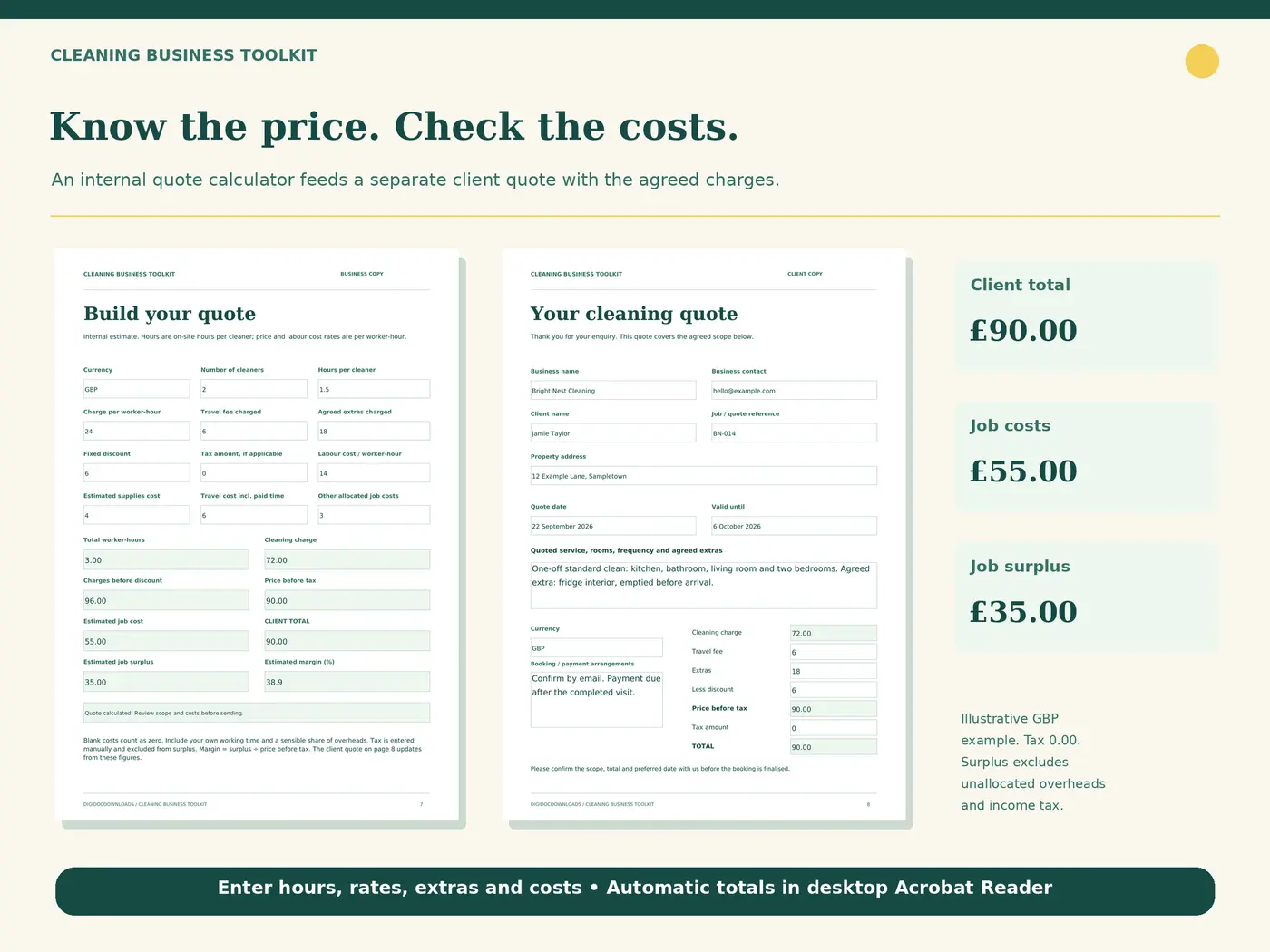
A notebook or spreadsheet can run this process perfectly well. The Cleaning Business Toolkit brings the enquiry, service plan, quote calculator, linked client quote, standard, deep-clean and move-out checklists, booking confirmation, visit report, actual job-cost record, payment tracker and monthly review into one 24-page A4 fillable PDF. Automatic calculations require desktop Adobe Acrobat Reader with JavaScript enabled; browser previews and mobile viewers may not calculate, while other logs are manual records. Keep a blank master and save a separate copy for each job. The wider small-business tools collection offers separate cash-flow and planning records when the quote is only one part of the administration.
A short cleaning-quote checklist
- Confirm the property, condition, access and requested service.
- Use the checklist that matches a standard, deep or move-out clean.
- Estimate every worker's time, including setup and the final check.
- Add travel, supplies, job costs, overhead and intended profit.
- Show optional extras and unavoidable charges clearly.
- Write the scope, exclusions, assumptions, payment terms and validity.
- Record actual hours and costs after the job, then review the method.
Once the scope is specific and the working figures are visible, the final quote becomes much less mysterious. It can be clear for the customer and sustainable for the business, which is a considerably better finish than a gleaming bathroom attached to an underpriced afternoon.
Explore Cleaning Business Toolkit
More to read, make and discover
A few useful, interesting and checked routes into the subject.
- Official price guidanceGOV.UK: providing clear and accurate information about prices
The Competition and Markets Authority summary explains that consumer prices should be clear, complete and accurate, include unavoidable charges and give prominent calculation information when the total cannot reasonably be known in advance.
- Small-business financeBritish Business Bank: determining real business costs
The British Business Bank distinguishes fixed and variable costs and describes contribution margin as sales less variable costs when assessing the profitability of a product or service.
- Official record keepingGOV.UK: expenses if you're self-employed
HMRC guidance says self-employed people should keep accurate records and proof of business expenses; the article uses this only as a record-keeping prompt, not personalised tax advice.
- Official invoicing guidanceGOV.UK: invoicing and taking payment from customers
The official overview distinguishes an invoice from a receipt and points to required invoice and payment information, supporting the article's separation of quotes from invoices.