
A good pet-sitter handover answers two different questions: what normally happens, and what should happen if the day stops being normal. The first needs specific routines; the second needs contacts, boundaries and a simple order of action. Put both in writing, then talk them through. Memory is a splendid companion until it is asked to recall which scoop belongs to which animal at half past six in the morning.
Begin with a one-page urgent summary
Put the information needed in a hurry at the front: each pet's name and identifying details, your contact numbers, a nearby backup person, the usual veterinary practice and its out-of-hours route. Add the address where the pet should be treated, any insurance or payment arrangement that the sitter genuinely needs, and what to do if you cannot be reached. The PDSA's holiday-care guidance recommends agreeing the carer's protocol for veterinary help before leaving. Keep the summary visible without displaying private access codes to visitors.
Describe the ordinary day in exact terms
Write when the sitter should arrive, how long visits normally last and what happens at each one. Replace ‘feed as usual’ with the food name, measured amount, time, bowl and storage place. Record fresh-water routines, litter or toilet care, walks, play, rest and any household boundaries. The RSPCA's holiday checklist includes the usual routine, food, exercise, behaviour and supplies because those details help a temporary carer preserve familiar patterns rather than inventing a new timetable.
Give every pet a separate profile
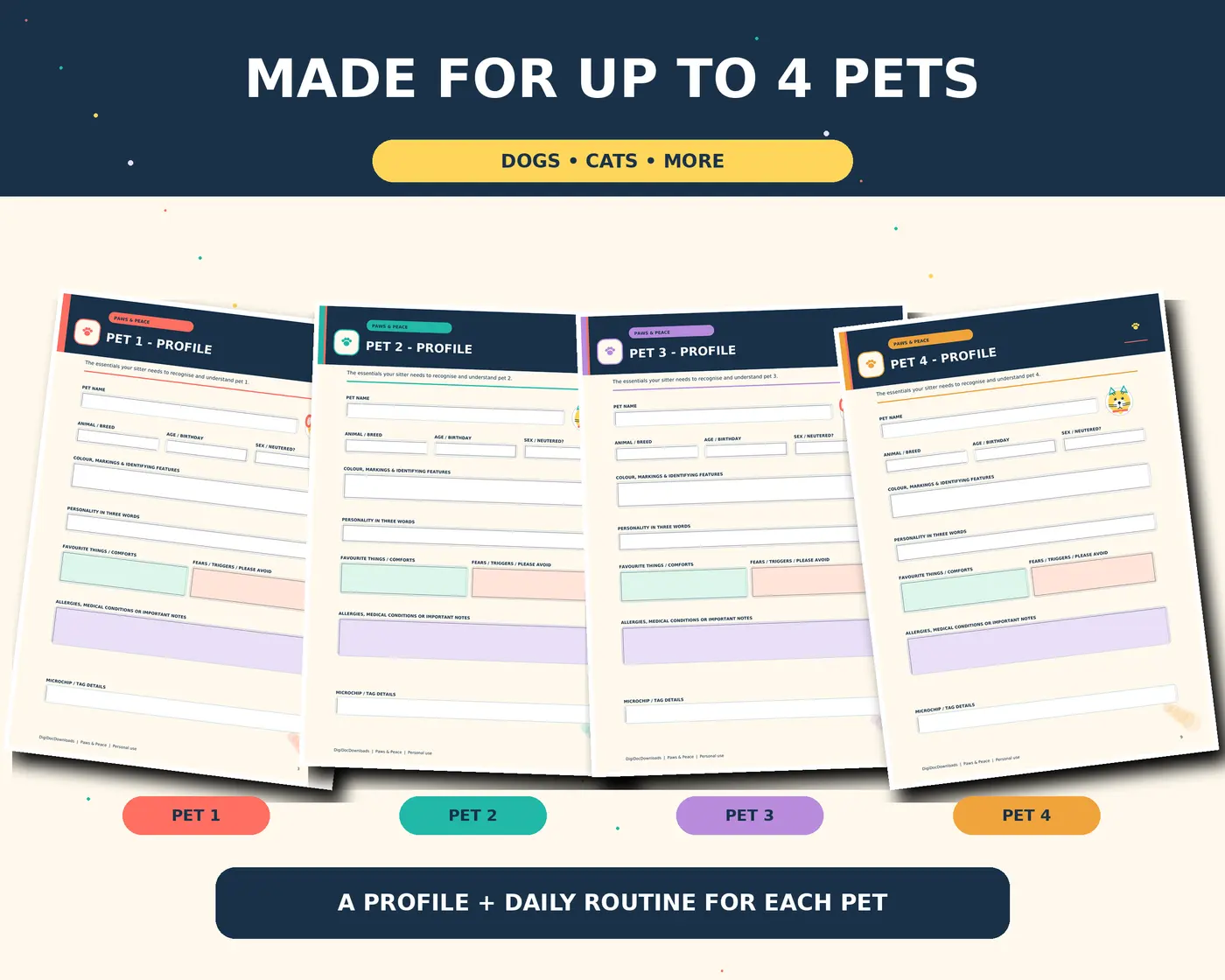
In a multi-pet home, shared instructions become ambiguous remarkably quickly. Give each animal a profile with a recent photograph, age, physical description, microchip details where appropriate, diet, usual activity, hiding places, handling preferences and health information. Explain whether animals eat together or separately, which lead belongs to whom and whether doors or gates must be managed in a particular order. A sitter should not have to identify the shy cat by a process of elimination while the confident one conducts the interview.
Copy medicine directions accurately
List each prescribed medicine exactly as supplied: pet, medicine name, amount, time, route, relationship to food, storage and the prescribing practice. Do not ask the sitter to interpret handwriting on a packet or alter a dose. Confirm the plan with the veterinary practice when anything is unclear, and check that the sitter is willing and able to give the medicine. PDSA specifically advises leaving enough medication, written timing and administration instructions, plus a plan for problems or side effects. Keep medicines in their original labelled containers.
Explain behaviour without turning it into a character sketch
Record practical clues: how the pet usually greets people, what makes them worried, where they retreat, whether they guard food or toys, how they behave around other animals and which handling should be avoided. Say what is normal after a visitor arrives and what would be unusual enough to call you or the vet. ‘Nervous’ is a description; ‘usually hides behind the sofa for ten minutes, then comes out for dinner’ is information a sitter can use.
Write the walk and outdoor rules down
For a dog, include the usual route or length, lead and harness, recall limits, interactions to avoid, garden security and waste routine. For a cat, state the indoor or outdoor arrangement, cat-flap setting and return times. Small animals need species-appropriate enclosure, feeding, cleaning and temperature notes. Follow the existing care plan rather than creating a universal schedule: age, health, species and temperament change what is suitable. Cats Protection's sitter guidance notes that very young, older or unwell cats may need more frequent visits.
Show the sitter where everything lives
Make a short location list for food, bowls, leads, carrier, litter, bedding, cleaning materials, towels, medicine and waste supplies. Leave more food and essential consumables than the exact calculation requires, within safe storage limits. Show the sitter how the carrier, gate, alarm and keys work rather than assuming they are self-explanatory. Cats Protection recommends testing home access before leaving and keeping a backup key with someone reliable.
Create a clear emergency chain
Write what the sitter should do first if a pet is injured, missing, refuses essential medicine or behaves very differently. The instruction should lead to appropriate professional help, not encourage diagnosis. Include the regular vet, the out-of-hours service, your primary and backup contacts and any transport arrangement. The American Animal Hospital Association's handover guide also recommends a visible emergency card and showing the sitter where the carrier, records and first-aid supplies are kept. Ask the veterinary practice what authorisation or payment information it needs before an absence.
Separate pet care from house care
List plant watering, post, bins, deliveries, lights and security as a separate section. Mark each item essential, optional or not needed. This keeps the animal routine readable and prevents a request to bring in the post from hiding beside a medicine time. Share only the home information the sitter needs, agree how keys and alarm details will be handled, and remove any access note from the visible handover when the booking ends.
Arrange a practice handover
Meet in the home before the first booking, ideally while the pet's normal routine is happening. Let the sitter prepare a meal, find the lead or carrier, practise the access route and ask questions. The RSPCA recommends introductory sessions with a new carer; Cats Protection similarly suggests meeting at home and arranging a backup. For medication or more complex care, a trial should confirm competence rather than merely familiarity.
Write the routine for an ordinary day, then the contacts and decisions for an extraordinary one.
Agree how updates will work
Choose one practical check-in method and frequency. A brief note can record arrival, food, medicine, exercise, litter or toilet care and anything unusual. Avoid requiring a photographic production after every bowl unless that serves a real care need. Give the sitter a route for urgent contact and another for routine updates, and say when you may be unreachable. Daily records are most useful when they help the next visit, not when they become a small social-media department.
Use a planner only if it makes the handover easier
Plain paper can hold excellent instructions. The Paws & Peace pet-sitter planner brings profiles and routines for up to four pets together with feeding, medicine, walks, emergency contacts, home access, plants, post, bins, deliveries, daily logs, incident notes and a sitter report card. It includes fillable A4 and US Letter PDFs, so details can be typed in desktop Adobe Acrobat Reader or printed and completed by hand. The nearby planners and trackers collection includes separate household and care records; none replaces an individual veterinary plan.
A final pet-sitter handover checklist
- Give each pet a separate profile and recent photograph.
- Record exact food, water, exercise, litter or toilet routines.
- Copy prescribed medicine directions and confirm the sitter can follow them.
- Explain useful behaviour clues, boundaries and outdoor rules.
- Leave owner, backup, vet and out-of-hours contacts in a clear order.
- Show the sitter the carrier, supplies, access route and security system.
- Separate essential pet care from optional household tasks.
- Complete a practice visit and agree routine and urgent check-ins.
Read the instructions once from the sitter's point of view. If a step depends on knowing where something is, what ‘usual’ means or which number to call, add the missing detail. The result should not attempt to predict every possible event; it should make the ordinary care straightforward and the first response to a problem unmistakably clear.
More to read, make and discover
A few useful, interesting and checked routes into the subject.
- UK veterinary charity guidancePDSA: going on holiday and finding care for pets
PDSA advises leaving written feeding, exercise and medication instructions, enough usual food and medicine, owner and vet contacts, and a plan for decisions if the owner cannot be reached.
- UK animal-welfare guidanceRSPCA: choosing care and preparing a holiday checklist
The RSPCA checklist covers routine, food, emergency and out-of-hours vet contacts, medication, behaviour, exercise and supplies, and recommends an introductory session with a new carer.
- Cat-care guidanceCats Protection: going on holiday without your cat
Cats Protection recommends a home meeting, a backup sitter, daily care and medical details, carrier and supply locations, reliable access and visits suited to the individual cat.
- Veterinary-practice guidanceAAHA: essential pet-sitter instructions
The American Animal Hospital Association sets out useful pet-profile, routine, supply, house-access, emergency-contact and preparedness details for a sitter handover.